Chancellor faces down Cabinet 'jitters' about economic strategy
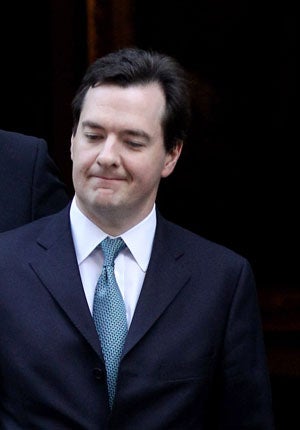
George Osborne has been forced to fend off doubts about his economic strategy from cabinet colleagues worried that growth is so weak. The Chancellor, who refuses to consider a "Plan B", defended his approach in a discussion on Britain's economic prospects at Tuesday's cabinet meeting.
One minister described the doubts as "jitters" rather than demands for a change of course. It is understood that the most searching questions were asked by Conservative rather than Liberal Democrat ministers.
Downing Street aides insisted there is "no wobble" despite criticism from economists and Labour that the economy is "flatlining" because the Government is going "too far, too fast" on spending cuts. The minister added: "We will stay the course. It is still early days."
On Wednesday the Organisation for Economic Co-operation and Development (OECD) downgraded its forecast for UK economic growth this year from 1.5 to 1.4 per cent and lowered next year's forecast from 2 to 1.8 per cent – lower than the Office for Budget Responsibility's predictions of 1.7 per cent for this year and 2.5 per cent for next year.
Weak growth of 0.5 per cent in the first three months of this year has also raised fears among cabinet ministers that the Conservatives and Liberal Democrats may receive little credit from voters at the next general election unless the recovery is stronger. Eric Pickles, the Communities Secretary, told students at the Cambridge Union this week that the electoral fate of both Coalition parties rested on "whether or not our economic policy works". He added: "If our economic policy doesn't work, then we're both in a great deal of trouble."
Ministerial fears will be enhanced by a think-tank study today suggesting that low- and middle-income earners may not reap the benefit from the recovery by the planned date of the next election. The Resolution Foundation predicted that average pay by 2015 would be no higher than in 2001.
It warned that a combination of stagnated wages, high levels of personal debt and a declining share of "middle skilled" jobs would put pressure on living standards, along with tax credit cuts. It found that the living standards of people on low and middle incomes were already faltering before the recession. Between 2003 and 2008, median wages flatlined and disposable income per head fell in every English region outside London despite economic growth. James Plunkett, the report's author, said: "We all know that the recession has hit living standards hard. But something deeper has changed in our economy. Even during the boom years, ordinary workers weren't seeing their living standards rise. The big question now is what will happen when growth resumes. Will ordinary workers reap any of the benefits? It is far from certain."
Yesterday a survey by Ipsos MORI found that two in five people (43 per cent) believe that if the economy improves in the next year, the public would think it will be down to the state of the global economy, while only a third (35 per cent) would believe the coalition parties were responsible. However, if the economy were to get worse over the next 12 months, the Coalition, the previous Labour government, the banks and the global economy would all share the blame. At present, 42 per cent predict that the economy will get worse in the next year.
Ed Balls, the shadow Chancellor, said: "George Osborne's rigid determination, despite all the evidence, to stick with deep and fast cuts and refuse to even consider a Plan B does not boost his credibility, it undermines it."
Join our commenting forum
Join thought-provoking conversations, follow other Independent readers and see their replies
Comments
Bookmark popover
Removed from bookmarks