First cuts mark end of coalition honeymoon and a taste of bitter things to come
The coalition Government declared that the "years of plenty" for public spending were over yesterday, as it admitted that its £6.2bn package of immediate savings was "only the start" of a huge programme of cuts.
Ministers were accused of hiding crucial details of the cuts after announcing headline reductions for Whitehall departments, some of which were unable to give a full breakdown of how they would be achieved.
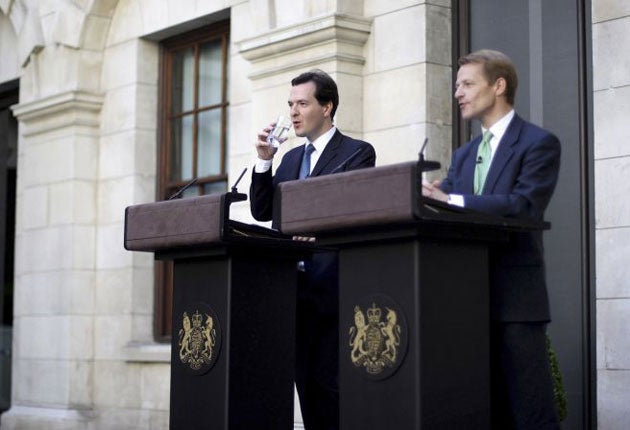
George Osborne, the Chancellor, and his Liberal Democrat deputy, David Laws, put the emphasis on cutting Whitehall waste and omitted some sensitive areas at a Treasury press conference. It emerged later that the savings would include £130m from police administrative costs; cuts in low carbon projects; a £100m reduction for Network Rail; £108m for London's transport network; £5m for the Arts Council and £266m for regional development agencies.
Other measures include: axing 10,000 planned extra university places; scrapping offers of temporary jobs under the young person's guarantee scheme to save £290m; ending child trust funds, designed to provide a "nest egg" for young people when they reach the age of 18; a £1.16bn squeeze on local government; a £150m reduction in the housing budget; saving £1.7bn from delaying and renegotiating contracts and halting projects; £95m from IT schemes and £600m from cutting the costs of quangos.
There will be an immediate freeze on civil service recruitment to save £120m and on "unnecessary spending" on outside consultancy, advertising and computer contracts; ministers will share drivers or use public transport to cut the cost of the government car service by a third, and ministers and officials will normally travel second class to cut the £45m-a-year bill for first-class trips.
Mr Laws said he wanted to send a "shockwave" through Whitehall. He admitted: "These are only the first steps we will need to take in order to put our public finances back in shape. There will be many more tough decisions, but the British people understand that these choices can no longer be ducked. The years of public sector plenty are over. But the more decisively we act, the more quickly we can come through these tough times."
The extent of the squeeze over the next three years is expected to emerge in the Budget on 22 June, with the details of the cuts needed to meet spending ceilings revealed in a spending review this autumn.
Yesterday's downpayment amounts to only 1 per cent of total government spending and a fraction of the £156bn deficit in the public finances. The Institute for Fiscal Studies (IFS) warned of more pain to come. It said yesterday's measures would cut borrowing by only £5bn this year. "This is less than a tenth of the fiscal repair job that Alistair Darling's 2010 Budget forecast suggested will be needed over the next few years," it said.
Labour warned that immediate cuts would threaten the fragile recovery. Alistair Darling, the shadow Chancellor, urged the coalition to "come clean on the detail of what these cuts mean" – including how many jobs would be axed. The turnover in civil service jobs is about 30,000 a year. Mr Laws said the impact on jobs would be "modest" and achieved mainly by the recruitment freeze. The Chief Treasury Secretary promised the coalition would "cut with care", insisting: "We are going to be a progressive government even in these difficult times".
There were a few crumbs of comfort. The Government announced it would protect the budgets of schools, Sure Start centres and the education of 16 to 19-year-olds this year, as well as health, defence and international development.
Parents of disabled children will get an extra 8,000 week-long breaks of respite care at a cost of £20m a year. Some £500m of the £6.2bn will be recycled to boost growth, with £200m handed back to the Department for Business, Innovation and Skills, £150m on more apprentices and £170m on social rented housing.
Mr Osborne claimed the coalition had conducted the "fastest and most collegiate spending review in recent history". But negotiations in Whitehall lasted until 11.45pm on Friday.
The biggest loser in cash terms in Whitehall is Vince Cable's Business Department, with a net cut of £636m. Spending on higher education is being cut by £200m, with another £233m cut from medical research. He insisted: "I am happy that we have made a substantial contribution to what is a very big task. We are still in the foothills – we are not in the mountains when it comes to deficit reduction."
In percentage terms, the highest losers are the Department of Communities and Local Government (7.4 per cent); Work and Pensions (5.7 per cent); Environment (5.6 per cent) and Transport (5.1 per cent).
Many of yesterday's savings were soft targets and some were already in Labour's pipeline as part of a £15bn efficiency drive this year. A Liberal Democrat plan to axe child trust funds, which will save £520m from next year, prevailed over a Tory manifesto pledge to cut them for better-off families. Mr Laws said it was a "deception to claim that young people are being made richer" by the funds because "for every pound paid into this scheme there is an extra pound of public debt".
But David White, chief executive of the Children's Mutual, said: "We are appalled by the Government's announcement. This is a betrayal of millions of families."
University lecturers attacked the decision to halve the number of extra students to be enrolled this September. Sally Hunt, general secretary of the University and College Union, said: "Students must wonder what they have done to be treated so badly by this coalition Government. First, the Liberal Democrats renege on their flagship policy to fight against fees, and now the opportunity of a university education is being restricted."
Steve Smith, president of Universities UK, which represents vice-chancellors, said it was not student numbers but funding per student that was crucial. "This is the only way we can hope to maintain the world-leading position of the UK's higher education system," he added. Academics believe about 200,000 would-be students will be turned away this summer following a 15.6 per cent rise in applications.
UK DEBT AT A GLANCE
*Public sector net debt today: £893.4bn
*Forecast public spending deficit for 2010-11: £157bn
*Forecast public sector net debt for 2014-15: £1,406bn
*Net spending cuts outlined by George Osborne and David Laws: £5.7bn (after £500m of £6.2bn cuts is reinvested)
*UK GDP: £1.396trn
*Public sector net debt as proportion of GDP (2009-10): 54.1 per cent
*Public sector net debt as proportion of GDP (2014-15; estimate): 74.9 per cent
Join our commenting forum
Join thought-provoking conversations, follow other Independent readers and see their replies
Comments