Hague looks beyond the US in his vision for foreign policy
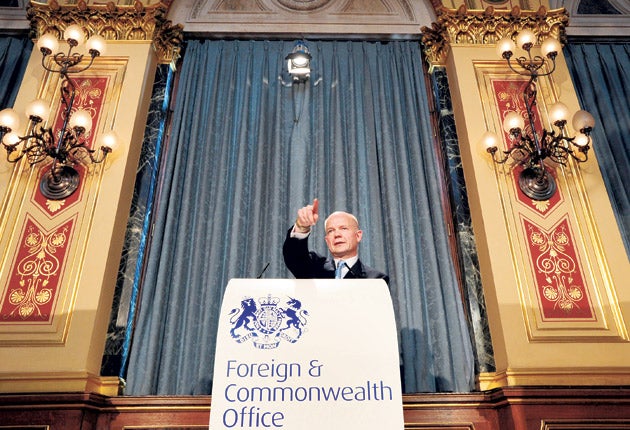
William Hague has outlined the Government's vision of Britain's role in the world, promising a sweeping overhaul of foreign policy aimed at expanding the country's influence to every inhabited continent.
In his first major speech as Foreign Secretary Mr Hague stressed that while he wanted to maintain the strong relationship with the United States, it should "solid not slavish". There was a need for greater influence inside the EU and especially for closer alliances with its smaller, often overlooked member states. He stressed the importance of forming closer ties with "new and emerging powers" like India, China and Brazil and seeking new relationships with countries in Latin America.
A fresh start was necessary, said Mr Hague, to rectify 13 years of inaction in vital aspects of international relations by Labour governments.
"It became increasingly apparent to me the previous government had neglected to lift its eyes to the wider strategic interests of the country, to take stock of British interests, and to determine in a systematic fashion what we must do as a nation if we are to secure our international influence and earn our living in a world that is rapidly changing," said Mr Hague.
However his vision of expanded diplomatic engagement comes as the Foreign and Commonwealth Office (FCO), in common with other government departments, has been ordered to slash its budget by 25 per cent. A Conservative former foreign secretary and two former senior civil servants warned yesterday of the damage to Britain's role abroad from the prospective cuts. Lord Howe of Aberavon, who was foreign secretary for six years in the 1980s, declared that instead of reducing funding the Foreign Office should receive increased funding. "A substantial enhancement of the Foreign and Commonwealth Office is fundamental to the successful conduct of foreign policy."
Lord Kerr of Kinlochard, head of the FCO from 1997 to 2002, added: "The fat on the diplomatic service is long gone. You can't wield the knife again without losing global reach and influence". Lord Butler of Brockwell, cabinet secretary for a decade from 1988, said: "I fear that we will do irreparable harm to one of Britain's greatest sources of overseas influence, the respect still felt for our diplomatic functions and our cultural activities overseas."
There were also doubts about Mr Hague's assertion that the Afghan government would be able to take over its own country's security by 2014. Senior Nato officers in Kabul once again warned against putting forward timelines, and, in London, Major-General Gordon Messenger, the British military's spokesman on the Afghan war, highlighted the ferocity of the fighting.
Mr Hague stressed that the UK should be more extensively engaged with the EU, reflecting the "Lib-Con" view rather than that of a large swathe of the Tory party. In particular, he said, there should be more UK officials in senior roles to promote British interests in Brussels.
The Foreign Secretary accused Labour of creating a "generation gap" during the party's time in power by failing to ensure there were enough civil servants of British nationality in the EU's corridors of power. The UK accounted for 12 per cent of the EU population, but only 1.8 per cent of the staff, he claimed.
Mr Hague stressed that Britain's bonds with America were "unbreakable" and remained the country's most important bilateral relationship. However the partnership should be "solid but not slavish". In the past he said, "British politicians and British leaders have been so preoccupied by those ties that they have neglected to build the wider relationships in the world".
The Foreign Secretary continued: "The real economic action in the world has been taking place in Brazil and India and China and the Gulf states and those are the places to which we have to connect ourselves much more strongly than we have ever tried to do before."
The "special relationship" with India would be buttressed through a visit by David Cameron accompanied by business representatives and there will also be a "further deepening of our relationship with China".
The shadow Foreign Secretary David Miliband said: "William Hague made his name with good parliamentary jokes, but he now needs to take responsibility for the Foreign Office and realise he will be judged by his record, not on the previous government's."
The coalition's world view deconstructed
Europe: Defying the sceptics
The coalition would be "highly active and activist in our approach to the European Union and the exercise of its collective weight in the world", the new William Hague said. He sounded a different political animal from the old William Hague, who fought a "save the pound" election campaign in 2001. Mr Hague cheekily accused Labour of failing to "give due weight to the exercise of British influence in the EU". In fact, its strategy was not that different to Mr Hague's – to maximise Britain's influence without joining the euro. Mr Hague said the proportion of Brits with top jobs in the European Commission had fallen, not surprising given EU membership has grown from 12 to 27 states since 1995. His plan to forge closer links with small EU states is good politics but has its limits. The new Government has been more positive towards the EU than its officials had dared to hope. Eurosceptic Tory MPs grumble, blaming Nick Clegg. The sceptics are wrong, since David Cameron decided before the general election that he would not pick a fight with the EU.
Andrew Grice
Emerging nations: Embracing new powers
In Mr Hague's brave new world, Britain will forge strong economic and diplomatic ties with the "emerging" powers. The initial focus will be on Brazil, India and China, but the aim is also to strengthen links with other states such as Turkey and South Africa. The diplomatic offensive will start when David Cameron leads a large delegation of diplomats and business representatives to India later this month.
Mr Hague blamed Labour (a running theme), for neglecting these potential friends, only appearing to make contact when there was the need for support at the UN or over an international treaty. He pointed out that by 2050 the economies of the rising states would be 50 per cent larger than those of the G7. The problem is however, that as a member of the EU, the UK cannot act unilaterally on trade. There will also be political difficulties on matters such as China's attitude to civil rights and the links the current government of Brazil is pursuing with Iran. Relationship building with India will also have repercussions in Pakistan.
Kim Sengupta
New media: A connected world
The Foreign Secretary and his opposite number in Bahrain follow each other on Twitter, William Hague boasted. He used that tidbit to posit the theory that the world is now "networked" and to argue that we need a new foreign policy to reflect that. Viscount Castlereagh became the first foreign secretary in 30 years to travel abroad when he went to the Congress of Berlin in 1814, Mr Hague said. By contrast he conjured a mental image of today's foreign ministers texting like teenagers or chatting with each other for "hours" every day. His point about how online connections between individuals and groups around the world can influence policy in previously unthought-of ways had more substance. In something of an exaggeration he credited the emergence of the opposition movement in Iran to "the astonishing power of the internet". But he was right to highlight how the Gaza flotilla outcry showed the power of swift global communication. Likewise it was valid to stress that 100 million young Pakistanis with mobile phones offered new openings for communicating British aims in the region.
Katherine Butler
United States: Not so special
The bond with America remained "unbreakable" and the UK's most important bilateral relationship, Mr Hague said. However, after Tony Blair's almost moist-eyed adoration of George Bush and the disaster of the Iraq war, the mantra now is "solid but not slavish". The indications from the Obama administration, as in the case of the BP oil spill, is that Washington, too, has a taken a slight step back in the "special relationship". The Government will undoubtedly have a close relationship with Washington, but, Mr Hague stressed, it should not be at the expense of other potential partners. The newly created National Security Council will play a key role in formulating foreign and security policy, Mr Hague made clear. Although the current Government had in opposition criticised the performance of some Nato allies in Afghanistan, Nato forms a cornerstone of British defence policy. The fact that the UK will keep its Trident nuclear deterrent, despite Liberal Democrat vows to scrap it before the election, has removed a potential hurdle with Nato.
Kim Sengupta
Join our commenting forum
Join thought-provoking conversations, follow other Independent readers and see their replies
Comments