Jobs for the boys: Osborne's cuts are 'worst attack on equality for generations'
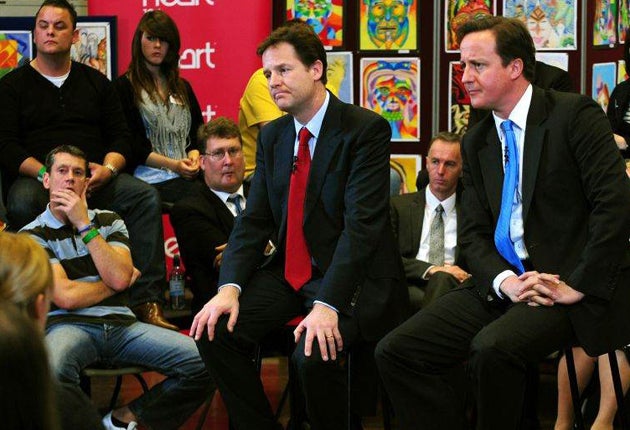
David Cameron and Nick Clegg set out yesterday to defend their £80bn programme of ‘tough but fair’ spending cuts. Yet new analysis suggests that 350,000 of the 500,000 public sector workers who will lose their jobs as a result will be women. Tough, certainly. But fair?
Up to twice as many women as men will lose their jobs as a result of public sector spending cuts, in what critics described yesterday as the "biggest attempt to turn back the clock on women's equality for generations".
An analysis for The Independent suggests about 350,000 women will leave the public sector over the next four years, compared with 150,000 men.
And there were warnings last night that cuts to childcare allowances, also announced in George Osborne's Comprehensive Spending Review, will mean that many will not return to the workforce, even as the economy recovers.
Figures from the Office of National Statistics show that women make up 65 per cent of the six million public sector workers. About half of all women in employment work for the state.
If the job losses were spread equally, 325,000 women would lose their posts. But personnel experts said women were disproportionately represented in back-room administrative roles which are being targeted for redundancies.
In local government, where one in 10 jobs are expected to go as a result of the spending cuts, 75 per cent of the workforce is female.
Even in areas such as health and education, which are protected from the worst of the spending cuts, there are likely to be significant job losses in backroom roles. The health service alone is hoping to make up to £20 billion of "efficiency savings".
The shadow minister for women and equality, Yvette Cooper, described the changes as the biggest attempt to turn back the clock on women's equality in a century. "Each generation of women has taken for granted that we would have more choices, more opportunity and break more glass ceilings than the previous generation," she said.
"But this is a huge reversal of the progress that has been made and suggests that the Government does not believe the public sector has a role to play in helping families.
"If these cuts go ahead the next generation of women will not have the same kind of choices as mine has had and I worry about my children."
A spokesman for George Osborne insisted that it was impossible to say that women would be disproportionately affected by the cuts and that the Government they had carried out an equalities assessment of the measures in the CSR. He added: "Yvette Cooper's party never did that in their 13 years in power."
Women who work part-time are likely to be particularly badly hit by the public sector job cuts.
Over the past 10 years the number of women working part-time for the state has grown by about 10 per cent, compared with 4 per cent in the private sector. More than 1.5 million women work part time in the private sector. Many have children and rely on the Government to contribute to childcare costs.
But in the CSR it was announced that the amount of childcare support available through the tax credits system will fall by 10 per cent. This will mean a family with two children losing up to £1,560 a year. "This change goes against the rhetoric of making work pay," said Ryan Shorthouse at the Social Market Foundation think-tank. "In particular it provides less incentive for women who work part-time to continue."
Other critics said the change would stop women who were made redundant from the public sector looking for jobs in the private sector, even if that work became available.
Dr John Philpott, chief economic adviser at the Chartered Institute of Personnel and Development, which represents both public and private sector human resources managers, said the institute estimated that up to 80 per cent of job loses in the public sector would be women.
"We are working on the assumption the women will be disproportionately affected by these cuts. This is not just because more women work in the public sector than men but also because they more likely to be working in administrative jobs that are being targeted for redundancy. It is quite possible that over the next five years you could be looking at 450,000 women leaving the public-sector workforce."
Dr Philpott said it was far from certain that these women would be absorbed into the private sector: "A lot of private sector employers have a rather jaundiced view of the public sector. And it is possible that they will look at those people being made redundant as the least effective part of that sector. I think a lot will depend on the strength of the economic recovery."
The Fawcett Society, which campaigns for the rights of women, described the measures as a "disastrous blow for gender equality". Anna Bird, its head of policy, said: "Not only has the private sector been much slower to take advantage of flexible working but there is also a substantial pay differential which may not make it worthwhile for women to take up any new jobs that are available. "There is a big danger that we're turning the clock back on equality and many women will be unable to go out to work and will move back to the home where they will become financially dependent on others."
The numbers...
65.5 per cent of public sector workers are women (around 3.9 million people)
32.7 per cent of women in employment work in the public sector, compared to 15.1 per cent of men
75 per cent of the work force in local government are female
90,000 women work part time in the civil service, compared with just 15,000 men. In addition, 145,000 women work in administrative roles, compared to 100,000 men
Join our commenting forum
Join thought-provoking conversations, follow other Independent readers and see their replies
Comments
Bookmark popover
Removed from bookmarks