Plan to oust Saddam drawn up two years before the invasion
Secret document signalled support for Iraqi dissidents and promised aid, oil and trade deals in return for regime change
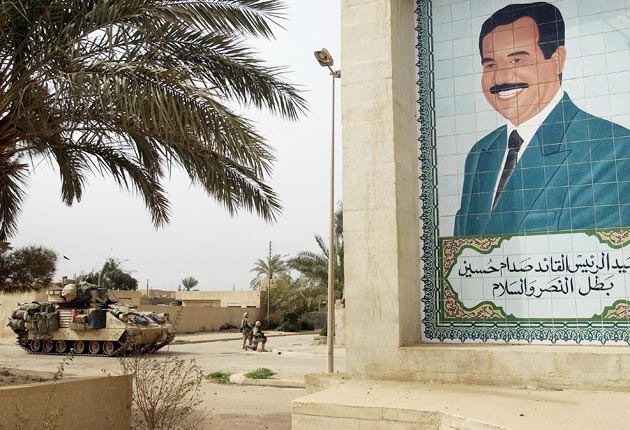
A secret plan to foster an internal coup against Saddam Hussein was drawn up by the Government two years before the invasion of Iraq, The Independent can reveal.
Whitehall officials drafted the "contract with the Iraqi people" as a way of signalling to dissenters in Iraq that an overthrow of Saddam would be supported by Britain. It promised aid, oil contracts, debt cancellations and trade deals once the dictator had been removed. Tony Blair's team saw it as a way of creating regime change in Iraq even before the 9/11 attack on New York.
The document, headed "confidential UK/US eyes", was finalised on 11 June 2001 and approved by ministers. It has not been published by the Iraq inquiry but a copy has been obtained by The Independent and can be revealed for the first time today. It states: "We want to work with an Iraq which respects the rights of its people, lives at peace with its neighbours and which observes international law.
"The Iraqi people have the right to live in a society based on the rule of law, free from repression, torture and arbitrary arrest; to enjoy respect for human rights, economic freedom and prosperity," the contract reads. "The record of the current regime in Iraq suggests that its priorities remain elsewhere.
"Those who wish to promote change in Iraq deserve our support," it concludes. "We look forward to the day when Iraq rejoins the international community." A new regime was to be offered "debt rescheduling" through the Paris Club, an informal group of the richest 19 economies, given help from the World Bank and the International Monetary Fund and handed an EU aid and trade deal. Companies were to be invited to invest in its oil fields. A "comprehensive retraining programme" was to be offered to Iraqi professionals.
During his evidence to the inquiry last week, Mr Blair said it was only after 9/11 that serious attention was given to removing Saddam as the attack changed the "calculus of risk". However, another classified document released by the Iraq inquiry on Friday night showed that No 10 explicitly saw the Contract with the Iraqi People as an early tool to remove the former Iraqi dictator. A memo issued in March 2001 by Sir John Sawers, then Mr Blair's foreign policy adviser, cited the document under the heading "regime change".
"Regime change. The US and UK would re-make the case against Saddam Hussein. We would issue a Contract with the Iraqi People, setting out our goal of a peaceful, law-abiding Iraq," the memo states. "The Contract would make clear that the Iraqi regime's record and behaviour made it impossible for Iraq to meet the criteria for rejoining the international community without fundamental change."
Officials planned to release the contract alongside tougher sanctions against Saddam's regime being negotiated in 2001. When no agreement was reached and the US began to seek more active measures to remove the Baghdad administration after 9/11, the contract was dropped.
The document was not released by the Iraq inquiry, despite being cited as significant by Foreign Office officials. Sir William Patey, the Government's head of Middle East policy at the time it was drafted, said it was "our way in the Foreign Office of trying to signal that we didn't think Saddam was a good thing and it would be great if he went". He said it was used in place of an "explicit policy of trying to get rid of him".
"It was a way of signalling to the Iraqi people that because we don't have a policy of regime change, it doesn't mean to say we're happy with Saddam Hussein, and there is life after Saddam with Iraq being reintegrated into the international community," he said.
Ed Davey, the Foreign Affairs spokesman for the Liberal Democrats, said the document called into question Mr Blair's evidence and should have been made public before his hearing on Friday. "A plan to back Iraqis seeking to oust Saddam may have been far less damaging and certainly more legal than what happened. Yet it shows that Blair's intent was always for regime change from an early stage and before 9/11," he said. "Yet again, it seems that critical documents have not been declassified, hampering the questioning of Blair and others."
* Tony Blair is to be recalled by the Chilcot Inquiry to give further evidence, according to The Guardian. It claims that Mr Blair will be questioned in both public and in private after the panel raised concerns that his evidence relating to the legality of the invasion conflicted with that given by the former Attorney General, Lord Goldsmith.
Join our commenting forum
Join thought-provoking conversations, follow other Independent readers and see their replies
Comments
Bookmark popover
Removed from bookmarks