PM dismisses obsession with UK's 'special relationship'
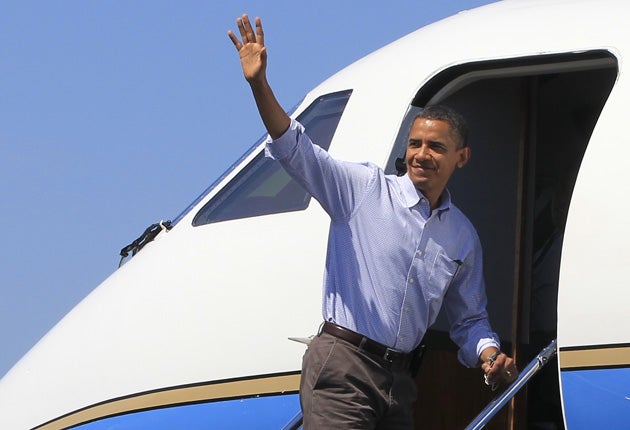
David Cameron will today seek to change the public's perception of the "special relationship" between the United States and Britain.
Mr Cameron, who flew to Washington last night for talks with President Barack Obama, called for a more grown-up approach to the way the relationship is analysed, saying: "I care about the depth of our partnership, not the length of our phone calls."
Insisting that "Kremlinology" about just how special the relationship is belonged to another era, Mr Cameron added: "I hope that in the coming years we can focus on the substance, not endlessly fret about the form."
His comments are an attempt to pre-empt the intense scrutiny of such transatlantic trips which have been both a blessing and a curse to generations of British Prime Ministers.
Writing in The Wall Street Journal today, Mr Cameron said: "No other international alliance seems to come under the intense scrutiny reserved for the one between Britain and the United States. There is a seemingly endless British preoccupation with the health of the special relationship. Its temperature is continually taken to see if it's in good shape, its pulse checked to see if it will survive. I have never understood this anxiety."
Mr Cameron argued: "The US-UK relationship is simple: it's strong because it delivers for both of us. The alliance is not sustained by our historical ties or blind loyalty. This is a partnership of choice that serves our national interests." Describing the partnership as "entirely natural", he said: "Yes, it always needs care and attention, but it is resilient because it is rooted in strong foundations." He described himself as "unapologetically pro-America", saying he "loved" the US and "what it's done for the world".
Mr Cameron's remarks will be seen as an attempt to escape the microscopic scrutiny which bedevilled his predecessor. Gordon Brown distanced himself from Tony Blair's close relationship with George Bush but was the subject of hostile media coverage when he tried to forge a close bond with President Obama.
Today Mr Cameron is due to spend about three hours at the White House. After an hour of private talks and a working lunch with officials, there will be a "media opportunity" with the President but Cameron aides said yesterday its precise form was still being "nailed down".
The Prime Minister said three kinds of critics seemed to fret incessantly about the relationship – those who question the whole concept, those who say it is no longer "special" and those fixated on form rather than substance. Each is misguided, he claimed.
"I know how annoying this is for Americans, and it certainly frustrates me. I am hard-headed and realistic about US-UK relations. I understand that we are the junior partner – just as we were in the 1940s and, indeed, in the 1980s. But we are a strong, self-confident country clear in our views and values, and we should behave that way," he said.
Mr Cameron said the US is a global power and is strengthening its ties with the world's rising powers, pointing to his forthcoming visits to Turkey and India as evidence that Britain is doing the same thing. In a world of fast-growing, emerging economies, there was a responsibility to engage more widely and bring new countries to the top table, he said. "To do so is pro-American and pro-British, because it's the only way we will maintain our influence in a changing world."
The Prime Minister insisted there was "no daylight" between him and the President over the Scottish Government's decision to release the Lockerbie bomber, Abdelbaset al-Megrahi. During his visit, Mr Cameron will face questions about the affair by Congressmen, amid claims that BP lobbied for Megrahi to be sent back to Libya to help it win a £550m oil exploration contract.
Mr Cameron said: "Abdelbaset al-Megrahi was found guilty of murdering 270 people. They weren't allowed to go home and die in their own bed with their relatives around them. I never saw the case for releasing him, and I think it was a very bad decision."
The Prime Minister admitted there were "differences of emphasis" between him and the President on the importance of trade, which would be a "huge priority" for the British Government. "Trade isn't a zero-sum game. Just because another nation's exports grow doesn't mean your own have to fall. When we import low-cost goods from China we're not failing, we're benefiting – from choice, competition and low prices. Where there are potential issues between us we must work at them and deal with them," he said.
Cameron downgrades to business class
*When a British Prime Minister attends an international summit, the plane he charters from British Airways or Virgin is always dwarfed on the Tarmac by the US President's giant Air Force One.
For David Cameron, the inferiority complex has just got worse. He flew business class on a commercial British Airways flight to Washington last night, a willing victim of his own Government's austerity measures.
Downing Street has abandoned its previous policy of hiring a plane for long-distance trips. This can cost between £200,000 and £300,000 and the bill for taxpayers was only partly recouped by charging the pack of journalists who travel with the PM.
Westminster hacks smelt a rat when Mr Cameron used a commercial airline to fly to Afghanistan last month. They suspected the new Downing Street team did not want him subjected to questioning by reporters during his travels. Although Mr Cameron is enjoying a honeymoon phase at present, his advisers know that reporters might not be so friendly if his administration runs into trouble.
The PM's aides insist the main reason for the change of travel plans is to save money. Like all departments other than Health and International Development, Downing Street must draw up plans to cut its budget by 25 per cent. "Subsidising the media is not seen as a priority," one insider said.
Mr Cameron is expected to charter a plane when he visits India shortly as he will be accompanied by a delegation of British businessmen. But he will fly on commercial flights on most of his trips.
Britain is the only big economic power whose senior ministers do not have their own plane. Tony Blair drew up plans to buy a "Blair Force One", and the Government's efficiency adviser Sir Peter Gershon found that purchasing a fleet of three aircraft would be "cost neutral". But the move was grounded by the then Chancellor Gordon Brown because it would have required a large upfront expenditure.
Join our commenting forum
Join thought-provoking conversations, follow other Independent readers and see their replies
Comments
Bookmark popover
Removed from bookmarks