Rumbling dissent on backbenches mars Lib Dem breakthrough
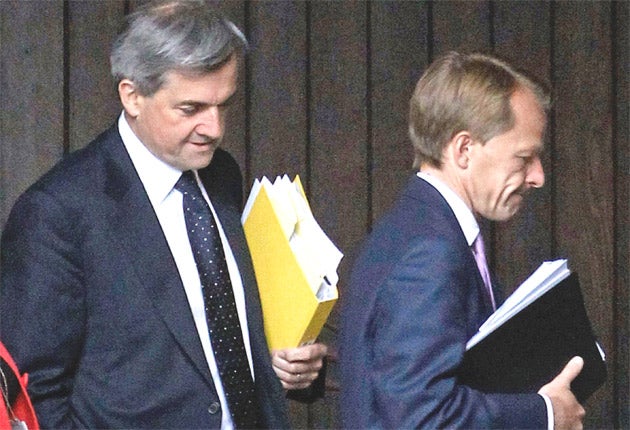
The Liberal Democrats were celebrating the beginning of a new era for their party last night after agreeing to form a coalition that will see them form part of the Government for the first time in their history.
The deal will see senior figures take critical jobs in David Cameron's Cabinet. They will be the first Liberal politicians to sit around the Cabinet table since the Second World War. The coalition Government will serve for five years under a fixed-term parliament.
However, some senior Liberal Democrats on the left of the party said they would never accept Government posts and would struggle to support the coalition.
Nick Clegg's party secured huge concessions from the Tories as part of the agreement that will him become Deputy Prime Minister. Last night, Downing Street confirmed that four of his senior team will also serve alongside him in a Cameron-led Government. Vince Cable also looked set to the Treasury to serve as George Osborne's deputy.
Danny Alexander, Mr Clegg's chief of staff, was also tipped to be handed the role of Scottish Secretary. The Liberal Democrats have a much stronger presence in Scotland than the Tories. David Laws, the Liberal Democrat Education spokesman, was also expected to be handed the role of Education Secretary, ousting one of Mr Cameron's closest advisers, Michael Gove. Liberal Democrats will also be given junior ministerial positions right across Mr Cameron's Government. The strength of their presence within the new administration is a major coup for the party.
The two teams of negotiators from the parties finally emerged at 7.35pm last night after more than five hours of negotiations at the Cabinet Office, with a crucial concession on voting reform making a full coalition between the parties possible. In exchange, controversial plans for an amnesty of illegal immigrants were dropped by Mr Clegg's party. However, his negotiators were staggered by the number of their demands that were met.
Scrawled notes and lists of concessions were drawn up by each side as they came close to an agreement. Shared ground was also reached on education policy and political reform, as well as on tax. Mr Cable was seen in the Treasury yesterday afternoon as the agreement neared completion, the first major sign that a deal on a full coalition had been hammered out.
Desperate to return to power, the Tories were quick to offer the Lib Dems a key concession on electoral reform after Mr Clegg had begun talks with Labour. Their offer of a referendum on the alternative vote (AV) system was more than senior Lib Dems had hoped to secure. The party's negotiating team, comprising of Chris Huhne, Mr Laws, Mr Alexander and Andrew Stunell, had even been minded to push for accepting the Tory deal when they met with their MPs and peers on Monday.
Sources suggested last night that the Tories had agreed to alter their plans to raise the inheritance tax threshold, while also conceding ground on the Liberal Democrats' desire to spare millions of workers from paying income tax. Despite anger among some Tories that the Lib Dems had spoken to Labour in private, Mr Cameron's negotiators were keen to keep discussions amicable.
The spotlight will now be on whether discipline can be maintained in both parties. Some Tory backbenchers, vehemently opposed to voting reform, were reluctant to accept the concession of a referendum on introducing AV. And discontent is already surfacing in the ranks of Mr Clegg's party last night. Some Liberal Democrat MPs warned that they would not abide by any coalition with the Tories.
Mr Clegg needed the approval of his party last night to formerly complete the deal. Under the party's "triple lock" system, three-quarters of MPs, peers and the party's federal executive needed to green-light to the coalition. Even staunch opponents said they would abstain rather than vote against the pact as it was the only workable agreement. However, several senior figures said they would refuse to work in the coalition. "I cannot be a defender of such a government," said one. "I've no idea where this puts me."
While talk of a Lib-Lab deal swelled on Monday night, the first signs a deal with the Tories could be back on came early yesterday, as several Lib Dem MPs realised a stable government was unlikely under a rainbow coalition with Labour. "The heart is saying one thing, but the head another," said one MP. Another was quick to say the Labour deal was "sinking fast".
As speculation built in Westminster that Mr Clegg personally preferred a deal with Mr Cameron for the sake of building a stable coalition, talks between the two parties were back on. Tory MPs were informed about the final deal at 10pm last night. Many will be uneasy about the number of Cabinet posts surrendered to Mr Clegg's party.
The party's statement
"It is clear that the Labour party never took seriously the prospects of forming a progressive, reforming government with the Liberal Democrats.
"Key members of Labour's negotiating team gave every impression of wanting the process to fail and Labour made no attempt at all to agree a common approach with the Liberal Democrats on issues such as fairer schools funding for the most deprived pupils and taking those on low incomes out of tax.
"It became clear to the Liberal Democrats that certain key Labour Cabinet ministers were determined to undermine any agreement by holding out on policy issues and suggesting that Labour would not deliver on proportional representation and might not marshal the votes to secure even the most modest form of electoral reform.
"It is clear that some people in the Labour party see opposition as a more attractive alternative to the challenges of creating a progressive, reforming government, not least in the context of a Labour leadership election campaign."
A Liberal milestone
After the last Liberal Prime Minister, David Lloyd George, was skewered by the Conservatives in 1922, it took the Great Depression of 1931 for the door of No 10 to again be opened to the party.
Ramsay MacDonald's minority Labour government couldn't cope with the unprecedented economic disaster, made worse by Britain's adherence to the Gold Standard, a policy brought in by Chancellor Churchill seven years previously.
MacDonald set up the National Government. Sir Herbert Samuel, a dedicated Zionist recently returned from his role as high commissioner to Palestine, was given the job of Home Secretary. The 90-year-old Marquess of Reading took the Foreign Secretary job. But not for the first time, disagreements over protectionism split the party. The anti-protectionist ministers resigned their posts. The pro-protectionist "National Liberals" stayed put, with their leader Sir John Simon taking the job of Foreign Secretary. When the Conservatives' Stanley Baldwin won the 1935 election, standing under a National Government ticket, Sir John Simon maintained a senior role, this time Home Secretary, but as the gathering storm approached from Germany, their policies became progressively irrelevant.
The leadership of the Liberal Party fell to Sir Archibald Sinclair, who Winston Churchill included as Secretary of State for Air in his 1940 wartime coalition. Sinclair lost his seat in the Labour landslide of 1945, and the door to No 10 clicked gently shut behind them.
Tom Peck
Join our commenting forum
Join thought-provoking conversations, follow other Independent readers and see their replies
Comments
Bookmark popover
Removed from bookmarks