Smith pledges to cut ID card costs by £1bn
News in pictures
News in pictures
On Facebook
From the blogs

Disclosure: We’d never even been to a club when we made our first single

For most of us, reaching eighteen years of age opens up a new world for exploration, spontaneity and...

Top of the posts: Drunken rants, the Western Fail and misogyny pushers

The most read blogs this week, as determined by stats.

Sepp Blatter: Penalty shoot-outs must remain, they’re football’s great leveller

As England supporters, we should scorn at any such deciding factor within football. On so many occas...

Why do some men consider the street as a female meat market?

Pronouncements on sexual inequality in the UK are normally met with an eye roll by my generation. As...

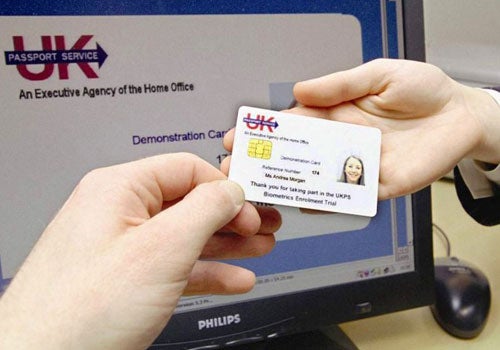
Most Britons will have a biometric identity card within nine years, Home Secretary Jacqui Smith said today.


She also pledged to shave £1bn off the total cost of the project, mainly by allowing private companies to fingerprint and photograph applicants.


The announcements formed part of a new charm offensive to bolster support for the controversial scheme by persuading Britons to enrol voluntarily.


However, millions of Britons could be forced to apply because of their jobs - including 200,000 airport workers, staff and volunteers at the 2012 Olympics and power station employees.


"The way we are now approaching the scheme will lead to a significantly quicker take-up of its benefits," said Ms Smith.


"One of the strengths of this choice is that now people will be able to get a card when they want, rather than wait until they renew their passport.


"This means that we can now aim to achieve full roll-out by 2017 - two years ahead of previous plans."


She added: "When we publish our next cost report in May I expect to see almost £1bn removed from the headline costs.


"That is a genuine reduction in the costs of the scheme."


In a speech in central London to the think-tank Demos, the Home Secretary promised she would ensure the ID card project was "hard-headed and cost-effective".

She predicted a future in which British people would voluntarily enrol for the cards - which carry their details and fingerprints in a microchip - because doing so would make their lives easier.


For example, checks by the Criminal Records Bureau for teachers, some nurses and carers could be trimmed from four weeks to just four days for card-holders, she added.


Ms Smith said: "It is inconceivable in today's world that someone should not have a single, safe way of securing and verifying their identity."


She added that rather than having to carry a range of utility bills, passport and other documents to prove one's identity, there would be huge benefits to possessing a single ID card.


She went on: "If anything, I think it will actually make it easier to retain your privacy."


The project will begin in November with compulsory ID cards for foreign nationals.


Within three years all new foreign applicants arriving in the UK will have to have a card.


British workers in sensitive jobs, such as airport staff, will have to have the card from 2009.


And Ms Smith announced that young people would be able to apply from 2010.


All new British passports will be entered on the National Identity Register - a database of the fingerprints and other details - from 2011 - 2012.

Independent Comment
blog comments powered by Disqus
Career Services

Day In a Page

Is Ridley Scott the most macho man in movies?

Ridley Scott: The most macho man in movies?

His cinematic CV is unparalleled. Yet the Alien director is still obsessed with beating his rivals.
Being Gary Lineker: The clean-cut anchorman is this summer's Mr Sport

Being Gary Lineker

The clean-cut anchorman is this summer's Mr Sport...
Gallic gourmets are putting French cuisine back on the culinary map

Gallic gourmets put France back on culinary map

Overdone, out of touch and old-fashioned: French cuisine has never been at a lower ebb...
So Moorish: Mark Hix offers his own take on classic Moroccan dishes

So Moorish: Mark Hix's Moroccan dishes

Why not create a north African-inspired feast to share with your friends?
Sin and the single mother: The history of lone parenthood

Sin and the single mother

Maureen Paton explores the history of lone parenthood.
The outsider: Margaret Howell is British fashion's queen of minimalism

The outsider: Margaret Howell

The designer tells Susannah Frankel why she has never felt part of the fashion industry.
The 50 Best luggage

The 50 Best luggage

From chic cases to compact baggage, pack it all in this summer
For men only: A pilgrimage to Mount Athos in Greece

For men only: A pilgrimage to Mount Athos

On a secluded peninsula in north-east Greece lies an enclave that's way off the tourist map, especially for women...
48 Hours In: Faro

48 Hours In: Faro

More than just the gateway to the Algarve, this city has much to tempt you off the beach.
Here, the coast is always clear: Celebrating sixty years of Pembrokeshire's National Park

60 years of Pembrokeshire's National Park

Mick Webb reveals a land of puffins, tanks and Hollywood blockbusters.
Free Range: Meet the designers of tomorrow

Free Range

Meet the artists of the future
Feeding a hungry world – or meddling with laws of nature?

Feeding a hungry world – or meddling with laws of nature?

As scientists at Rothamsted's GM trials plead with activists not to sabotage their work, Michael McCarthy visits the battle field
Monkey meat that could be behind the next HIV

Monkey meat that could be behind the next HIV

Deep in Cameroon's rainforests, poachers are killing primates for food. Evan Williams reports from Yokadouma on a practice that could create a pandemic
Catcalls, whistles, groping: just another day for a young woman

Catcalls, whistles, groping: just another day for a young woman

Government urged to take abuse more seriously as London study shows 41 per cent are harassed
Jailing of Maori separatists stirs colonial-era resentment

Jailing of Maori separatists stirs colonial-era resentment

Militant Tuhoe tribe members defiant amid claims race relations had been set back 100 years