Speeding up the Afghan pull-out 'risks UK lives'
Commons committee report says that troop withdrawal must chime with local conditions, not rigid timetable
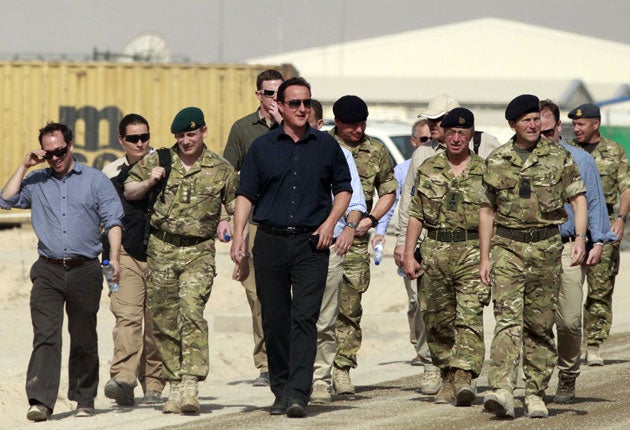
David Cameron is today warned not to risk the lives of British soldiers by making an early withdrawal from Afghanistan. The warning comes in a report from the influential House of Commons Defence Committee. Operations in Afghanistan states that pulling out more than a few hundred support troops could undermine the international coalition's strategy, while dangerously weakening those left behind.
Following his visit earlier this month to Afghanistan, the Prime Minister announced the drawdown of a further 500 troops, cutting the total force numbers to 9,000 by September 2012. But the report claims that scope for any more British troop reductions is "necessarily limited" in the short term. "A more significant drawdown, however, would have to involve a complete battle group. Weakening any battle group to withdraw numbers would be a dangerous move," it states.
Mr Cameron has repeatedly declared his intention to pull out all combat troops from Afghanistan by 2015, which happens to be the time of the next general election.
James Arbuthnot, the chairman of the defence committee, said: "We believe that the Nato 'conditions-based approach' to withdrawal is a suitable one. Withdrawal must have due regard to the circumstances at the time. There are still many challenges facing the Afghan National Security Forces and Afghan government before proper transition can take place."
He warned: "The Government's clear determination to withdraw combat forces should not undermine the military strategy by causing the Afghan population to fear that the international coalition might abandon them or by allowing the Taliban and others to think that all they have to do is to bide their time until the Isaf [International Security Assistance Force] withdraws."
The report also looks at the ill-fated British mission in Helmand in 2006, which resulted in a tiny force of little more than 3,000 troops engaged in what was described as the fiercest fighting faced by British soldiers since the Second World War.
It concludes that it was "unacceptable that UK forces were deployed in Helmand for three years, as a result of a failure of military and political co-ordination, without the necessary personnel and equipment to succeed in their mission".
In an attack on military commanders, the report adds: "We believe that such concerns as were raised by the armed forces were inadequate at best, and that they were not raised, as they should have been, to the very highest levels of government." It is "unlikely" commanders had sought ministerial authorisation for a change of tactics in 2006 which saw British troops move into northern Helmand where they were left "fighting for their lives... in a series of Alamos".
The report also takes the Ministry of Defence to task for not responding sooner to the threat of improvised explosive devices.
The report cites the defence committee as "not convinced" that British troops have enough helicopter support. "We are conscious that our predecessor committee was told in previous inquiries that UK forces have enough helicopters only to discover subsequently that this was not true."
Reacting to the report, the Secretary of State for Defence, Liam Fox, admitted: "Mistakes were made in the lead up to and during the initial deployment to Helmand in 2006. This was particularly true with regard to the troop numbers and equipment made available for the tasks expected of the UK forces deployed over that period."
However, he maintained that there are "sufficient" numbers of helicopters in Afghanistan. He pledged: "We will not abandon Afghanistan" and insisted: "We are on track to achieve our target of ending UK combat operations in Afghanistan by 2015."
This comes amid mounting levels of violence in the country. Civilian casualties are at record levels, with 1,462 Afghans killed in the first half of 2011, according to figures just released by the United Nations. "The rising tide of violence and bloodshed in the first half of 2011 brought injury and death to Afghan civilians at levels without recorded precedent in the current armed conflict," said the UN report, adding: "Violence rose as [insurgents] sought to demonstrate that Afghan security forces could not manage security on their own."
Meanwhile, an Afghan army soldier killed at least one Isaf soldier during a joint patrol yesterday near the southern Afghan city of Lashkar Gah, where responsibility for security is due to be handed over to Afghan forces, a senior police source said.
And in a high-profile assassination that demonstrated the reach of the Taliban, Ahmad Wali Karzai, head of the Kandahar Provincial Council and the younger half-brother of President Hamid Karzai, was shot dead at his home last Tuesday by one of his own security guards. It came just weeks after the Taliban struck at the heart of Kabul, when a group of suicide bombers stormed the Hotel Inter-Continental and killed 12 people.
From war to withdrawal
October 2001 British and US forces launch air strikes after the Taliban refuse to hand over Osama bin Laden and are blamed for 9/11
November 2001 Opposition forces seize Mazar-e Sharif and march into Kabul
5 December 2001 Hamid Karzai named head of post-Taliban interim government
October 2004 Karzai declared winner of Afghanistan's first democratic presidential elections
September 2005 Afghanistan holds its first parliamentary and provincial elections in more than 30 years
January 2006 Defence Secretary John Reid announces deployment to Helmand of 3,150 troops for three years
October 2006 UK sends 1,300 extra troops to Afghanistan
July 2007 Additional 1,370 British troops sent to the Regional Battle Group South
March 2009 Barack Obama sends extra 4,000 US personnel to train the Afghan army and police
August 2009 Elections are marred by patchy turnout, Taliban attacks, and fraud
December 2009 Obama announces an extra 30,000 soldiers will be sent to Afghanistan
June 2010 David Cameron declares Britain will leave Afghanistan by 2015
May 2011 Cameron says 450 British troops will be withdrawn from Afghanistan by December 2011
June 2011 Obama says 10,000 US troops are to be withdrawn from Afghanistan by the end of 2011
July 2011 US troops begin to leave as part of planned drawdown of 33,000 soldiers by September 2012
Join our commenting forum
Join thought-provoking conversations, follow other Independent readers and see their replies
Comments
Bookmark popover
Removed from bookmarks