The defence cuts bleeding our forces dry
Troops are dying unnecessarily, millions of pounds are being wasted and Britain's standing in the world is at risk, say the authors of a damning study. Jonathan Owen and Brian Brady report
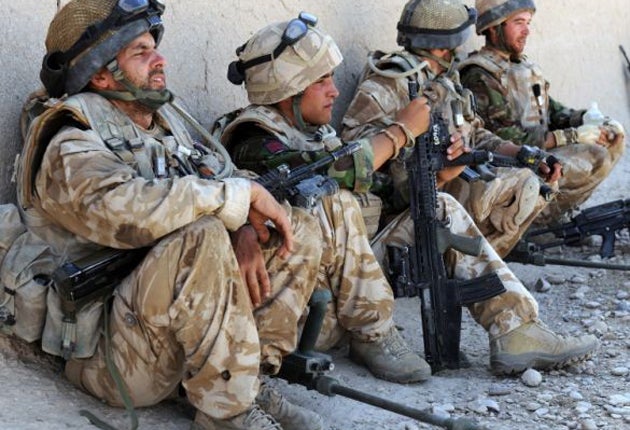
Britain's armed forces are "dangerously depleted" and the Ministry of Defence (MoD) is suffering continued "downsizing" as UK forces struggle to hold the line in Afghanistan, a damning new report has concluded.
The report, which highlights the extent to which Britain's armed forces were run down as they fought in Afghanistan and Iraq, concludes that military funding should be "threat-driven, not budget-driven". It draws on insights from senior ranks across the Army, Air Force and Navy, accusing politicians of "moral cowardice" in looking to make budget cuts.
In a scathing assessment of the Government's support for the forces over more than a decade, experts from the UK National Defence Association (UKNDA) have warned that unless ministers commit to increasing the defence budget to around 3.5 per cent of GDP in the next three years, Britain should give up its prized seat on the UN Security Council.
The report comes as Downing Street scrambled to regain ground after the Chief of the Defence Staff, Sir Jock Stirrup – generally seen as supportive of the Government – joined other senior military figures in saying that the deployment of more helicopters to Afghanistan would save lives.
The UK has now lost more soldiers in Afghanistan than in the Iraq campaign, after several weeks of bloody fighting against the Taliban. Rifleman Aminiasi Toge, from the 2nd Battalion The Rifles, was yesterday confirmed as the 185th British military death of the conflict.
Sir Jock said: "I have always said that there's no such thing as enough helicopters in an operation campaign. In a situation where you have lots of improvised explosive devices, the more you can increase your tactical flexibility by moving people by helicopter, then the more uncertain, more unpredictable your movements become to the enemy."
His comments come after the head of the Army, General Sir Richard Dannatt, said he was returning from Afghanistan with a "shopping list" of equipment to protect troops from roadside bombs. This contrasts with Gordon Brown's repeated assertions that officers in Afghanistan are satisfied they have the equipment to do the job asked of them and that the Army is better equipped than ever.
Andrew Roberts, the historian, and Allen Sykes, authors of the UKNDA report, also warn of "a £10bn–£20bn cumulative deficit in crucial defence funding which explains the dire state of armed forces housing, medical provision, equipment and pay" and a £15bn deficit in the MoD's equipment plan.
They argue that simply to sustain its current levels of operations, the Army needs up to six new battalions. The RAF is so run-down, with an ageing and expensive fleet, that it is "unable to meet all its global commitments by a wide margin". The Royal Navy is also a shadow of its former self, says the report: "Personnel numbers have been halved, down from 70,000 in 1982 to only 36,000 today, and still shrinking."
To reinforce the downbeat judgement, the UKNDA cites a pessimistic forecast by the Royal United Services Institute, which states that £4bn of annual cuts to defence will be made between 2010 and 2016 "to be achieved by the further downgrading of Britain's military presence in Afghanistan and by not implementing the long-overdue recommended pay rises".
The forensic analysis of the forces' budget and requirements will be ammunition for service chiefs, who are going public in increasing numbers to express their concerns over the funds allocated to the MoD.
Downing Street clings to the hope that Gen Dannatt's successor, Gen Sir David Richards, will prove a more "on-message" head of the Army when he takes over next month. However, Gen Richards, the former commander of Nato forces in Afghanistan, has already served notice that he too believes Britain needs more troops to do the job properly.
Underlining the international repercussions of the MoD's budget crisis, the document warns that Britain's "special relationship" with the US could be jeopardised if the Government fails to invest in defence. The warning, from the respected US economist Irwin Stelzer, a director of the Hudson Institute's economic policy studies group, is made in the report's foreword: "There is no question that the Pentagon is engaged in a reappraisal of the extent to which it can look to Britain for support in any effort involving the deployment of military assets, and therefore the extent of its obligation should Britain need assistance."
The supply of helicopters to support troops on the ground in Helmand province in Afghanistan has dominated the defence debate in the past week, as politicians and defence chiefs demanded more protection for personnel increasingly at risk from roadside bombs. Despite the protestations from Gordon Brown and his ministers, there are still fewer than 30 supporting a force of 9,000; only four years ago, when the armed forces maintained a significant presence in Northern Ireland, they operated more than 50 helicopters. However, the UKNDA report makes clear that there are significant deficiencies in many more areas:
Manning
Although the UK military presence in Basra has been wound down, the operation in Afghanistan has not benefited from an Iraq dividend. Defence chiefs have asked for about 2,500 extra troops to help take on the Taliban this summer – and relieve the 9,000 already there – but the Government is preparing to reduce numbers by 1,500 after the Afghan elections next month. Rising unemployment has contributed to an 8 per cent boost in army recruitment, but most infantry battalions are operating with one of their three rifle companies in skeletal form – and some must depend on the Gurkhas to swell ranks when they go into theatre.
Over-stretch
Gaps in manning levels mean greater pressure on soldiers expected to fill in. In practice, the rule that units should be entitled to a two-year interval between tours of duty is only observed in a small number of cases – and the Conservatives claim the Grenadier Guards were granted only eight months between tours in Iraq and Afghanistan. The pressure to serve on active duty has also hit training: the MoD has halved the number of overseas exercises.
Vehicles
The MoD has been forced to order hundreds more armoured vehicles – costing more than £1bn – in response to the increased use of roadside bombs in Helmand, and the lack of protection offered by the controversial "Snatch" Land Rovers. But delivery of some has been delayed, many of the replacements have struggled in the rugged terrain, and one model, the Vector armoured vehicle, has been withdrawn completely. Another vehicle, the Mastiff – originally acquired primarily for on-road use on Iraqi operations – suffered when it was switched to off-road missions in Afghanistan. In evidence to the Commons Defence Committee in 2007, the MoD pledged that all Snatch Land Rovers would be removed from Afghanistan by the autumn of that year. This has not happened.
Helicopters
The lack of attack and support helicopters for our frontline soldiers is "a national disgrace". Despite senior commanders calling for years for more helicopters, little or no progress has been made. As a result, soldiers have little option but to travel on roads littered with Improvised Explosive Devices. The National Audit Office has highlighted the shortage of helicopter spares, which meant that aircraft stationed in the UK had to be "cannibalised'' for parts in order to keep those on operations flying. And the government body said ageing Lynx helicopters had "struggled'' in the intense heat of both Afghanistan and Iraq and were now undergoing a £70m engine upgrade.
Equipment
From September, just eight Tornado fighters will defend the whole of the north of the UK. The Royal Navy has just six warships assigned to protect British waters and by 2020, the fleet could be half its present size. The planned introduction of 12 Nimrods has been reduced to nine. Five programmes are to be cancelled, cut back or postponed. One example is the decision to drop plans for three new Nimrod MRA4 surveillance aircraft to replace the ageing MR2. Further cuts or delays are to be made on the Nimrod's radio eavesdropping equipment, and also on the pilotless drones, such as Reaper, able to spy on insurgents and fire missiles at them.
The concerns are not confined to combat operations: the Government has admitted to serious shortfalls in kit, including body armour and armoured vehicles, used for training troops and familiarising them with equipment before they go on operations.
Defence budget
At the end of May, £2bn of damaging defence cuts were agreed by the Defence Council, on the insistence of the Prime Minister. These will have a serious effect on frontline soldiers, who will be increasingly exposed to otherwise avoidable casualties. But the MoD has still managed to waste hundreds of millions of pounds in losses, budget write-offs and "special payments" relating to failed or abandoned projects. The latest additions to a list that has reached more than £2bn within a decade include a £36m write-off of "unsupported balances" such as an Apache helicopter labelled a "duplicated asset", £25m caused by the reduction in the number of integrated biological detection systems and £3m on the cancellation of a radioactive waste processing plant project.
The UKNDA report concludes: "Defence provision must be increased steadily over the next three years to 3 to 3.5 per cent. The sums involved are not merely affordable, they are essential to avoid the serious risks now facing Britain and her independent, secure and prosperous future.
"No political leader endorses Britain's retreat from being a top-tier military power, so they must now commit the funds to avoid it. An adequate defence provision must be threat-driven not budget-driven, because it is the essential guarantee for all other benefits, both public and private. The issues are that stark. The stakes could not be higher."
Join our commenting forum
Join thought-provoking conversations, follow other Independent readers and see their replies
Comments
Bookmark popover
Removed from bookmarks