The Evidence of Witness 69: Blair has shown himself more a fool than a liar
The most revealing thing about the former PM's evidence was how little he understood about the situation on the ground
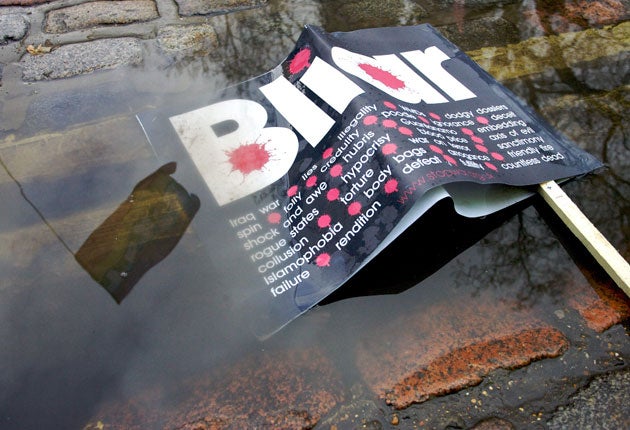
The case against Tony Blair has revolved too much around his good faith and too little around his competence. The placards held up by protesters on Friday as he gave evidence should have read "sucker" and "dope" rather than "Bliar".
Amateurs often have a fluency denied to professionals because they see no "ifs" and "buts" that would interrupt the flow of their argument. Books proving that Bacon wrote Shakespeare are often highly articulate and have great narrative pace because their authors see all facts pointing to the same inevitable conclusion.
It is this mixture of amateurism and evangelical conviction which made Mr Blair such a lethally inept leader before and during the war in Iraq. His greatest weakness was not so much that he adjusted facts to support his policies, but that he had so little grasp of the facts in the first place.
When the US and Britain invaded Iraq in 2003, they unwittingly began a series of revolutionary changes which are still reverberating. The inevitable consequence of getting rid of Saddam Hussein's regime was that the Shia Arabs would replace the Sunni as the predominant community in Iraq and Iran would greatly increase its influence in the country with the fall of its old enemy.
Yet Mr Blair said last week that he was wholly surprised by the emergence of Iran and al-Qa'ida as forces destabilising the occupation of Iraq. But al-Qa'ida became a power in Iraq only because the five million Sunni Arabs, stripped of power and jobs by the war, were already rising in rebellion.
Iran, with its 900-mile border with Iraq, was bound to be a serious player post-Saddam because it was traditionally the Shia community's main foreign supporter. Moreover, Mr Blair, by going to war as an ally of President Bush, does not seem to have noticed that senior members of the Bush administration were openly demanding that victory in Iraq be followed by regime change in Tehran and Damascus. Not surprisingly, the Syrians and Iranians were determined to give the US and Britain enough trouble in Iraq to make sure they did not move on to the next stage.
In trying to prove him mendacious, critics of Mr Blair underplay his incompetence. His very fluency as a propagandist militated against long-term military success. He conflates the invasion of Iraq with the long-term occupation of Iraq as if both were seen as acts of liberation by ordinary Iraqis. The US and Britain might just have got away with overthrowing Saddam Hussein, whom most Iraqis wanted to see the back of, but a long-term imperial occupation was never going to succeed because it had too many enemies inside and outside the country.
It was striking in Mr Blair's testimony that so many of his references to Iraq are inaccurate. In trying to prove some connection between the perpetrators of 9/11 and Saddam's regime, he mentioned Abu Musab al-Zarqawi, later head of the Iraqi branch of al-Qa'ida, as being in Iraq before Saddam was overthrown. He failed to mention that he was in a camp in Kurdistan in a part of the country not controlled by Saddam Hussein. He said Iran intervened in Iraq because it feared a Shia democracy on its doorstep. In fact, Iran supported the Shia government in Baghdad after it was elected in 2005, but opposed the presence of American and British forces.
This limited knowledge of Iraq on display last Friday is significant because it reflects the fantasy picture of the war Mr Blair increasingly produced after 2003. By 2006, he was denying that Iraq was convulsed by a sectarian civil war which finally led to 3,000 dead a month and the flight of two million refugees.
Such is the fury of so many people in Britain at Mr Blair's distortions of the truth that an important point is being overlooked. This is scarcely surprising since a YouGov poll earlier this month shows that 23 per cent of the public think he should be tried as a war criminal.
But he is not alone in his responsibility for what went wrong in Iraq. There is too much focus on his staff's manipulations of the "dodgy dossier" and too little on miserable performance of British intelligence. The service which knew the entire German order of battle in 1944 proved incapable of finding out accurate information about the rickety regime in Iraq some 60 years later. The Foreign Office and the British Army often showed a similar ineffectiveness during the Iraq war, possibly because they never approved of it and their hearts were not in it.
In Basra, for instance, the British Army found itself fighting a war that was wholly different from the one portrayed by Mr Blair. He claimed that here were Iraqis yearning to breathe free from Shia militias and Iran. But I remember a former British military intelligence officer saying to me that the great difference between fighting in Basra and guerrilla wars in Malaysia and Northern Ireland "is that here in Basra nobody really supports us".
Perhaps Mr Blair's greatest error was in his view of America. There is nothing surprising about him wanting to be the main ally of the US in the world. This has been British policy since 1940. Nor should there be any doubt about him having committed Britain to war early on. "I have made up my mind that Saddam needs to go," President Bush said at the Crawford ranch meeting as Mr Blair stood compliantly beside him.
But the war which followed showed that the US is more dysfunctional politically and militarily than Mr Blair supposed. For all the pitfalls of Afghanistan and Iraq, the Taliban and Saddam Hussein should not have been quite such hard acts to follow.
One extraordinary revelation did emerge in Mr Blair's evidence. The disasters of the Iraq war largely discredited the neoconservatives in Washington, but his repeated rants in favour of confrontation with Iran last week shows that Mr Blair has himself joined their ranks.
Join our commenting forum
Join thought-provoking conversations, follow other Independent readers and see their replies
Comments