Ethiopia demands stolen crown back
President writes to British museums to call for return of more than 400 treasures looted in 1868
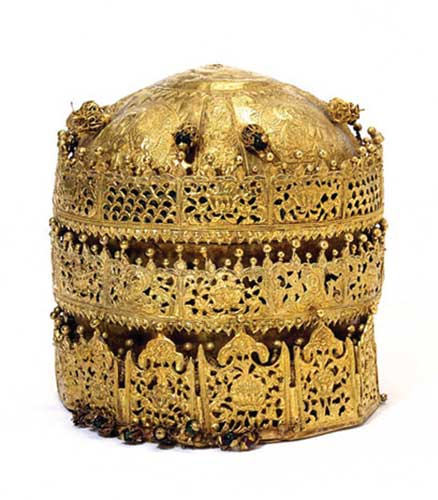
Ethiopia is demanding that Britain's museums return some of its most significant religious treasures. President Girma Wolde-Giorgis has personally intervened in a dispute to get the artefacts, including the Ethiopian royal crown, returned home 140 years after they were "looted" by marauding British troops.
The President has written to the British Museum, the Victoria & Albert Museum, the British Library and Cambridge University Library seeking the restitution of more than 400 so-called "treasures of Magdala", which were stolen by British soldiers following a battle in 1868.
In the letter, obtained by The Independent on Sunday, the President wrote: "I must state that Ethiopians have long grieved at the loss of this part of their national heritage. Ethiopians feel that this act of appropriation had no justification in international law. I feel, therefore, that the time has come for the return of Ethiopia's looted treasures."
Among the items being held in the UK is an 18-carat gold crown and more than 300 priceless manuscripts, including Christian scriptures. Experts say the issue is particularly sensitive for Ethiopians because many of the artefacts hold deep religious significance for them. These include nine tabots, or sacred wooden altar slabs, which are recognised as so holy that the British Museum has pledged never to display them. When a tabot was returned in 2005 after being discovered in the back of an Edinburgh church, thousands of people turned out to greet its return in Addis Ababa.
The objects were among those seized by British soldiers after the storming of the Fortress of Magdala in 1868, a punitive expedition that followed the kidnap of several Britons. Emperor Tewodros committed suicide after the battle. According to contemporary accounts, British soldiers slaughtered hundreds of poorly armed Ethiopians after the battle, and then "jostled each other" to grab a piece of the emperor's blood-stained shirt, which they tore from his body. They also looted the citadel and a nearby church, carrying off treasures that included "an infinite variety of gold, and silver and brass crosses", as well as "heaps of parchment royally illuminated".
British museums have in the past resisted calls for artefacts from their collections to be returned to their countries of origin, but it is understood that Neil MacGregor of the British Museum and Mark Jones of the V&A have already met the Ethiopian ambassador to discuss the matter.
Museums often argue in restitution cases that the artefacts are better off in Britain because anyone in the world can view them, and the V&A is known to have asked Addis Ababa whether the silver crown of Emperor Tewodros, which it returned to Ethiopia in 1925, is available for public view.
The V&A said yesterday that discussions were still ongoing, even though the President's letter was sent in February this year. The four organisations involved have also held meetings over the way forward.
The Magdala treasure differs to other restitution cases, such as that of the Elgin Marbles, because it is acknowledged that the treasures were simply stolen. "It was straightforward looting," a spokeswoman at the Ethiopian embassy in London said.
A spokeswoman for Afromet, an organisation that has campaigned for the restitutions of the items, said: "These museums hold most of Ethiopia's heritage. It means far more to Ethiopians than it could ever do to anyone else."
Join our commenting forum
Join thought-provoking conversations, follow other Independent readers and see their replies
Comments
Bookmark popover
Removed from bookmarks