Last day at Tower, the coalmine that became a goldmine
When the Conservative government declared their colliery 'unviable' in 1994, the miners invested their redundancy money in keeping their workplace and community alive. Tony Heath reports on their triumph
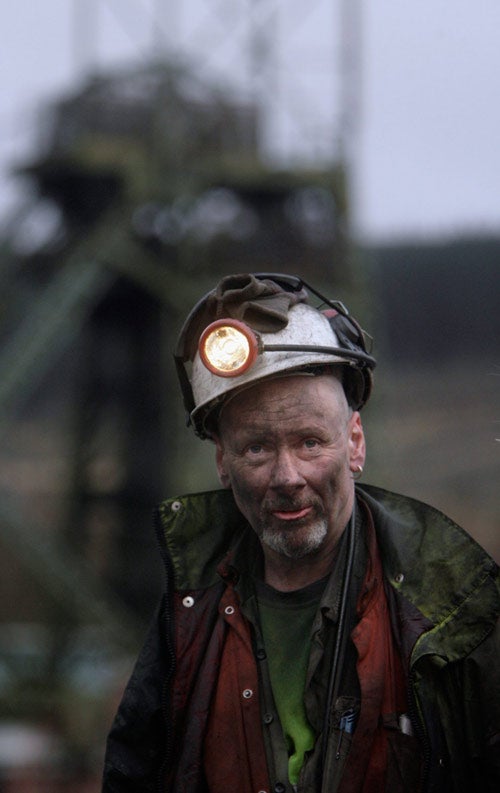
The wind whipping round the Rhigos mountain on Friday turned the banners carried by miners marching to mark the closure of their colliery into sails where red predominated. It seemed like nature's tribute to an event that underlined the way, against all the odds, they saved a colliery when Britain's coalfields were put to the sword in the early 1990s.
To call it "their" colliery is the rock-solid truth. Tower, the last deep mine in South Wales, has for 13 years belonged to the men now winding their way from the giant headstocks past hundreds of well-wishers. In 1994, they were told it, and themselves, were no longer of any use. The mine would close. But they fought for it, and, using their redundancy, bought and re-opened it. On 2 January 1995, they marched back to the pit in triumph behind a brass band, and, for the next 13 years, ran it themselves as a going concern.
But now, geology has achieved what a Conservative government, Michael Heseltine, British Coal and all their accumulated bureaucratic gamesmanship could not. Tower closed. And so – led by no band, but instead walking heads up to the continuous applause of a large crowd lining the way – the men marched on Friday away from the pit.
"Silence was right because everyone has memories," affirmed Tyrone O'Sullivan, a burly figure muffled against the wind in a dark overcoat. "The glory of Tower was the way ordinary working people showed they were powerful enough to tell off the bosses."
When the march ended his family gathered for photographers – Elaine, his wife of 40 years, daughters Taryn, aged 33, and Czarina, 28, and three grandchildren. "This isn't a day to be sorrowful. It's a day to celebrate what we've achieved together – all of us – in the last 13 years," Mrs O'Sullivan proclaimed.
The story of Tower is one that has inspired, and will continue to inspire, generations of working people given formal notice that they, and what they make, are no longer wanted. Some 13 years ago, the colliery was called "unviable" by tunnel-visioned know-alls at British Coal. Michael Heseltine, then President of the Board of Trade, let it be known that reprieve was out of the question. The pit was closed that April. Tyrone O'Sullivan, Tower's National Union of Mineworkers lodge secretary since 1973, and his co-workers thought – knew – otherwise. Men who daily went underground to work the anthracite seams maintained that there was at least five years' life in the pit.
And so, 239 determined men chipped in with £8,000 of their redundancy pay-off to buy Tower. Coal had first been cut there in the 19th century. History demanded a fight and the word spread. Money flowed in from supporters at home and abroad. Cash and cheques arriving at the office the miners set up in nearby Aberdare were stashed away for banking. Glyn Roberts recalls: "I had hundreds, thousands under the bed for wheeling off to the bank next day. It was quite scary."
And this was not just a fight for jobs. Tower, near Aberdare, is an area where comradeship is more than a word in a dictionary. Coal, too, was no mere commodity; the cost of bringing it to the surface ran like a bloodied seam through the communities of the valleys. At Tower, in 1962, nine men had died in an explosion, a year later Tyrone O'Sullivan's father had been killed in a roof fall, and the very name Aberfan stirred feelings no outsider could fully understand.
The fight to secure Tower's future won media attention from far and wide. Cynon Valley MP Ann Clwyd, with miner-minders, was smuggled underground to stage a sit-in. Emerging, face coal-dust streaked, she was carried shoulder high before the waiting press. She recalls Michael Heseltine saying to her at Westminster that she should tell the miners to throw in the towel. "I replied: 'Tell them yourself,'" she says.
And the alternatives to the pit were not good. Had it closed male unemployment in Aberdare and the Cynon Valley was likely to have reached one in three. With security guard work at less than a couple of quid an hour, the Job Centre was more a recruiting office for slave labour.
But the men of Tower won through. With City money backing their own redundancy cash and commitment, they re-opened and have had 13 hard but prosperous years. A total of more than 17 apprentices were taken on and trained, proper sickness paid for the first time, and local charities and sports clubs shared in the profits. The co-operative was chaired by Philip Weekes, the former National Coal Board director for South Wales. Unpaid, of course, as befitted a man born and brought up in Tredegar, the home town of Nye Bevan. "All I want is a pint after a board meeting," stressed the man who resigned in protest at Ian McGregor's closure programme following the 1984 miners' strike. Over the years, journalists and TV crews from many countries with mining industries journeyed to Tower. Many were there on the final day. So were miners from other collieries closed during the past 20 years.
Ron Stoat, NUM lodge chairman at Penallta, a pit 20 miles down the valley which closed soon after the strike, said: "I'm here to pay my tribute to Wales's last deep mine and the men who gave it their all to keep it going." A skilled miner, he hunted high and low for work when Penallta went. For a time he drove a truck delivering potatoes to chip shops. "It was a job, of course, but ..." his words trailed away.
Tower is no longer a coalmine, but the 480-acre site is valuable. It will take a couple of months to bring saleable machinery to the surface and carry out safety checks underground before the shaft is filled in. Demolition of the buildings will follow.
Plans for an eco-park have been mooted, and Tyrone O'Sullivan says the future is "promising" and that no one should end up out of pocket. "The task is to create hundreds of jobs on this land. We are all shareholders and the opportunities for a new kind of Tower are here."
And so, in the club on Friday, emotion and pride were shoulder to shoulder, just as the miners and their families had been throughout the traumatic 1984 strike, a hard-fought struggle to keep intact the pit and the community around it, the triumph of the buy-out and the 13 fulfilling years that followed – and, yes, the day of the march away after all the coal that could be mined was brought to the surface. "We didn't leave an ounce down there," Tyrone O'Sullivan declared.
Today, the coal industry in Britain is much reduced, slimmed to a handful of pits at a time when imports from as far away as Colombia and Poland pile in to feed the insatiable demand for energy. But the spirit of the miners lives on. Small wonder that clenched fists were raised as Tower's owners marched away with pride and emotion from their colliery.
Join our commenting forum
Join thought-provoking conversations, follow other Independent readers and see their replies
Comments
Bookmark popover
Removed from bookmarks