Mass graves to shed light on Britain's bloodiest battle
More than 28,000 died at Towton, but the Tudors' PR machine almost wiped it from history. Until now...
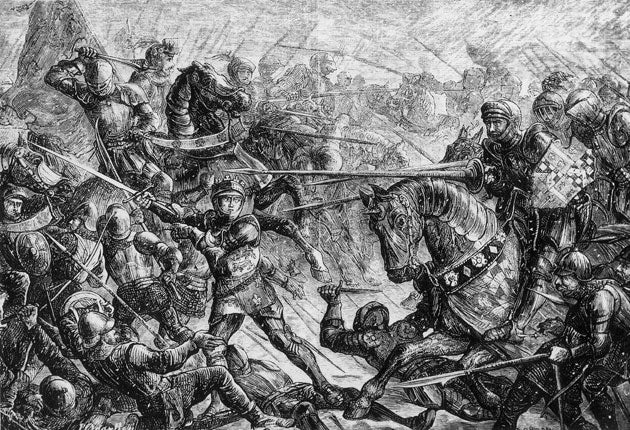
It was one of the biggest and probably the bloodiest battle ever fought on British soil. Such was its ferocity almost 1 per cent of the English population was wiped out in a single day. Yet mention the Battle of Towton to most people and you would probably get a blank stare.
Next week marks the 550th anniversary of the engagement that changed the course of the Wars of the Roses. It is estimated that between 50,000 and 80,000 soldiers took part in the battle in 1461 between the Houses of York and Lancaster for control of the English throne. An estimated 28,000 men are said to have lost their lives.
But this bloody conflict is unlikely to remain forgotten for much longer. Archaeologists believe they will unearth what is likely to be Britain's largest mass grave this summer.
Work is to begin in June, at a site 12 miles south of York between the villages of Saxton and Towton where the battle took place in snowy March weather. The locations of the graves were discovered by archaeologists using geophysical imagery and now, with funding in place, they are able to begin excavating.
Experts believe these new sites – up to five in total – could yield the remains of several hundred men.
Tim Sutherland, a battlefield archaeologist from the University of York, said: "We think there will be three or five very large grave pits at the site. These are the main mass graves found right in the middle of the battlefield. They are the big ones. Every time the field is ploughed we go to this exact spot and as soon as the rains wash the surface clear we start finding fragments of human remains."
In an attempt to safeguard the artefacts, the Towton Battlefield Society has set up the country's first accreditation scheme for metal detectorists on a historic battlefield. Anyone seen on the site without authorisation can now be prosecuted.
Very few records of the battle survive, which is one reason that so little is known about it. Historians believe this could be due to an early propaganda campaign by the Tudors.
Author and historian George Goodwin, who this month publishes a new book: Fatal Colours: Towton, 1461 – England's Most Brutal Battle, said: "The Tudors did a tremendously good propaganda job in making Bosworth the key battle because that was the battle which ended the Wars of the Roses. They were the winners and they got to write the history books. Because Towton was a Yorkist victory that wasn't really very useful to them."
The exact losses are a matter of continuing debate for historians, though they all agree the battle was brutal. England was in the grip of civil war between the North and South. Towton represented the appalling climax of the disastrous 40-year reign of England's youngest ever king, the pious and weak Henry VI from the House of Lancaster. Henry was just nine months old when he succeeded his father to the throne.
The houses of Lancaster and York met at Towton on a cold, Palm Sunday, on 29 March, 1461. The Lancastrians, who initially had the upper hand with a larger force and a position on higher ground, retreated when a fierce blizzard turned against them and Yorkist reinforcements arrived. No quarter was given and the battle soon turned into a massacre, with bodies piling up by the minute.
Subsequent studies of some of the remains offer a frightening glimpse of the brutality inflicted on the Lancastrian soldiers. Experts found multiple chops, incisions, punctures and cuts on the facial areas and some evidence that prisoners may have been summarily executed.
"It was Britain's most brutal battle because there was absolutely no quarter, and the victorious army had licence to kill anybody," Mr Goodwin said. "The Yorkists had the blood-lust of victory. Part of the reason it was so atrocious was because a sense of 'the other' had crept in, and there was a real hatred of the enemy."
Join our commenting forum
Join thought-provoking conversations, follow other Independent readers and see their replies
Comments
Bookmark popover
Removed from bookmarks