The Big Question: Was Cromwell a revolutionary hero or a genocidal war criminal?
Why are we asking this now?
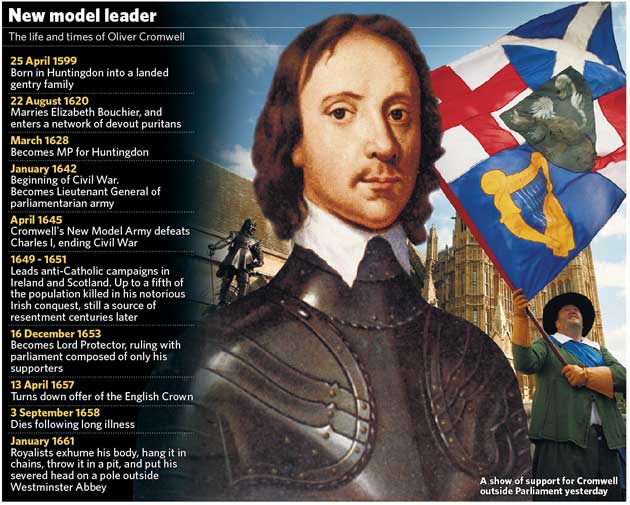
The 350th anniversary of Oliver Cromwell's death yesterday was marked by the publication of a new book which suggests that the Lord Protector's reputation should be reassessed in the light of two massacres he conducted in Ireland. The slaughter at Drogheda and Wexford in 1649 rank among the greatest atrocities in Anglo-Irish history, suggests the Irish historian Micheál Ó Siochrú in God's Executioner: Oliver Cromwell and the Conquest of Ireland. England's great parliamentarian, he says, was guilty of war crimes, religious persecution and ethnic cleansing.
This is surely not the usual account?
In recent years, that's true. The overwhelming majority of the 150 biographies of Cromwell published over the past century have been favourable. And Cromwell came third in a BBC poll to find the greatest Briton of the second millennium. But in Ireland they have long taken a different view.
Cromwell has also viscerally divided thinkers in the past. He is variously a fanatical regicide and the father of English democracy and tolerance. David Hume dubbed him the "most frantic enthusiast... most dangerous of hypocrites... who was enabled after multiplied deceits to cover, under a tempest of passion, all his crooked schemes and profound artifices". He has even been called the father of European fascism.
But admirers like Thomas Carlyle painted him as a hero in the battle between good and evil – a man who restored morality in an age dominated by expediency and compromise, who pressed a new political equality and a religious toleration which even extended to readmitting the Jews to England 350 years after they had all been expelled.
What took Cromwell to Ireland?
In 1641 Irish Catholics attacked the Protestant settler community. Thousands were killed. But news of massacres and atrocities were greatly exaggerated in the English press, which reported that as many as 200,000 had been slaughtered. Cromwell, then an obscure MP, served on a committee to organise relief for the Protestant victims. Within a decade, however, he had become, thanks to the English Civil War, the greatest soldier of the era, and when a new rebellion occurred in Ireland against the Parliament which had overthrown the English king his response was governed by the outrage he still harboured at the earlier atrocity.
What did he do there?
The first major town Cromwell and his army encountered when they landed in Ireland was Drogheda. He summoned the royalist commander and invited him to surrender. When he refused, Cromwell's model army seized the town and put the entire garrison of 2,500 officers and men to the sword. It was an act of ruthlessness which sent shockwaves of fear through the rest of Ireland. Other towns surrendered as soon as Cromwell's army approached, and their inmates were spared.
Only Wexford refused. During the siege there Parliamentarian troops broke into the town while negotiations for its surrender were ongoing, and sacked it, killing about 2,000 soldiers and 1,500 townspeople and burning much of the town.
Wasn't that how wars were fought then?
Historians disagree on that. Some, like Tom Reilly in Cromwell, an Honourable Enemy, suggest what happened at Drogheda was not unusually severe by the standards of 17th-century siege warfare. Other historians, like Micheál Ó Siochrú, suggest that Cromwell's resort to extreme violence was not a reaction to the conditions of battle but a pre-determined exercise in religious and ethnic vengeance. "Even by the standards of the time [Cromwell's] behaviour was beyond the pale," he has said. Cromwell offered a different justification: by making an example of these two towns he ensured that others would surrender peacefully, saving lives.
Could he have acted differently?
Probably. He had arrived in Ireland in a strong position politically; Charles I had been executed, the mutiny of the Leveller radicals had been crushed, and the Commonwealth declared. Militarily he was dominant too; he had an effective and disciplined army and the opposition was what the poet Milton described as "a mixed rabble, part papists, part fugitives, and part savages". He ought to have been able to pacify Catholic Ireland with minimal violence. On the other hand more than 80 per cent of Ireland was in the hands of those hostile to the Parliamentarian's revolution. There were fears that a force from Ireland might invade England and threaten the settlement which Parliament had established in its victory over the King.
What is the case for the defence?
That Cromwell was just a man of his time. What he did in the two sieges was in accordance with well-established military practice. That his decision to make an example of the garrisons at Drogheda and Wexford was intended to prevent more extensive bloodshed throughout the land. That the civilians killed were, in modern parlance, unhappy collateral damage. That compared to others he was one of the most restrained of all the commanders in Ireland in the early modern period. And that he cannot be held accountable for what happened in Ireland after he had gone.
What happened after he left?
Cromwell's forces ordered Irish Catholics to move to live west of the Shannon river only. The alternative to this forced mass population transfer was clear. The Irish were told "To Hell or to Connaught!" It was the greatest act of ethnic cleansing in the British Isles since the Norman Conquest. By the end of 1656 four fifths of the Irish land was in Protestant hands. When Catholics fought back, in guerrilla groups numbering some 30,000 Cromwell's generals forcibly evicted civilians who were thought to be helping the resisters and systematically burned the area's crops and killed all livestock. Famine followed, exacerbated by bubonic plague. Three years on, a fifth of the population had died.
So what's the overall verdict?
Cromwell was a paradox. He was a great Englishman who swept away the last remnants of feudalism from England, paving the way for democracy, freedom and tolerance. But the drive and idealism which motivated him to do that were perverted into a ruthless dismissal of the humanity of those who were his political and religious opponents. Drogheda and Wexford were his Hiroshima and Nagasaki. The question of whether evil can be done in the name of good is not one which was peculiar to him or to his time.
Did Cromwell attempt ethnic cleansing in Ireland?
Yes...
* The massacres at Drogheda and Wexford in 1649 rank among the worst in British history
* Non-combatants were killed, and priests tortured, as examples to terrify the Irish nation
* The slaughters were followed by forced expulsions on a mass scale
No...
* The besieged garrisons knew that if they did not surrender there would be no quarter
* The confusion of battle mean that the facts are not clear
* His acts of war must be seen in the context of defending a progressive political settlement
Join our commenting forum
Join thought-provoking conversations, follow other Independent readers and see their replies
Comments
Bookmark popover
Removed from bookmarks