The first sister of feminism
She threw off her habit and put women on the stage. Simon Caldwell tells the tale of the feisty nun set to become a saint
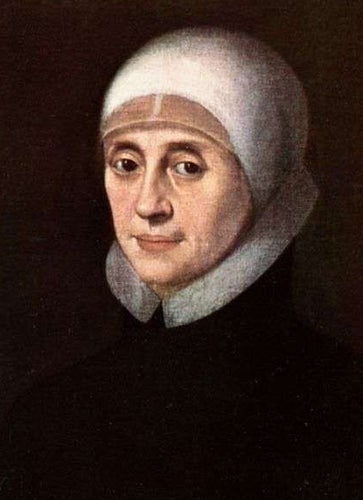
In 1631, an exhausted 46-year-old woman arrived at the gates of the Vatican. Mary Ward, a Yorkshire-born nun, had walked more than 1,500 miles from her order in present-day Belgium to Rome, knowing that she might end up in prison.
For more than two decades, she had been leading an order of devotees that lived in defiance of the Vatican's strict rules that confined nuns to their cloisters.
Ward had taught her religious sisters not to wear habits and trained them to work with the poor and the persecuted, and to found and teach in Catholic schools. She also encouraged women to perform in plays, a move considered scandalous in Shakespearean times when all female roles were played by boys.
She was living at the height of the Roman Inquisition where accusations of heresy abounded. The pope at the time was Urban VIII, the same pontiff who threw Galileo in prison for daring to suggest that the Earth orbited around the Sun.
Now this revolutionary woman had gone to Rome asking him for official approval of her rebellious order which lived in defiance of centuries of Catholic teaching.
It was, therefore, perhaps of little surprise that Urban threw Ward in jail and issued a papal bull ordering her movement to be suppressed.
But now the same institution that declared her a "heretic" has taken the first decisive step towards making Ward a saint. A panel of Vatican theologians from the Commission of the Congregation for the Causes of Saints has concluded that Ward lived a life of "heroic virtue". They are recommending that she should be declared "Venerable" – the first major step toward recognition as a saint.
Ward was born in Ripon in 1585 to a staunchly religious family at a time when Catholicism was under persecution. Two of her relatives were involved in the Gunpowder Plot and as a young girl she spent much of her life on the run.
At age 15 she crossed the Channel to become a Poor Clare, a strictly orthodox Franciscan order of nuns who led a life of prayer and penury. But she soon grew tired of the rigid strictures placed on Catholic nuns and in 1609 founded her own order at St Omer. Based on the Jesuits, her sisters were highly active within their community and believed in educating young women and preserving Catholicism across the Channel – an increasingly dangerous task.
Most controversial was Ward's insistence that women should be allowed to act in plays, at a time when female roles were almost always played by young men. In England it led to the nuns being derided as "chattering hussies" and caused shock on the Continent, where actresses were viewed with the same contempt as showgirls or prostitutes. Urban also singled this idea out for vehement criticism.
The Pope placed Galileo under arrest a year after meeting Ward, whose supporters argue that she is comparable to Galileo not only in the way she was treated but because her ideas were just as revolutionary.
Sister Gemma Simmonds, a member of the Congregation of Jesus, the name by which Ward's order is known today, said: "The Church has apologised for its treatment of Galileo and there is a statue of him in Rome. We are still waiting. Mary Ward had a vision of what women could do in the Church and in society not only decades but centuries before anyone else saw it. She was given this insight directly by God."
Sister Simmonds, who lectures in theology at Heythrop College, the University of London, believes that Ward should be regarded as a feminist icon for Catholics and non-Catholics alike.
"She had a vision of the equality of men and women before God and a vision of the capacity of women to do good and to work for the kingdom of God," she said. "She had this at a time when universities were still discussing whether women had souls.
"She was ferociously persecuted by the Church and she submitted to this because she had to. But she never grew bitter and she never allowed a word of bitterness or resentment against those who persecuted her to appear in her writings. Even in prison, even when they thought she was dying, she never lost that extraordinary gift of hope and trust in God. I want her to be canonised. I want justice for her and I want the justification for what women can do in the Church." Ward spent a year in prison in Munich and after her release, she ordered that the Pope's wishes to close down her order be carried out. She died in 1645 in the siege of York during the English Civil War and was buried in the parish church of Osbaldwick, on the outskirts of York. In the century that followed, English nuns persuaded various popes to lift the suppression on the order but they would only do so on the condition that Ward was not recognised as its foundress.
Then in the 1900s, a French member of the order, Sister Magdalen Gremion, asked Pope Pius X to his face to restore Ward as foundress. He immediately denounced Ward as a heretic but later concluded that there was no case against her.
His successor, Pope Pius XI, opened Ward's cause for sainthood in 1932, and Pope Pius XII later praised her as an "incomparable woman".
Father Peter Gumpel, the Rome-based Jesuit who is in charge of the cause, said that he expected Pope Benedict XVI to declare Ward "Venerable" by next year.
The bishops and cardinals of the Vatican's Congregation for the Causes of Saints will first review the decision of the theologians and scrutinise a 5,500-page position paper on Ward's life. "I expect the decision to be unanimous in favour of the cause progressing," said Father Gumpel. "I think it would be very strange if the cardinals and bishops disagreed with the view of the theologians and I have no reason to think that they would do that."
Today, Ward's order has about 4,000 sisters in two branches – the Institute of the Blessed Virgin Mary, or Loreto sisters, and the Congregation of Jesus – working in every continent, and in places as far afield as Cuba, Siberia, outer Mongolia and East Timor.
Join our commenting forum
Join thought-provoking conversations, follow other Independent readers and see their replies
Comments
Bookmark popover
Removed from bookmarks