The secret of Stonehenge
It is half a century since the inside of the mysterious circle was last excavated. Now a fresh dig has begun, aimed at solving a mystery which continues to baffle archaeologists
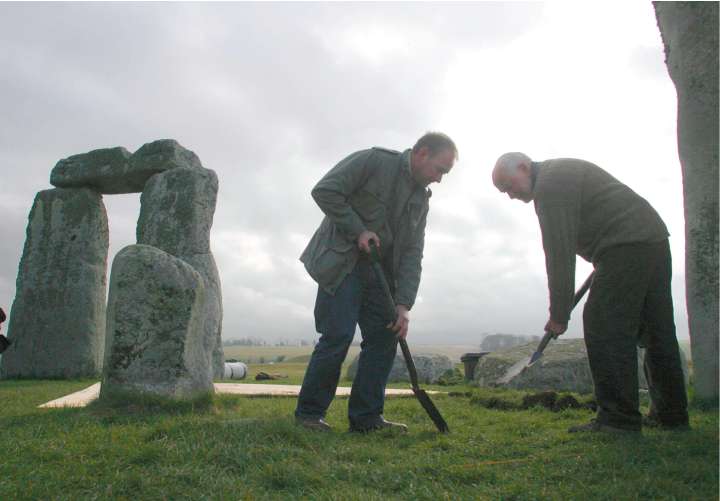
The last time any excavation was allowed inside its ancient sarsen stone pillars was in 1964 but now the first archaeological excavations at Stonehenge in almost half a century are attempting to solve, once and for all, the mystery of how and why the stone circle was built.
The enigma of Stonehenge, famed for its orientation in relation to the rising and setting sun, has puzzled and divided experts for decades. Some say the ancient stones were built as a temple used to worship ancient earth deities. Others say it was a prehistoric astronomical observatory; others claim it was a sacred burial site for people of high birth. Arthurian legend even has it that the stones were put there by the magician Merlin.
But yesterday, researchers started the dig inside the stone circle, a project English Heritage is calling the most significant in the site's history, and which they hope will finally lift the lid on the truth behind one of Britain's most famous landmarks.
The two-week project will try to establish the precise dating of the "Double Bluestone Circle", the first stone structure to have been erected at the site thousands of years ago. A research team will hand-dig a trench, eventually measuring 3.5m wide and 1.5m deep, in a previously excavated area on the south-eastern quadrant of the Double Bluestone Circle, with the hope of retrieving fragments of the original bluestone pillars to be carbon-dated.
"The bluestones hold the key to understanding the purpose and meaning of Stonehenge," said Dr Simon Thurley, the chief executive of English Heritage. "Their arrival marked a turningpoint in the history of Stonehenge, changing the site from being a fairly standard formative henge with timber structures and occasional use for burial, to the complex stone structure whose remains dominate the site today."
The bluestones are natural columns of white-spotted dolerite, found only in the Carn Menyn region of the Preseli Hills, in north Pembrokeshire, and it was from there, about 4,500 years ago, that Stonehenge's neolithic builders brought 80 of the stones the 160-mile journey from south-west Wales to Salisbury Plain. The reasons why they did so, archaeologists argue, hold the key to Stonehenge's existence.
Geoffrey Wainwright, the president of the Society of Antiquaries, who is leading the dig with colleague, Timothy Darvill, of Bournemouth University, said it was "an incredibly exciting moment and a great privilege to be able to excavate inside Stonehenge". He added: "This excavation is the first opportunity in nearly half a century to bring the power of modern scientific archaeology to bear on a problem that has taxed the minds of travellers, antiquaries, and archaeologists since medieval times: just why were the bluestones so important and powerful to have warranted our ancestors to make the gargantuan journey to bring them to Salisbury Plain?"
The project is being funded by Smithsonian Networks and BBC Timewatch, which will broadcast a special documentary in the autumn based on the investigation's conclusions. The dig will also investigate the "Stonehenge Layer", a layer of debris and stone chippings spreading across the whole extent of the stone circle and comprising a high proportion of bluestone fragments.
Stonehenge will remain open as normal and visitors will be able to observe up close the excavation as it happens by watching plasma screens inside a marquee.
English Heritage agreed to the excavation on Salisbury Plain, Wiltshire, after consent by the Secretary of State for Culture, Media and Sport,
Dr Simon Thurley, the chief executive of English Heritage, said: "Very occasionally, we have the opportunity to find out something new archeologically; we are at that moment now. We believe this dig has a chance of genuinely unlocking part of the mystery of Stonehenge."
Previous research by Professor Wainwright and Professor Darvill, two of the country's most knowledgeable Stonehenge experts, has shown the Preseli Hills were a centre for ceremonial and burial in prehistoric times. They now believe that Stonehenge was initially built as a major healing centre, the prehistoric equivalent of Lourdes or Santiago de Compostela.
In their re-evaluation of Stonehenge's original purpose, they believe it is far more associated with water sources which traditionally were imbued with healing properties, than has been previously thought. In ancient, medieval and even later times, all over Britain and throughout continental Europe springs were identified with healing. Yet until now, the only water link to Stonehenge was that the monument was connected to the River Avon by a two-mile processional avenue.
Researchers now believe that, long before the avenue was extended down to the river, its first 500m were constructed specifically to connect Stonehenge with a spring at the head of a valley, known today as Stonehenge Bottom. If true, it would explain for the first time why the processional avenue does not take a direct route to the River Avon, which is just one and a half miles away.
A six-year research project Professors Darvill and Wainwright mounted in south-west Wales now suggests that, for thousands of years, the Preseli mountain range was home to a series of magical healing centres. Springs bubbled out of the rock in many places in the Preselis and some were enlarged over the millennia by local people and holy men who burrowed into the rock to create dozens of holy wells. The archaeologists now believe that the Preseli Hills have the densest concentration of such healing centres in south-west Britain, an estimated 30 to 40 holy wells. Their work proposes, for the first time, why the builders of Stonehenge went so far afield in 2600 BC to obtain the stones for their great monument, despite much nearer sources of good stone.
They also argue that Stonehenge's healing role is actually in line with long-lost folklore.
Arthurian legend, recorded by the medieval writer Geoffrey of Monmouth, has it that Stonehenge was indeed a healing centre where the stones had been imported by the wizard Merlin, precisely for their healing properties. The monument's stones were regarded as having magical healing powers as late as the 18th century, when visitors to the site often chipped bits off to take away as talismans. A further study by the two archaeologists into prehistoric human skeletons buried in the Stonehenge area, is also beginning to suggest that a larger than normal percentage of them suffered from particularly bad health problems.
This, they argue, would be consistent with Stonehenge having been an ancient healing centre attracting huge numbers of sick Neolithic and Bronze Age pilgrims from all over Britain and continental Europe. They point out the high incidence of small exotic artefacts from prehistoric continental Europe and even the ancient Mediterranean world found in the Stonehenge area.
Stonehenge may also have doubled as an important oracle, thus attracting even more pilgrims. The archaeologists believe that the great stone monument may have been a temple to the sun god, described by the BC classical historian Diodorus Siculus citing the fourth century BC Greek geographer, Hecataeus of Abdera, in a key 1st century classical source.
A classical legend associated with the Greek Oracle of Delphi may also be relevant to Stonehenge's past. The legend states that the oracle at Delphi functioned for only part of the year because, for three months around the winter solstice, the site's oracular deity (the sun god Apollo) went to the "land of the hyperboreans" (literally "the land of the people beyond the north wind!"), which is generally believed to be Britain. Significantly, Stonehenge is aligned with the winter as well as the summer solstice.
"The evidence we have gathered has led us to a totally new interpretation of why Stonehenge was built and why people went there," said Professor Darvill. "It opens up completely new avenues of investigation, which need to be followed up within the Stonehenge landscape."
Join our commenting forum
Join thought-provoking conversations, follow other Independent readers and see their replies
Comments
Bookmark popover
Removed from bookmarks