When Nelson lost his arm (and returned to work half an hour later)
Journals revealing the accounts of surgeons who treated Horatio Nelson have shone a light on the horrors of naval warfare 200 years ago
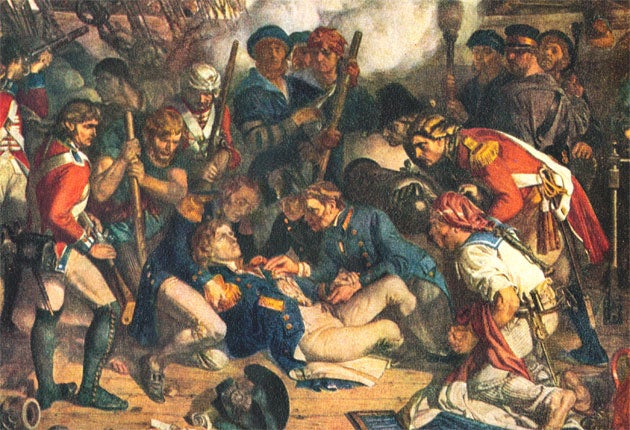
The true horror of life on board British fighting vessels in the 18th and 19th centuries has been depicted in a fascinating collection of 1,200 naval journals not seen for 200 years. They include details of the medical treatment given to Horatio Nelson.
Researchers at the National Archives in Kew have gathered personal accounts written by surgeons at sea, including the medical log from the Battle of Trafalgar. The journals also reveal some of the first scientific investigations into diseases like scurvy, the scourge of the sailor at the time.
The Independent has been given exclusive sight of the records before cataloguing is completed next year. Among the most historically significant are a handful of journals showing how surgeons nursed back to health the Royal Navy's most revered and successful admiral after he lost an arm fighting in the Canary Islands.
In July 1797 Nelson led a doomed assault on the Spanish island of Tenerife in which he was hit in the right arm by a musket ball shortly after stepping ashore. Bleeding heavily, he was taken back to HMS Theseus, where the injured limb was amputated. On 25 July the ship's surgeon, James Farquhar, wrote in his journal: "Compound fracture of the right arm by a musket ball passing thro a little above the elbow; an artery divided; the arm was immediately amputated."
It is claimed that within 30 minutes, Nelson was again issuing orders to his men. On 1 August Farquhar noted: "Admiral Nelson; amputated arm; continued getting well very fast. Stump looked well; no bad symptoms whatever occurred... The sore reduced to the size of a shilling in perfect good health, one of the ligatures not come away."
A year later Nelson was to win a famous victory against the French at the Battle of the Nile. But he was shot in the head by a French navy sniper. The surgeon's log of HMS Vanguard describes the treatment administered: "Wound on the forehead over the right eye, the cranium is bare for more than an inch, the wound three inches long. Discharged 1 September. The wound was perfectly healed on the first September but as the integuments were much enlarged, I applied (every night) a compress wet with a discutient embrocation for nearly a month which was of great service."
Yet in 1805 Horatio Nelson's dying moments at the Battle of Trafalgar were omitted from the naval journal of the Victory. Experts at the National Archives in Kew believe the omission was deliberate as Sir William Beatty, the surgeon who tended Nelson's mortal wounds, wanted to save the details for his own book, Authentic Narrative of the Death of Lord Nelson, published in 1807.
Many of the surgeons serving with the Royal Navy used their journals to record much more than a daily inventory of the illnesses and wounds of the ship's company. There are also illuminating watercolours of the flora and fauna and indigenous people that the surgeons encountered on the long voyages. Some of them include pictures of anthropomorphic monkeys and other creatures, recreated in fine detail.
Bruno Pappalardo, principal records specialist in maritime matters at the Archives, said: “The cataloguing of these journals, funded by the Wellcome Trust, will open up these previously neglected sources to a much wider audience helping us to understand past medical history and which could inform the future."
Some of the journals demonstrate how the Navy was struggling to combat the effects of scurvy. The surgeons fought hard to find new ways to alleviate the terrible effects of this disease. Some of the graphic drawings and annotations show the range of debilitating symptoms sailors suffered, including black, pustular skin.
There is also a surgeon's account of one of the first combined army and naval diving operations off Spithead in 1840 to raise the Royal George, which sank in 1782. The surgeon's principal interest is the illnesses suffered by the divers, but he has also provided a unique pictorial description of an early diving expedition.
However, it is the daily treatment of sailors which provide invaluable insights into the horrors of naval warfare at this time. One of the most gripping is contained in the log written by Robert Young on board HMS Ardent, which saw action at the Battle of Camperdown on 11 October 1797.
Young wrote: "I was employed in operating and dressing till near four in the morning, the action beginning about one in the afternoon. So great was my fatigue that I began several amputations, under a dread of sinking before I should have secured the blood vessels."
He complained: "Ninety wounded were brought down during the action, the whole cockpit deck, cabins wing berths, and part of the cable tier, together with my platform, and my preparation for dressing were covered with them. So that for a time, they were laid on each other at the foot of the ladder..."
It was this kind of medical skill and bravery under fire that gave British sailors a much greater chance of surviving their wounds than their French and Spanish adversaries.
Join our commenting forum
Join thought-provoking conversations, follow other Independent readers and see their replies
Comments