Will we ever learn just to be content?
We're stuck on a treadmill of envy, acquisition and dissatisfaction, says John Lanchester. Worse, developing nations are copying our unsustainable ways.
La ricchezza è una ragione tra due persone." "Richness is a relationship between two people." This observation, by the Italian economist Ferdinando Galiani, was first brought to my attention by James Buchan, and it seems to me that it is one of the truest things ever said about money. A lot of the discourse around money is very abstract: it's about numbers that are often so big that it is difficult for us to wrap our minds around them in any useful way. Most of us are never going to encounter a billion of anything visible, so our use for the concept of a billion is, in practice, limited. That goes for a lot of what we read on the financial pages of the newspapers – if we did read them, which, in practice, most of us don't.
That's why the idea that "la ricchezza è una ragione" hit me with such force. Richness is a relationship. As I've said, much of the discourse about money is in some sense abstract, i.e. it is self-referential and circular – people talking about money in terms of its effects within the world of money. When we think about it in the non-abstract, i.e. the effects of money in the wider world, the one idea we need to hold in our minds is that richness is a relationship. Richness, the idea of having plenty of money, is not an inherent state, nor is it an absolute state. Richness is about the amount of money you have compared with the people you see around you. It's about where you are in relation to others, and where they are in relation to you, and whether you can have the things you want and other people have.
Government poverty statistics reflect this fact. The Government says that they are poverty statistics, but the number they track, the number of the population who live below 60 per cent of the median income, is a measure not of absolute poverty but of inequality. And there is an increasing body of evidence to suggest that that's the right thing to be studying. Some of this evidence comes from the field of behavioural studies and specifically from a growing new area called "happiness studies" – you may laugh, but it's a growing field: the most popular and oversubscribed recent course at Harvard was happiness studies. One of the things we learn from this area is how fundamental envy is to our nature. People would rather earn 60 grand in an area where their neighbours earn 40, than earn 80 in an area where their neighbours earn a hundred.
Why? Well, I suspect the answer lies in another finding from behavioural psychology, to do with what is called loss aversion. Consider the following experiment, which has been repeated many times and in many subtly different flavours, but which always reaches the same finding. There are two different scenarios. I give you £100. Then, I say, "There's a choice. We can either toss a coin, and if you guess right, you keep the £100, but if you guess wrong, I take it away. Or the other option is, we don't toss a coin and you keep only £50." The point about this choice is that it is mathematically identical – there's statistically no difference between the two outcomes. In this event, people usually opt for the safe £50. In the second option, though, you say, "I'm going to toss a coin, and if you call it right, you win £100, but if you call wrong, you win nothing. Or you can just have £50." In that scenario, people choose to toss the coin. Again, that's significant because all four scenarios are mathematically identical. But we are hard-wired to see the prospect of loss completely differently from how we see the possibility of gain. In the jargon, we are loss-averse. In plain English, we don't like losing things.
What's this got to do with inequality? Well, I think that what happens is that when we see people who have things that we don't have, we experience it as a form of loss. It's as simple as that. People who have stuff, opportunities, material prosperity, that we don't have, make us feel bad. They make us feel that we are losing something.
The next question to ask is whether this matters, and if it does, whether there is anything we can do about it, or whether we should just accept our feeling about envy and inequality and loss as a fact of human nature, something to file along with the permanent truth that the most powerful feelings we have concerning money involve greed and fear. Maybe all we have to do is add another one: greed, fear and envy. We are a desiring species. We want. It goes very deep in us. Perhaps we should just accept that we want, and we particularly want what we can see that other people have but we don't.
Unfortunately, we can't do that, for two reasons. First, the incitement of envy is built into the mechanics of capitalism and advertising. We are made to want more and more, not just as an accidental feature of modern life but as a fundamental principle of the modern economy. It isn't just that advertising is central to the modern world and modern business and economics – though it is – but it's the plain truth that our prosperity is built on wanting new stuff, and buying new stuff, and selling new stuff to each other, and transporting new stuff, and inventing new stuff, and marketing new stuff, and thinking up entirely new kinds of stuff for people to want by inventing new desires that they don't yet know they have. We are the first people in history to live so surrounded by images that attempt to incite our desires, our appetites, our sense of a lack within ourselves; a lack which will be assuaged, an ache which will go away, if we can lay our hands only on that last, perfect, necessary, piece of stuff.
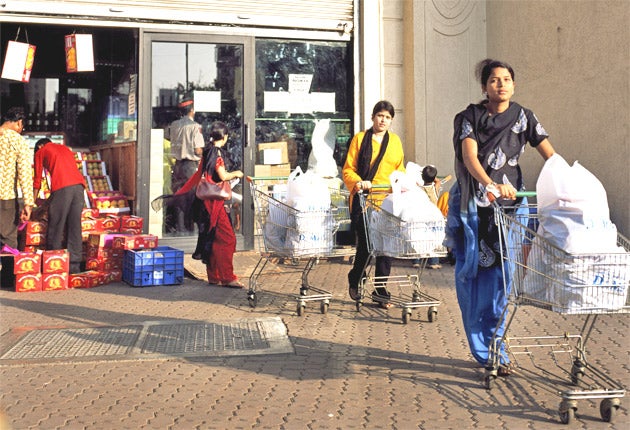
The trouble with this is not local, however. It is planetary. A system in which we all continually want more is not sustainable at our current levels of projected growth. When I say not sustainable, by the way, I'm not using a metaphor – "sustainable" is one of those words which is being hollowed out by overuse. I mean that we will run out of the resources to live like this. The economies of the developing world have many tens of millions of new consumers who live just as surrounded by images of the good life as we do – more so, perhaps. I've just got back from a visit to Madhya Pradesh, one of the poorest inland regions of India, one which gets very little tourism. We spent some time in Bhopal, which, let's face it, does not feature on many lists of must-visit hot spots. At least, that's how it seems from sleepy old England. But that's not how it seems in Bhopal. It is a booming city whose economy is roaring with the 8 per cent growth India is set to post this year, and where billboards selling stuff, touting stuff and advertising stuff completely dominate the urban landscape. It's an image that I don't think will ever leave me: right next to the site of the Union Carbide plant which killed 4,000 people in the gas leak of 1984 there is a huge advertising billboard touting the huge new residential development behind it. The name of the development: Elixir Greens. Elixir Greens is going to be a luxury residential development.
When you look at the developing world, you see hundreds of millions of people rising out of absolute poverty for the first time. These hundreds of millions of new consumers want an upper-middle-class First World lifestyle. That's what they see depicted on the billboards, that's what they see depicted in the television programmes they watch. They know what we have and they want it for themselves. Is the developed world going to say, "Sorry you can't have that life because we've already used it up. We've had our go and now the world has run out of resources, and you should just accept that limit to your aspirations"? Does that seem likely to be a satisfactory answer?
So now what? Well, I think we have a lot to learn from our relationship with food. No one could pretend that our modern Western interaction with food is uncomplicated, or even that it is particularly healthy or rational. We overeat, we undereat, we're obese, we're anorexic, we're obsessed; I imagine a significant number of people reading these words will have powerful negative feelings about what they eat and how much they eat and what they should be doing instead, every day of their lives. But that's only to be expected. Most of all the human beings who have ever lived have lived with a complete lack of certainty that they will have enough to eat. We are hard-wired to be obsessed with food; we are animals, and all animals are obsessed with food. It's just that we have to live out that obsession in the complicated ways forced on us by modern life, and in the face of a new problem, one that our ancestors didn't have: we know we will never go hungry unless we deliberately choose to do so. There are no natural limits to our appetites, so we have to learn limits. We have to learn when to stop.
That's what we in the developed world have to learn to do more generally. At the moment, we are stuck on what is called the "hedonic treadmill": as you have more and more, your idea of what it would be to be happy keeps receding just out of reach. It's always the next pay rise, the next purchase, the next place you move to or where you go on holiday, which will make you happy. We in the West can do something that no people in history have done: we can show the world that we know when we have enough. As the planet runs out of resources, due mainly to the fact that everyone on it wants to live an equivalent lifestyle to those of us in the West, this lesson would have the potential to offer a new model for how we should live. If the people who have everything are content to live with less, maybe the whole world will consider the virtues of knowing when to stop. We have no choice other than to learn this at some point, because the planet is not an all-you-can-eat buffet. It's going to run out.
We are either going to be saved from the problem of over-consumption by some magic technological fix, or we are going to face planetary crisis, or we are going to learn to consume less. We have to start thinking about when we have sufficient – sufficient money, sufficient stuff – and whether we really need the things we think we do, beyond what we already have. "La ricchezza è una ragione." We are richer and more fortunate than most of the people who have ever lived. We should look less at what our next-door neighbours have, and more at what the rest of the planet dreams of having. Then, we should try to learn to be content where we are. In a world running out of resources, the most important ethical and political and ecological idea can be summed up in one simple word: "enough".
John Lanchester will be delivering a sermon for the School of Life on 'Enough' this Sunday. www.theschooloflife.com
Join our commenting forum
Join thought-provoking conversations, follow other Independent readers and see their replies
Comments
Bookmark popover
Removed from bookmarks