British holidaymaker is 'beheaded by al-Qa'ida'
Tourist executed in Mali after British Government refuses to pay for his release
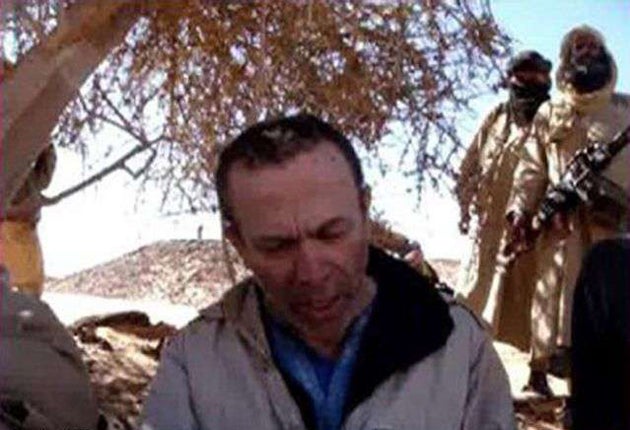
A British tourist held hostage for more than four months has been murdered in Mali after Britain refused to meet ransom demands from an Algerian terrorist group linked to al-Qa'ida.
Al-Qa'ida in the Maghreb claimed it had carried out its threat to kill Edwin Dyer – who was kidnapped in January in the border area between Mali and Niger – on Sunday after Britain failed to meet its demand to release a Jordanian militant reputed to be the European envoy of Osama bin Laden. Abu Qatada is being held in Britain pending extradition to his homeland.
But the killing appears to have followed a refusal by Britain to pay a ransom for Mr Dyer, who was taken with three other European tourists after attending a nomadic cultural festival on 22 January. Two of the four hostages were released in April, along with two Canadian diplomats taken in a separate incident, after a €5m (£4.3m) ransom was paid.
Mohamed Ben-Madani, the editor of the Maghreb Review, said the terror group wanted to show it "meant business" after its ransom demands were ignored. "They were more after money. They don't give a damn about Abu Qatada. They weren't prepared to release Mr Dyer for nothing and Britain said 'Release him, that's it.'"
There were unconfirmed reports from Mali yesterday that Mr Dyer had been beheaded. His death is expected to spark a debate over Britain's stance on ransom payments. Most countries publicly deny the payment of cash in return for hostages but many Western nations have done so through third parties, as the piracy crisis on the Horn of Africa has demonstrated.
"If they had made some kind of offer they could have saved his life," said Mr Ben-Madani. "The Germans paid, the Swiss paid, the Canadians paid."
Gordon Brown condemned the killing as a "barbaric act of terrorism" and took the opportunity to restate Britain's policy of not negotiating with – or paying ransoms to – terrorists. While offering his condolences, Mr Brown said: "This tragedy reinforces our commitment to confront terrorism. It strengthens our determination never to concede to the demands of terrorists."
In a statement posted on an Islamic website, the militants said: "The British captive was killed so that he, and with him the British state, may taste a tiny portion of what innocent Muslims taste every day at the hands of the Crusader and Jewish coalition."
Mr Dyer, a German speaker who worked in Austria, was seized with a Swiss couple, Werner Greine and Gabriella Burco, and a German woman, Marianne Petzold, as they were driving back from the Anderamboukane festival, a showcase for Tuareg culture.
A local cook who was part of the tour group and was later found near the scene said he had suffered a "mock execution" during the attack, where a bullet was fired within inches of his skull.
The two women were released along with a UN envoy, Bob Fowler, and his Canadian colleague, Louis Guay, who had been taken hostage in Niger in December last year.
Concern is mounting for Mr Greine, who is still being held. There will be intense pressure on Swiss authorities to meet any ransom demands being made through Malian intermediaries.
The self-styled al-Qa'ida in the Maghreb is an outgrowth of Algeria's brutal civil war and has in recent years moved into kidnapping operations and strayed over the borders into Morocco and further south into Mali, Niger and Mauritania. Until now, the kidnappings had remained a commercial enterprise with no hostage killings. In fact the group's ideological commitment to the global jihad espoused by al-Qa'ida has been unclear and some analysts have called the link-up a "rebranding exercise" designed to reinvigorate a flagging nationalist movement.
Algeria descended into bitter fighting in 1992 after the military – with explicit US and French approval – decided to overturn an election won decisively by an Islamist party. The war cost the lives of at least 150,000 people and was marked by atrocities on both sides. The fighting continued until an amnesty was offered in 1999, since which the Algerian government has pursued a dual policy of amnesty and hardline military action against remaining rebels.
This approach drove a few hundred surviving Islamic holdouts led by the Salafist Group for Preaching and Combat deep into the Sahara, where in early 2007 they declared their allegiance to Bin Laden. However, al-Qa'ida in the Maghreb has been an amorphous group operating in an impoverished region where claiming connection to the terror network can be a quick route to recognition and credibility.
The analyst Mark McGovern, from Yale University, said the murder, if confirmed, would "mark a serious turn for the worse" as it echoed similar actions taken by militants in Iraq and Afghanistan. He said that it remains unclear whether the Maghreb offshoot is just "borrowing the name" and what the group's depth of ideology is.
The kidnappings occurred in a region that is already dominated by gangs trafficking everything from people and drugs to mobile phones and pasta.
Representatives of the Tuareg community have strongly denied reports that they kidnapped the Europeans before selling them on to terrorists. The nomads are partly dependent on tourist income which is likely to be devastated by the hostage taking and the subsequent death of the Briton. "These people live on the edge of survival and calculate their economic interest very carefully," said Mr McGovern.
Intelligence reports suggest it is more likely the Europeans were taken by one of the trafficking gangs and then auctioned to the highest bidder.
Is this group run by Bin Laden? And why did it kill Edwin Dyer?
Q. Who are al-Qa'ida in the Maghreb and what is their connection with the original grouping?
A. The group, thought to number about 1,000 fighters, borrowed the al-Qa'ida name in early 2007, "rebranding" nationalist Islamic insurgents who were fighting the Algerian government. The GSPC, as it was previously known, was itself a splinter of the feared Armed Islamic Group or GIA, which refused to lay down arms after a 1999 amnesty. The new group labelled itself "fundamentalist" or Salafist but by the end of 2006 it was running out of fighters and weapons and had been pushed into the southern deserts of Algeria. The alignment with al-Qa'ida has seen a resurgence. In addition to kidnappings, which have until now been a commercial activity to fund weapons and recruitment, it has also undertaken suicide bombings.
Q. Does the group work for Osama Bin Laden or have close relations with him?
A. While its commanders are unlikely to take direct orders from the main al-Qa'ida leadership, their activities have been praised by Bin Laden's second-in-command, the Egyptian Ayman al-Zawahiri. Many GSPC fighters were trained and radicalised in Afghanistan and Iraq and intelligence sources fear that they have now been persuaded to take a more global view. Paris is investigating reported cells of the group in France and it is feared that the north African group is turning the Algerian mountains into a terror training camp.
Q. Why was Edwin Dyer executed when his fellow hostages were released?
A. Mr Dyer's murder followed the release more than a month ago of two European tourists captured with him and two Canadians taken last December. Regional experts say a ransom totalling €5m (£4.3m) was paid for their freedom. While the UK has spoken through intermediaries with Mr Dyer's captors, it has reportedly refused all of the group's demands, including releasing prisoners and paying a ransom demand. The captors appear to have killed the Briton because they weren't getting what they wanted.
Join our commenting forum
Join thought-provoking conversations, follow other Independent readers and see their replies
Comments
Bookmark popover
Removed from bookmarks