Demand for illegal ivory soars in booming China
Twenty years after a worldwide ban, there's a new black-market trade in elephant tusks from Africa
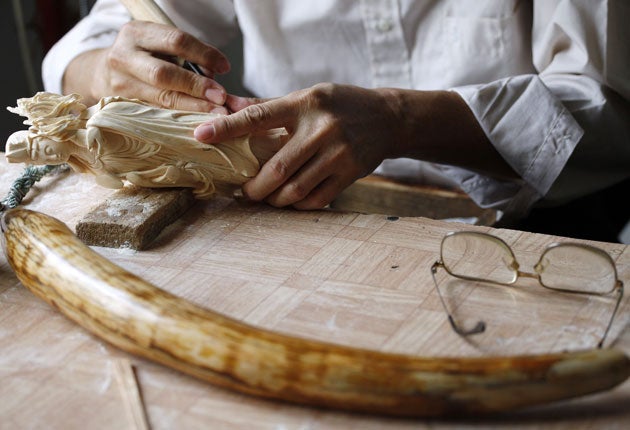
Tucked into a grimy building in Guangzhou, a small band of Chinese master carvers chip away at ivory tusks with chisels, fashioning them into the sorts of intricate carvings once prized by the Chinese emperors. A passion for ornaments such as these is what helped decimate African and Asian elephant populations until the United Nations Convention on International Trade in Endangered Species (Cites) banned the ivory trade two decades ago, in 1989. Today, China's economic rise, along with a seemingly insatiable appetite for status symbols among its nouveaux-riches, has spurred the demand for African ivory.
Officials who regulate the domestic ivory trade in China said that there hasn't been a conspicuous increase in ivory consumption as tight laws and controls restrict ivory sales and manufacturing to some 130 addresses nationwide. Yet this year alone, an extra 37 stores were approved as new, and official, ivory retail outlets.
There have also been tell-tale signs on the ground. In Guangzhou's antiques market, numerous stalls were openly selling uncertified ivory, from trinkets to large carved tusks. "I can get you as much as you like," said one dealer, surnamed Wu, who was asking 8,000 yuan (£700) for a small carved ivory Buddha's head and a similar price for an elaborate fan. "Come back later this afternoon," she added.
At another stall, a small painted tusk was prominently displayed in a bustling alleyway. "Guangzhou has especially close economic ties with Africa, and there are tens of thousands of traders there, so we cannot discount the possibility that they are bringing ivory in," said Wan Ziming, the director of law enforcement and training in China for Cites. "Guangzhou has become a hub for the smuggling of ivory," he said.
Professor Xu Hongfa, the China director of Traffic, the wildlife trade monitoring network, says enforcement needs to improve across China, as there is evidence of contraband ivory seeping across China to places as far afield as Tibet. A Traffic researcher currently carrying out field investigations throughout China, who requested anonymity because of the sensitive nature of her work, said the illegal trade is now rife, with contraband ivory at least a third cheaper than in official stores.
In remote pockets of Africa, such as Kenya's Tsavo East region, where giraffes wander lazily across tarmac freshly laid by Chinese labourers, and in the teeming market towns along the banks of the Nile in Sudan, where Chinese barter and buy ivory openly, the Chinese imprint is conspicuous and growing. "The Chinese are all over Africa and are buying up ivory, worked and raw," said Esmond Martin, a conservationist who has closely tracked Chinese involvement in the black-market ivory trade. "The last time I was in Khartoum, I found that about 75 per cent of all the ivory being sold was bought by Chinese people," he said.
A 2007 report by Cites stated that China faced a "major challenge", because it continues to be the "most important country globally as a destination for illicit ivory", exacerbated in part by its spreading influence on and ties in Africa. Chinese nationals have been arrested and convicted for ivory smuggling in Africa, and organised crime gangs are also involved in bringing large quantities of illicit ivory into China, according to the London-based Environmental Investigation Agency (EIA).
In a controversial attempt to stem illegal poaching, Cites allowed a 62-tonne batch of elephant tusks to be imported legally into China last year. At the time, Allan Thornton, of the EIA, expressed concern that the sale would fuel a massive appetite for ivory there. "In a country of 1.3 billion people, demand for ivory from just a fraction of 1 per cent of the population is colossal," he said.
While most countries enforce the ban on the trade in ivory, in recent years Japan and now China have been permitted to buy non-poached ivory from several African countries in a move aimed at raising money for wildlife conservation, and to smother demand for poached ivory with a steady flow of cheaper tusks. "If the demand is supplied by legal-origin ivory, then that should begin to close the doors for the criminals," said John Sellar, a senior enforcement officer for Cites in Geneva.
He added that the 20-year ivory ban had helped to stabilise overall elephant numbers, with only scattered local populations under any real serious threat from poachers in countries such as Chad and the Democratic Republic of Congo. While only around 4,000 wild tigers remain worldwide, he noted, in Botswana alone there are more than 130,000 wild elephants. "The elephant as a species is no way in danger," he added.
Join our commenting forum
Join thought-provoking conversations, follow other Independent readers and see their replies
Comments
Bookmark popover
Removed from bookmarks