Disillusioned Libyan rebels flee and abandon their gains
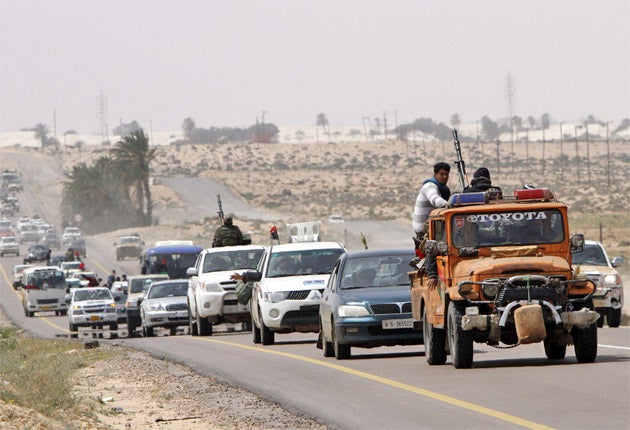
The rebels in Libya were in terrified retreat yesterday, enmeshed in recriminations against their own leadership and accusing officials dealing with the international community of misrepresenting the reality on the ground.
After 12 nights of Western military intervention that had been seen as irreversibly changing the course of this conflict, the revolutionary forces had been pushed back by yesterday evening to the last city before Benghazi, the capital of the opposition provisional government, seemingly with their confidence drained and showing little will to continue the fight.
The collapse by the revolutionary forces in the space of 48 hours was spectacular. On Monday they had been within 40 miles of Sirte, the birthplace of Muammar Gaddafi, already celebrating the capture of the loyalist stronghold and key staging post to the capital, Tripoli. They are now 100 miles back along the coast in Ajdabiya, one of two important oil ports in the area. The other, Brega, was left undefended as the rebels fled through it without stopping.
As frustration and bitterness mounted, many of the fighters lashed out at their military and political hierarchy. "Where is Khalifa Heftar? Where is Fathar Yunis?" demanded Captain Ahmed Abdul-Karem. "I have been at the front for the last two months, I have never seen them. Where are the weapons and trained men they promised us?"
Generals Yunis and Heftar are said to be back in Benghazi in charge of the grand strategy for the military campaign. Criticism was also levelled at others at this week's London conference on Libya. "I saw the people who had gone to England on television, in their nice suits, talking about how they were leading the war so successfully," said Ali Slimani with a dismissive wave of his hands. "They were never here. The foreign governments should come and see for themselves what is going on."
Ominously, Gaddafi's forces were continuing to push forward on the eastern front in an organised and deliberate pattern, despite two weeks of attacks by the world's most powerful military forces. An illustration of this resilience could be seen yesterday afternoon outside the town of Al Aghayla, where regime troops pursuing rebels were pounded by warplanes from the international coalition with at least eight missile strikes.
The revolutionary forces, known as the Shabaab, responded with prolonged cheering and cries of "Allah hu Akhbar", some charged back up the road in their cars and pick-up trucks. But soon they were fleeing again, as the loyalists, instead of melting away, fanned out across the desert to outflank their quarry.
The conduct of those who should be allies nearer home is also causing problems for the rebels. At some towns and villages, residents turned against them and fought alongside loyalist troops.
Awad Abu Tawib was shot in the leg in Bin Jawad yesterday. "It came from one of the houses. We know the Gaddafi group were not there and it was someone who lived there," he said. "The houses were searched and some people have been arrested."
The opposition maintains that these men had been paid by the regime to take up arms. But it is also the case that allegiances vary. Some local resentment has also been fuelled by the rebels' hunt for "fifth columnists" supposedly colluding with the Gaddafi forces. In Bin Jawad, The Independent witnessed around 220 men, either members of the Hosseini clan or people associated with them, being dragged out of their homes, beaten up and taken away. The "arrests" took place as the rebels traded fire at the gates of the town with regime troops. Residents, already frightened, saw doors being kicked down by Shabaab fighters who also fired at windows where they claimed to have seen snipers.
In Ajdabiya, others were fearful of being caught up. Qadir Fikri's family of five were among hundreds leaving the city. "This is the second time we are doing this," he said. "We went to stay with relations in Al Bayda when the Gaddafi men came in the last time and we had only got back two days ago... We thought we can settle back, but now we are having to go away again."
Join our commenting forum
Join thought-provoking conversations, follow other Independent readers and see their replies
Comments