Divided and disorganised, Libyan rebel military turn on Nato allies
Feuding leadership of revolutionary forces fails to capitalise on coalition air strikes
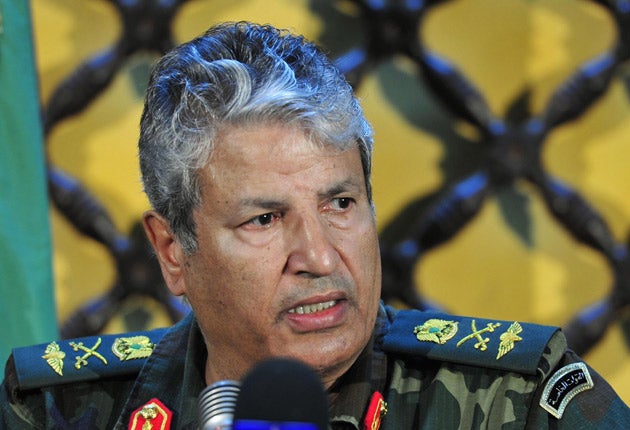
General Abdel Fattah Younes was scathing in his condemnation of Nato. "They have disappointed us. Nato has become our problem. Either Nato does its work properly or we will ask the Security Council to suspend its work."
That was on Tuesday night at a packed press conference in Benghazi. Yesterday General Younes was on one of his rare visits to the frontline, with an escort of Western security guards as the row over his remarks rumbled on. The head of the rebel forces apparently does not like travelling through risky areas without his recently acquired foreign protection team.
The relationship between the allies in Libya's civil war is currently a fraught one. The opposition government accuses their US and European sponsors of not doing enough, yet the evidence on the ground suggests the rebels are capable of doing little against the forces of Muammar Gaddafi without the help of the international coalition.
Behind the recriminations over the performance of the coalition lies the fact that Libya's opposition administration is itself deeply divided and engaged in internecine feuding involving leading personnel.
General Younes has sought to take on the mantle of the nationalist commander who is prepared to make a stand against powerful international states. But the man who referred to Colonel Gaddafi as his personal friend and served as his interior minister has been viewed with suspicion by many in the protest movement.
General Younes has been involved in a power struggle, which he appeared at one stage to have won, against Khalifa Heftar, who had cut his links with the regime earlier and recently returned from exile in America. The former general became the head of the rebel military, by, he claimed, popular acclaim, while his critics maintained it was actually self-appointment.
Following the disastrous performance of the rebel fighters, who had continued to lose ground despite Western air strikes destroying much of the regime's armour and artillery on the eastern front, a crisis meeting held in the rebel capital, Benghazi, descended into accusations and insults.
At the end of the heated session General Heftar was supposedly removed from his post. But he has apparently refused to leave and continues, he says, to be in charge, carrying out his own very occasional visits to the shifting battlefront.
According to officials, there is little liaison between General Younes and General Heftar, the latter saying he reports directly to Omar al-Hariri, the rebels' defence minister. However Mr al-Hariri, a former political prisoner, is said to have a limited grasp of military matters and, say officials, is largely ignored by both heads of the rebel army.
The resultant lack of a chain of command and co-ordination was plain yesterday even as General Younes was carrying out his tour in a Japanese pick-up truck with Western guards following close behind in another vehicle.
The revolutionary forces, an assorted mixture of volunteer fighters, known as the Shabaab, and defected military personnel, had retreated around 25km from their previous position outside the oil port of Brega, after a barrage of artillery and mortar rounds from the Gaddafi troops.Captain Suleiman Jawad, a former gunner, involved in a losing struggle to keep the Shabaab, some with makeshift weaponry, others unarmed, from the new frontline acknowledged that he did not know who the commander was. "I have not seen General Younes today, but General Heftar was here a few days ago. I have also seen them together, so it is difficult to know who is more senior.
"But our main problem is the Shabaab. There are a few who can fight, but the rest of them spread panic and get in the way. But they have no one in charge, so what can you do?"
Captain Jawad was cautious about backing General Younes's attacks on Nato. "We have not seen many air strikes in the last few days," he said. "But they are the only things we have to protect them from the Gaddafi soldiers. We are helpless without them."
A little later, black plumes of smoke rose near Brega following the air strikes. Abdullah Yassin Ali, a 23-year-old Shabaab fighter was not satisfied. "I think they only dropped two bombs, that is not enough." He looked surprised when asked why he and his comrades were not going forward to engage the enemy. "Because it is dangerous, we might get shot. It is for Nato to clear the Gaddafi men," he explained.
Nato officials insisted yesterday that action by its warplanes have continued although difficulties have been created by regime forces moving themselves and their armament into centres of population. But, said spokesperson Oana Lungescu in Brussels, "the facts speak for themselves. The tempo of operations has continued unabated."
The French Foreign Minister, Alain Juppé, conceded that the position of rebel-held cities – under daily shelling and sniper fire from the army – was intolerable but said there was little more which could be done immediately. "We've formally requested that there be no collateral damage for the civilian population," he said. "That obviously makes operations more difficult."
* Khaled Kaim, Libya's foreign minister, accused "British warplanes" of killing three security guards in an attack last night on an oilfield in in the Sirte region. He told reporters late last night: "British warplanes have attacked Sarir oilfield and this resulted in the death of three of our oilfield guards; other employees were also injured." He claimed that the attack which also caused "material damage" was against international law, not covered by the UN resolution which sanctioned western militarfy intervention and was "aggression against the infrastructure of the oil industry in Libya.
Asked it was known that the warplanes were British, Mr Kaim said he would refer the question to the military and give an answer when he had one.
Join our commenting forum
Join thought-provoking conversations, follow other Independent readers and see their replies
Comments
Bookmark popover
Removed from bookmarks