Ethiopian PM denies aid was diverted
Stung by BBC allegations that Live Aid money was spent on weapons, Meles Zenawi tells Paul Vallely that the report is based on lies
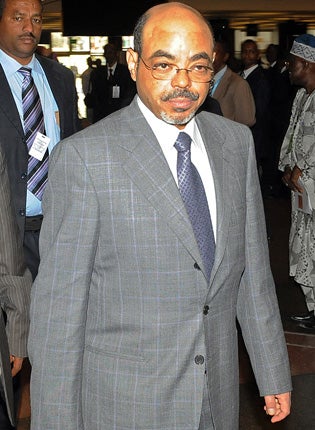
The prime minister of Ethiopia has stepped into the row between Sir Bob Geldof and the BBC which has claimed that 95 per cent of the $100m aid raised, by Live Aid and others, to fight famine in rebel-held northern Ethiopia in 1985 was diverted to be spent on weapons.
Meles Zenawi, who was one of the leaders of the rebel group the Tigrean People's Liberation Front, is now the country's Prime Minister. In an interview with The Independent he said that the BBC had fallen for lies put out by his political opponents on the eve of a general election in Addis Ababa next month.
"The notion that a decision was taken to spend 95 per cent of aid on the military is a complete lie," he said. "Anyone who knows anything about the situation in Tigray in 1984-85 would know that. The logic of that would be just ridiculous."
The rebels were then fighting the army of the Mengistu dictatorship whose troops were mainly conscripts who often ran away and abandoned their weapons when fighting began. "We captured large amounts of guns and tanks. We did not need to buy arms. What we needed was food. So why would we sell food to buy arms?" Mr Meles said.
"We needed food because by 84-85 we had an extensive liberated area under our control. But it was terribly hit by famine. The danger was that the population, on whom we depended, would leave the liberated area and go over to the government area in search of food. So we needed the food to keep our people in our area.
"There would have been no military logic in selling food to buy guns. It would have been completely suicidal to starve our own people to buy guns. We would have had no movement if we had had no people. When not enough food was available we encouraged hundreds of thousands of people to make the long trek across the border to Sudan."
The BBC yesterday insisted it was standing by its story. It issued a statement that said: "Aregawi Berhe, the TPLF military commander in the mid-1980s, told the programme that the relief society connected to the TPLF received about $100m and that a decision was made that only 5 per cent should be spent on helping famine victims. The balance, he said, was used to fund the TPLF and a linked political party. The programme made clear that the assertion was made by a once high-ranking TPLF figure, now in exile."
The Ethiopian Prime Minister offered some telling detail on timing. "When the planting season arrived we encouraged all the able-bodied to go back to plant. That was the summer of 1985. That was when the cross-border feeding operation began in earnest. The only significant amounts of aid going across the border from Sudan were in that period."
Significantly, that was a year after Aregawi Berhe had left the area. It was also a year after a photograph was taken showing a Christian Aid worker, Max Peberdy, buying grain from the second rebel quoted by the BBC, Gebremedhin Araya, who claimed he had duped Christian Aid by selling them sacks full of sand. "Gebremedhin Araya was not the head of finance of the TPLF, as has been claimed," Mr Meles said. "He was in no leadership position. He was just a paramedic." Christian Aid yesterday disclosed that Mr Peberdy had also left the area a year earlier.
Five other leading aid agencies have criticised the BBC report. Oxfam, Save the Children and Christian Aid were yesterday drawing up a joint complaint. Band Aid's lawyers were preparing an official complaint for the broadcasting standards watchdog Ofcom.
Sir Brian Barder, a former British ambassador to Ethiopia, stated: "The erroneous impression given by the BBC risks doing great damage to future international disaster relief programmes."
Join our commenting forum
Join thought-provoking conversations, follow other Independent readers and see their replies
Comments
Bookmark popover
Removed from bookmarks