Fears of new civil war as Sudanese town razed
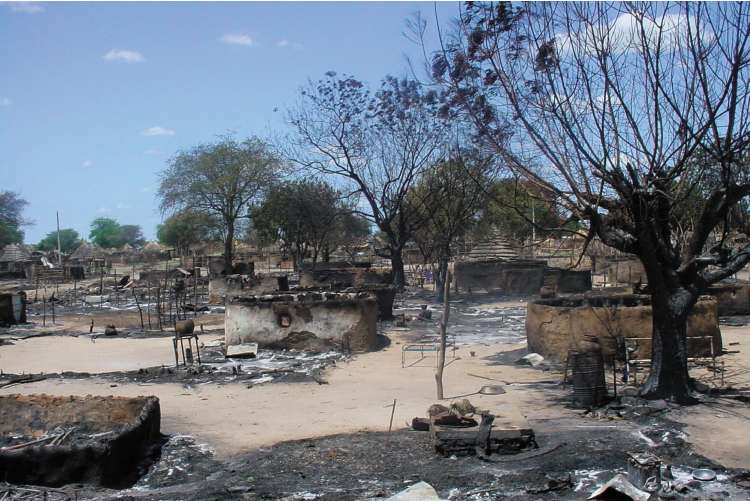
Abyei, in the heart of Sudan, was a town of more than 30,000 people. It had a school and a hospital, a marketplace and a bar.
It doesn't exist any more. Almost everything has been burnt to the ground. What remains is devastation.
Days after the fighting took place, plumes of smoke rise into the afternoon sky as fires still burn. The charred remains of metal bed frames surrounded by neat squares of black and grey ash indicate where a row of houses once stood. Clay pots lie broken in the dirt. Children's clothes, some burnt, are scattered outside a still-smouldering mud hut.
Bicycle tyres, upturned tables, a wicker basket that carried grain – all burnt. Outside what was once a hut someone had been cooking. The metal pot stands untouched on a still-burning fire. A pile of onions, peeled, lie in the sand alongside it.
A putrid smell drifts through the air – burnt human remains, decaying in the afternoon sun. The Red Cross is trying to negotiate access to pick them up, but days have passed and the dead are still there. No one knows yet how many people were killed.
A peace deal signed in 2005 brought an end to Sudan's 20-year civil war – a conflict between the Khartoum government and rebels in the south, which claimed the lives of two million people. Regional analysts now fear that the razing of Abyei by – according to witnesses – forces allied to Sudan's President, Omar al-Bashir, will cause the peace agreement to unravel. Analysts warn of a new civil war across Sudan that would destroy chances of peace in Darfur and suck in many of Sudan's nine neighbours to the conflict.
Abyei had been one of the most contested regions in the war, an area which both sides claimed as their own. In the past two years, the majority of Abyei's population had returned. They lived under the protection of the United Nations. More than 300 troops are based here, with tanks, guns, and a mandate to monitor the peace deal between north and south. But President Bashir's ruling party, with more than one eye on the large oil reserves in the region around Abyei, has refused to accept the decision of an independent commission giving the area's residents the option of joining the south.
The UN's top official in Sudan, Ashraf Qazi, warned of an escalation of violence in other disputed regions across central Sudan. "This could easily spread to other areas and threaten the peace deal," he said.
Abyei's residents may have fled, but it is not a ghost town just yet. Some of the men who burnt it to the ground are now sifting through the wreckage for items to loot. At the market place a bus is loaded up with pots and pans, bicycles and mattresses. Seeing the UN peacekeepers make a rare foray out of their base, the men, some wearing Sudanese armed forces uniforms, aim their guns at the tanks.
"If the peace agreement falls apart all hopes for peace in Darfur go out the window," said David Mozersky of the International Crisis Group. "There will be a much broader and more devastating civil war in Sudan with deadly consequences for the country and the region at large."
For those who ran from Abyei the immediate concern is survival. Upwards of 90,000 people from the town and its surrounding areas have fled in fear. A UN aid operation has been hampered by the Sudanese government. A few days ago, as food was being distributed to several thousand people, a government Antonov circled above six times sending terrified refugees running for cover.
Join our commenting forum
Join thought-provoking conversations, follow other Independent readers and see their replies
Comments