From Arab Spring to elections: Tunisia steps into a new era
The previously banned Islamist party, Al Nahda, is leading the opinion polls and is pitching a moderate, pluralist agenda
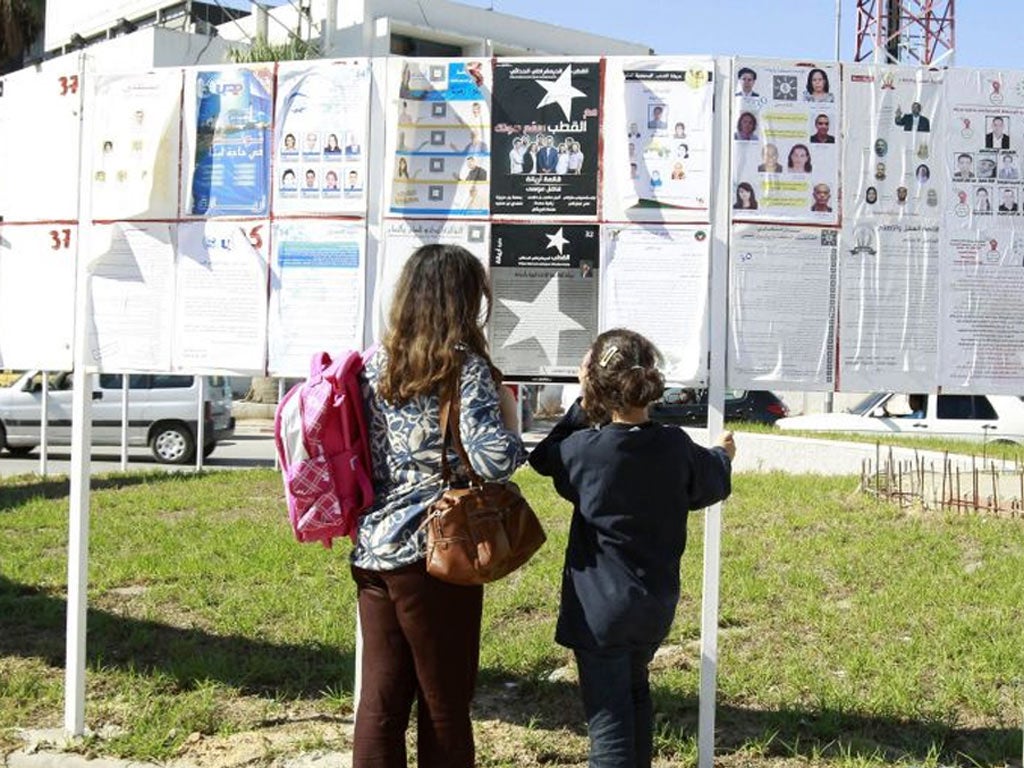
As she browses a wall plastered with photos of election candidates, Ameni, a 21-year-old student at Carthage University in Tunis, is preparing to take on a new responsibility. "It's a major turning point," she says. "I feel like a real citizen for the first time."
For Ameni and more than 10 million other Tunisians, the vote in elections this Sunday is their first experience of democratic election. Decades of despotic rule ended in January this year when Tunisia's revolution brought down President Zine el Abidine Ben Ali. This small North African country sparked a string of revolutions in the Middle East – and now it is the first to put democracy to the test at the polling booth.
"I never voted. I never imagined that I would," says 62-year-old Mohamad Ali Mahfoudh, a magazine proof-reader in Tunis. "Before, there was no point [voting] as the elections were faked."
Like others, Mr Mahfoudh takes his time to survey the campaign posters along Avenue Habib Bourguiba – Tunisia's central artery, named after the nation's first president after independence from French rule. The street is itself a collage of recent history. At its central square, a giant clock monument that once commemorated 7 November 1987, when Ben Ali seized power, has now been renamed to honour 14 January, the day of his fall. To one side, barbed wire, army tanks and riot police protect the loathed interior ministry building – home to the state police whose brutal repression helped trigger the revolution. No one has yet been put on trial after about 300 pro-democracy protesters were killed in the January uprising. Underneath lies what locals say is a vast underground prison that once held hundreds of political prisoners.
Tunisians face a choice of more than 100 new political parties, and about 11,000 candidates are vying for 217 seats. The winners will form an assembly to write the county's new constitution over the next year and appoint a transitional government.
Tunisia's previously banned Islamist party, Al Nahda (renaissance), is leading the opinion polls with 25 per cent of the vote. Better organised and funded than its rivals, the party is pitching a moderate, pluralist agenda, but liberal and secular parties worry that it will impose religious restrictions on a nation proud of its socially liberal society and the most progressive women's rights in the region.
Ameni says she is thinking of voting for the party but is put off by possible future alliances between Al Nahda, whose moderate politics she likes, and the rigidly conservative Salafists.
Other parties include the Progressive Democratic Party (PDP), an established secular party with about 16 per cent support; Ettakol, the Democratic Forum for Labour and Liberties, a centre-left party founded in 1984 and now level with the PDP; and the Congress Party for the Republic, another centre-left party with a civil liberties platform and 8 per cent support.
Fears remain that the elections may still not be genuinely free, despite the presence of 10,000 observers. "There will be no fraud inside the polling stations," says Alaeddine Saidi, a 40-year-old economics professor in Tunis. "But there is manipulation and attempts to bribe and buy influence outside."
Successful elections could dispel Western suspicions that Arabs are immune to democracy and inspire neighbouring pro-democracy movements. For Tunisia, says Mr Mahfoudh, "it's definitely going to be better than it was."
Join our commenting forum
Join thought-provoking conversations, follow other Independent readers and see their replies
Comments
Bookmark popover
Removed from bookmarks