'Gaddafi cannot hurt his people any longer'
Special Report: Kim Sengupta sees the body of the Libyan dictator
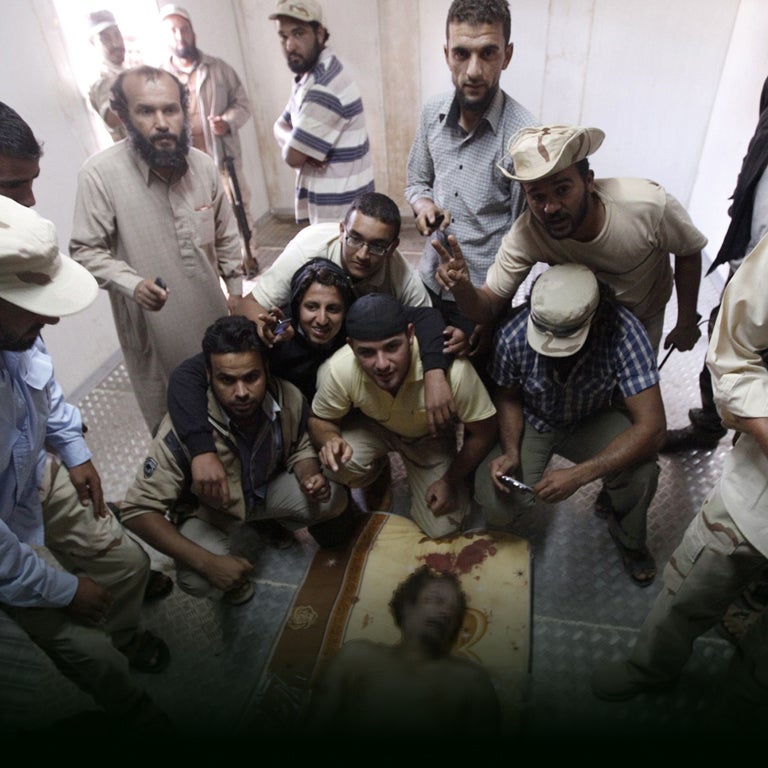
The blood had been washed off and the faces, eyes shut, were in repose. But the terrible wounds of the last violent moments were left uncovered by the shrouds of white cloth that had been hastily thrown over them. The bodies were on stretchers, Muammar Gaddafi in a temporary military barracks, Mutassim Gaddafi in a container.
These were temporary resting places for the former dictator and his son. After being brought back to Misrata from Sirte, the scene of the killings, the corpses had been moved from place to place – at one point to the home of a former rebel official and then to a meat warehouse. Officials of the new government said this was to prevent the residents of this city, who had suffered a long and bloody siege at the hands of the regime, from venting their anger on their dead enemies.
But it was as if no one wanted responsibility for disposing of these grisly symbols of the revolution's triumph after such a bitter civil war. Some of the country's rulers talked about handing them over to Gaddafi's tribe for burial. Others were adamant that a shrine should not be created and the best course of action would be a burial at sea.
Looking down at the body of Colonel Gaddafi, Firuz al-Maghri, a 55-year-old schoolteacher who had been allowed into the barracks by a friend in the opposition militia, shook his head as he recalled a brother and a cousin who had died in Tripoli's Abu Salim prison, a place of fear and despair. "Twelve hundred prisoners were murdered there," he said. "It is difficult for outsiders to understand, but he was responsible for so many lives lost, families who never found out what happened to those who disappeared. We feared him, I was afraid. But seeing him like this...."
Captain Rahim Abu-Bakr, an engineer who became a fighter, patted Mr Maghri's shoulder. "It does not matter," he said. "He cannot hurt people any longer. What happened at the end to him and his son was bound to happen. But this was a bad death. I do not like being here."
Colonel Gaddafi appeared to have been shot in the head, the bullet wound clearly visible under his previously curly hair for which he was famous– it now lay lank. Mutassim had injuries to his chest and stomach. But exactly what happened when the final reckoning came at Sirte remains unclear.
Libya's new government, the National Transitional Council, has declared that tomorrow will be National Liberation Day to commemorate the departure of Colonel Gaddafi. But no one really believes the account given by Mahmoud Jibril, the Prime Minister, that Colonel Gaddafi was killed when loyalist forces made a last-ditch attempt to rescue him. "He was already under arrest and he was hit in the crossfire," Mr Jibril said.
For many of the rebels at Sirte, it had been another day of frustration in the long and grinding battle for Gaddafi's birthplace, with the last pockets of loyalist fighters offering obdurate resistance. What was somewhat unusual were prolonged and fierce Nato air strikes, something that had become less frequent with the opposition's victory. They were French warplanes hitting a convoy of vehicles leaving Sirte at high speed. It had become the policy of Nato not to attack retreating regime soldiers because they did not pose any obvious danger to civilians and to avoid unnecessary bloodletting – and facilitate reconciliation.
But the attacks had taken place after the interception of messages by Western intelligence, suggesting high levels of remnants of the regime were on the move. Eleven vehicles were destroyed and the rest split into groups. But these, too, were hunted down from the air and a few, including the one carrying Colonel Gaddafi, returned to the outskirts of Sirte.
Colonel Gaddafi and a handful of his men then abandoned their vehicles and crawled into two drainage pipes. The rebels chased the fugitives, but say they were still unaware of who they were. Then, a little later, a man ran out waving a piece of white rag. "My master is here, he has been injured, it is Muammar Gaddafi, Muammar Gaddafi," the man apparently said. The soldier, a member of the Leader Guard, was dragged away.
Those there at the time describe a sense of astonishment among the rebel fighters when they discovered that the figure emerging from a ditch with a pistol in hand, but looking cowed, was indeed Colonel Gaddafi. This turned to elation, mocking of the former master of Libya – then vicious rage. "I don't think anyone thought he would be there, we all thought that he would be in the south, or maybe across in Niger or Algeria. We were as shocked as he was at first," said Abdullah Hakim Husseini, who had taken part in the brutal investing of Sirte from the start. "We were so happy when we knew it was him. I thought, 'at last, it's all over'."
Because there had been little expectation of catching the main prize, there was no procedure in place for what to do with him. Mr Husseini said some of the officers tried to call headquarters in Tripoli and Misrata. But the rebels, an egalitarian bunch with little respect for rank, pushed them aside.
Mr Husseini said: "OK for sure, he was being beaten, kicked, with rifle butts, boots. He looked confused and afraid, he was saying 'help me, help me', but his voice was really strained, he was croaking. A few of us were around him, we thought we should get him somewhere we could question him about the others. But he was then taken away in a wave of people and then there were shots."
Other reports described him being told as he was hit: "This is for Misrata, you dog." Colonel Gaddafi replied: "Do you know right from wrong?"
Join our commenting forum
Join thought-provoking conversations, follow other Independent readers and see their replies
Comments
Bookmark popover
Removed from bookmarks