Gaddafi's forty years in power celebrated with a 'gallery of grotesques'
War crimes suspect and notorious Somali pirate turn out for anniversary party
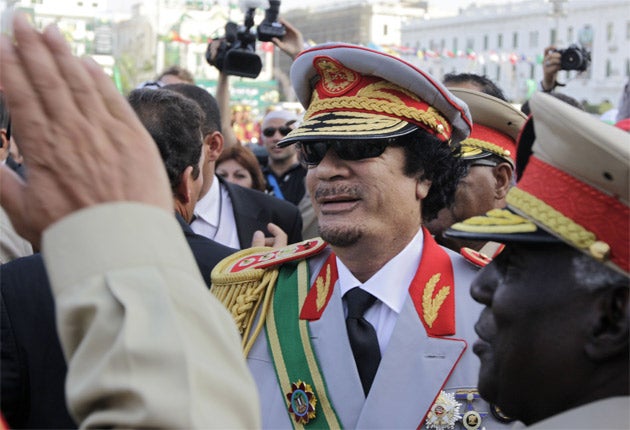
The celebrations marking Colonel Gaddafi's 40th anniversary as Libya's dictator lit up the Tripoli sky last night as a number of international pariahs, described by one diplomat as a "gallery of grotesques", gathered to enjoy a lavish parade, dance spectacles and fighter jets streaking overhead.
The celebration was meant to be the crowning act in Gaddafi's rehabilitation on the international stage, but the Libyan leader's respectability, already undermined by the controversy raging over the release of the only convicted Lockerbie bomber, was further eroded by accusations that a notorious Somali pirate leader was among the VIPs in attendance.
Mohammed Abdi Afweyne, a confessed leader of one of the largest pirate gangs that has been terrorising shipping off the Horn of Africa, has been in Tripoli since Saturday, according to sources in Somalia.
Government sources refused to confirm or deny the presence of Afweyne, the leader of a gang of hijackers that seized control of the MV Faina, a Ukrainian cargo ship loaded with tanks and heavy weapons. Reports also suggest that Afweyne had met with senior Libyan officials.
Zimbabwe's President Robert Mugabe and Omar al-Bashir, the Sudanese ruler who is indicted for war crimes in Darfur, were among those enjoying the party which was expected to go on until dawn.
The only European leader to accept an invitation to the opening of the week-long extravaganza marking the Libyan leader's 40 years in power was the Maltese President George Abela. France and Italy were represented at ministerial level while Britain attempted to distance itself by sending an embassy chargé d'affaires, Mark Matthews. The British Government has been deeply embarrassed by repeated accusations that it traded the release of the convicted Lockerbie bomber in return for Libyan oil and gas. Britain's ambassador to Libya, Vincent Fean, took the opportunity to visit Malta instead of staying for the party, while in private British diplomats were said to be deeply concerned with the content of last night's show.
As dozens of world leaders were seated behind bulletproof glass to watch the festivities, only Venezuela's President Hugo Chavez broke away from the heavy security to joke with reporters.
European diplomatic sensitivities were best illustrated by a heated last-minute row over the colour of smoke in a planned aerobatics display.
The Italian equivalent of Britain's Red Arrows refused to use exclusively Libyan (and Islamic) green smoke as requested by the hosts. Italian Prime Minister Silvio Berlusconi said the jets would not be allowed to take off if they were were not permitted to emit the red, white and green of the Tricolore – Italy's national colours.
Even Mr Berlusconi, often breezily undiplomatic, retreated from Tripoli on Sunday in the face of international criticism of the Libyan leader.
Col. Gaddafi's propensity for embarrassing Western governments, displayed last week by the welcome accorded the released Lockerbie bomber Abdelbaset Ali al-Megrahi, has complicated an occasion meant to mark Libya's return from the international wilderness. The presence of the notorious Somali Afweyne will also raise questions over whether the 67-year-old leader is now sponsoring pirate groups. Col. Gaddafi has used his position as chairman of the African Union (AU) to defend the hijackers who have been involved in a record surge of piracy in and around the Gulf of Aden over the last two years.
Addressing the AU in May, he said piracy was: "a response to greedy Western nations, who invade and exploit Somalia's water resources illegally". "It is not a piracy, it is self defence," he went on. "It is defending the Somalia children's food."
However, Afweyne has previously been behind the hijacking of a cargo ship carrying food relief for those same Somali children that Col. Gaddafi spoke of.
Afweyne is a former warlord sometimes referred to as the father of piracy off the coast of Somalia whose group was behind the capture and ransoming of a World Food Programme vessel carrying emergency aid, the MV Semlow, in 2005.
Until 2006 he headed up a band of Somali pirates based in the city of Haradhere that called themselves the Defenders of Somali Territorial Waters. That group was disbanded by the fledgling authority in Mogadishu, the Islamic Courts Union, which was toppled by a Ethiopian invasion later in the same year backed by the United States. More recently he has been spotted in Hargeisa, the capital of breakaway Somaliland, and is believed to be involved in ransom negotiations for at least one ship still being held off the coast of Somalia.
The Libyan leader, who is expected to speak later this month at the United Nations General Assembly, was officially removed from the US State Department's list of state sponsors of terrorism in 2006, but US government officials, including Secretary of State Hillary Clinton, have since compared acts of Somali piracy with acts of terrorism.
During the 1970s and 1980s the Libyan regime was involved in arming rebel movements in West Africa, Basque separatists in Spain and the IRA, among others. This led in 1991 to diplomatic isolation and an international wall of sanctions that lasted for more than a decade.
The presence of the pirate leader came as the Philippine President Gloria Arroyo offered, in Tripoli, to help fund and train a Somali coastguard.
Afweyne, along with the majority of Somali pirates, has repeatedly claimed to be acting as a de facto Somali coastguard while a number of Somali groups have been seeking sponsorship to rebrand themselves as coastguards. Since the collapse of the central government in Somalia in 1991 the coast has been targeted by illegal fishing trawlers and toxic dumping operations that have damaged coastal fisheries.
President Arroyo, in Libya attending the African Union summit staged to bolster the VIP ranks ahead of last night's party, met with Somali leader Sheikh Sharif Sheik Ahmed on the sidelines of the AU gathering.
'Dying' bomber: Questions over Megrahi's health
There was confusion last night over the health of the released Lockerbie bomber Abdelbaset Ali al-Megrahi after new claims from the Libyan government that he was close to death.
Tripoli's propaganda chief, Majid al-Dursi, told the Associated Press: "Only God knows when it will be over. He is dying now." Megrahi did not attend Monday's rehearsals for the celebrations of Colonel Gaddafi's 40th anniversary as dictator, appearing instead on video screens, but there has been no independent confirmation of his condition. Officials told The Independent there was no update on his well-being and could not confirm if he was still in hospital.
Daniel Howden
Join our commenting forum
Join thought-provoking conversations, follow other Independent readers and see their replies
Comments