How did rebels rape 200 women just miles from UN base in Congo?
Agency condemns attack but struggles to justify costly mission in North Kivu that was powerless to stop wave of sexual violence
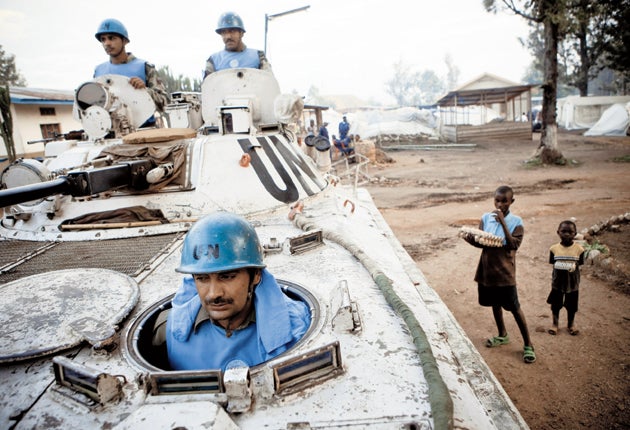
The UN Security Council yesterday condemned the mass rape of almost 200 women by rebels in eastern Congo as the organisation's top officials struggled to account for the failure of peacekeepers to prevent the attacks.
The UN has a large and costly peacekeeping operation in the Democratic Republic of Congo (DRC) which appeared powerless to prevent the rebel rampage through a string of rural villages.
UN officials in Congo said they only learned of the rape from an international medical charity 10 days after they occurred. But there is some dispute when the information was passed on. What seems clear now is that between 30 July and 3 August, Rwandan and Congolese rebels besieged the village of Luvungi in North Kivu, separated men from wives – and sometimes babies from mothers – before engaging in the mass rape of between 150 and 200 women. It happened even though the UN peacekeeping mission has a forward encampment just 19 miles away from Luvungi.
The Security Council held an emergency session in New York yesterday and called for those who carried out the attacks to be brought to justice.
Compounding the political embarrassment for the UN is evidence now surfacing that on 30 July, the day the rapes began, an email was sent out by the UN's safety and security divisions to humanitarian groups in Congo warning them to keep away from the Luvungi area because it had been overrun by rebels. The email made no mention of rape, however.
The UN Secretary General, Ban Ki-moon said he was "outraged" by the attacks. He dispatched his top peacekeeping official, Atul Khare, to Congo to talk with the victims and UN commanders. He will deliver his findings to the Security Council next week. "This is another grave example of both the level of sexual violence and the insecurity that continue to plague the DRC," said Mr Ban.
The UN is insisting it could not have responded to an incident that it had no information about. Officials said that even when patrols did go through the towns several days later, rebels still lingering disappeared into the surrounding countryside and none of the residents spoke to anyone about what had happened, either out of shame or because of fears of rebel reprisals against them. The attacks were blamed on a group involved in Rwanda's genocide and fled across the border to Congo in 1994 and who have been terrorising civilians ever since.
The charity that first sounded the alarm was the International Medical Corps (IMC). "Two hundred to four hundred armed men systematically pillaged and raped women in the villages," Giorgio Trombatore, country director for the IMC in the Congo confirmed. The UN has said that it learned of the mass abuse from the IMC on 12 August, but officials with the group have said details of what happened were passed on to the UN's Office for the Co-ordination of Humanitarian Affairs on 6 August.
A UN spokesman in the Congo confirmed that while patrols through the town resumed within days there was no way for peacekeepers to know what crimes had occurred there. "Unfortunately, the villagers and the local authorities never brought this issue to our knowledge," said Madnoje Mounoubai. "If we are not informed, it will be difficult for us to know."
Known under the acronym Monusco, the peacekeeping operation in the DRC is one of the largest ever launched by the UN with roughly 20,000 troops on the ground, many in the east of the country close to the border with Rwanda. That rapes on so large a scale occurred and escaped the notice of the mission for so long will inevitably cast new doubts on its effectiveness. However, it may also jeopardise plans to end the mission next year. Humanitarian groups will point to this latest abuse to question whether the government in Kinshasa will have the means to protect civilians from rebel attack without any UN presence.
Rape as a weapon of war...
How typical is this case?
Stories of terrible rape have been a feature of the Democratic Republic of Congo during the years of civil war and conflict that have scarred the country since war broke out in 1998. Margot Wallstrom, the UN's special representative on sexual violence in conflict, earlier this year described the Congo as the "rape capital of the world". The UN said that more than 8,000 women were raped during fighting in 2009. A report by the Harvard Humanitarian Initiative in April showed that 60 per cent of rape victims in one part of the country were attacked by the military, with a large proportion of them gang raped. Reports have emerged of young girls and elderly women being tortured. Like the latest case under investigation by the UN, the Harvard study reported that many women were attacked in front of their families with military rapes often accompanied by widespread pillaging.
What is the background?
The eastern part of the Congo continues to be plagued by army and militia violence. Fighting that began in 1998 – and continued despite a peace deal being signed in 2003 – become known as "Africa's World War" responsible for about 5.4 million deaths – making it the deadliest conflict since the Second World War. The fighting has continued because of entrenched ethnic disputes and the struggle for control of the country's rich natural resources. The UN mission has supported efforts to try to beat rebels linked to the 1994 Rwanda genocide. The rebels have used systematic rape as a weapon of war to shame and demoralise women and their families. UN troops have tried to deal with the problem by accompanying women on their way to market, but the latest case has shown its limitations.
What is the effect on the victims?
The Harvard study reported the devastating effects of rape in Congo, not least the spread of HIV/Aids and other sexually transmitted infections. The report also highlighted genital mutilation, infertility and a host of psychological effects. The victims of rape are also stigmatised in Congo, which can lead to the husband leaving, the inability to marry and being shunned by the rest of the community. Harvard researchers also discovered a surge of rape cases by civilians – suggesting that protection for women across a brutalised society had eroded. Sexual slavery was common with some women kept captive for several years.
Join our commenting forum
Join thought-provoking conversations, follow other Independent readers and see their replies
Comments
Bookmark popover
Removed from bookmarks