Inside the jails home to Libya's 'enemies'
Portia Walker reports from Zintan on how thousands accused of Gaddafi links are held illegally by militias in makeshift prisons
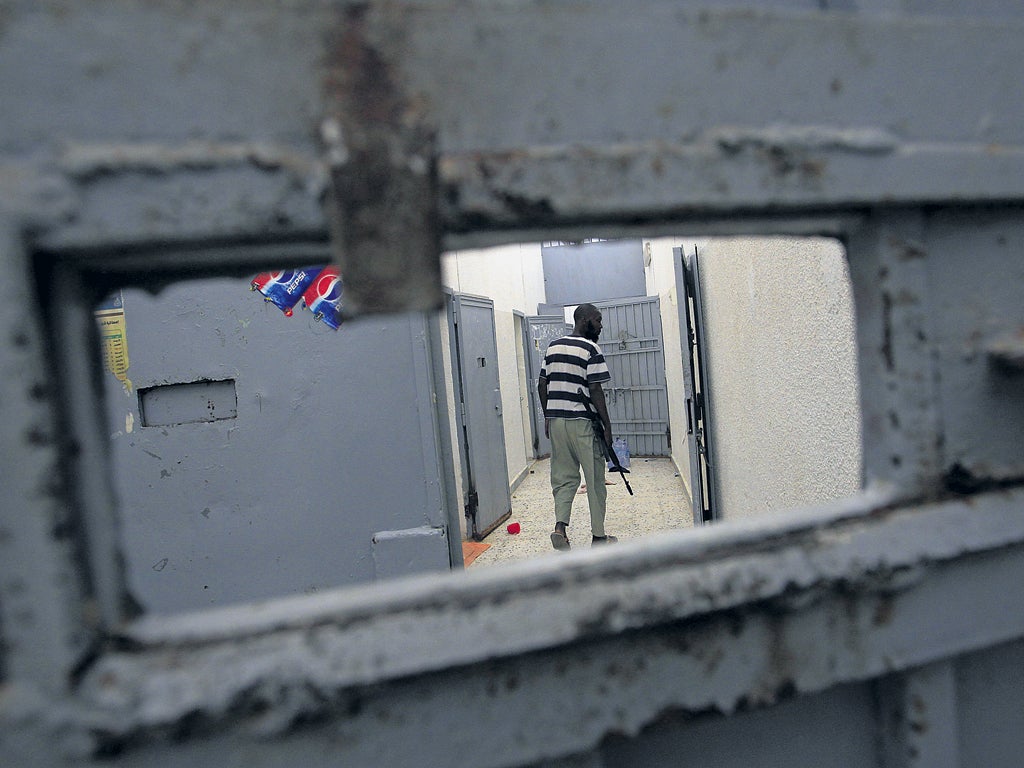
For four months, Ali Jumaa Tahir's parents had a funeral tent pitched outside their home in a small town 15km from Tripoli, as they mourned the son they thought had died fighting for Gaddafi.
It wasn't until October, when he was able to call them from a borrowed mobile phone lent by one of the guards in the makeshift prison where he is now detained, that they discovered their 36-year-old son was still alive.
Mr Tahir is just one of more than 7,000 "enemies of the state" believed to have "disappeared" in a dysfunctional system, according to a report by the UN Security General due to be released on Monday. Thousands of people, including women and children, it states, are reportedly being illegally detained by rebel militias in Libya where many are subject to torture, beatings and systematic mistreatment in private jails run by the Western-backed revolutionaries who now rule Libya.
In what was formerly a school in the small mountain town of Zintan – notorious as the place where Gaddafi's favoured son Saif al-Islam is being held – 162 men are crammed into a single-storey building, held by the rebels who now run the city. "All of them were in the war," said Abdul Rahman Mohammed, Zintan's general prosecutor, as he fielded phone calls behind a vast desk in his office inside the prison.
The windows have been bricked up and the men there say they are allowed out for exercise once a week. Many of the prisoners seen by The Independent were wasted and appeared to be suffering the ill effects of their sedentary lifestyle. Prisoners said that conditions had improved since the war had ended, but that they were still subject to regular beatings.
One of the captives, Hussein Abdullah Ashur, a 21-year-old from Chad, showed the wounds on his head and a cut on his chest from where he had been beaten with electricity cables after being captured. He said his nose had been broken when he was taken into captivity and demonstrated how he struggled to breathe.
"They beat them, then they say sorry. Everyone here has lost someone, some of the guards had their brothers die in the war," explained Mr Tahir, who spoke of the grim days after his capture in May when food was scarce and electricity had run out, not just in the prison but for the whole town of Zintan, as Gaddafi's forces laid siege to the city and blasted the road to neighbouring Tunisia with heavy rocket fire.
The men in the prison all denied having fired shots in the army. "I didn't do anything in this war, even one shot, nothing," Mr Ashur said. Others spoke of how they had been cajoled into fighting. "I am only a soldier. If they ask me to go to war, I can't refuse," said Massoud Mansour Kelane. "If I refuse or leave the war, maybe Gaddafi's forces would kill me."
The town's general prosecutor, Abdulrahman Mohammed, was supervising the prison. He said that at one point it had held more than 300 men but about 160 had been released and more would be if their innocence could be proven. "If they didn't do bad things like kill people, we release them. If the Libyan government released them all, we'd let them go," he said. "Except the killers. They will stay in prison all their lives or be killed by hanging."
Bashir Igna is a migrant worker from Mali who had been working near the town of Obari in the south of the country. He said he was rounded up and made to fight along with many other migrant workers from Mali. "I didn't like to go to the war, but if I didn't go to the war, they would kill me in Obari," he said. Prisoners who had been released were all Libyans, and the 50 or so foreigners held there had not been freed, he told The Independent.
The UN report states that sub-Saharan Africans constitute a large number of the detainees: "Cases have been reported of individuals being targeted because of the colour of their skin." The prisoners said that boys as young as 14 were being held there. When questioned, prison official denied this.
Prison authorities said the detention centre had been visited by Human Rights Watch and the International Committee of the Red Cross. All of the prisoners spoken to said they received adequate food and a number said that guards had given them cigarettes and lent their own mobile phones to allow the prisoners to talk to their families. But all of the captives were despondent about their situation.
"We have food. We have blankets," said Ashur. "We only want one thing – to go home."
Gaddafi's son's fingers 'were amputated'
A doctor treating Muammar Gaddafi's captive son, Saif al-Islam, says that his injured finger and thumb were gangrenous and needed to be amputated. But the Ukrainian doctor, Andrei Murakhovsky, told Reuters there was concern that Saif could be killed if he was taken to a hospital.
Saif has appeared on TV with a heavily bandaged right hand, leading to speculation that fighters had cut his fingers off. Dr Murakhovsky, however, said the wounds were consistent with blast trauma. "His index finger has been ripped off and the bones are all shattered," he said.
Join our commenting forum
Join thought-provoking conversations, follow other Independent readers and see their replies
Comments
Bookmark popover
Removed from bookmarks