Kenyan eco-town: From the slums to a shining town on the hill
In Kenya a little bit of money and a can-do attitude go a long way. Daniel Howden sees how Kaputei has transformed the lives of the country's poor
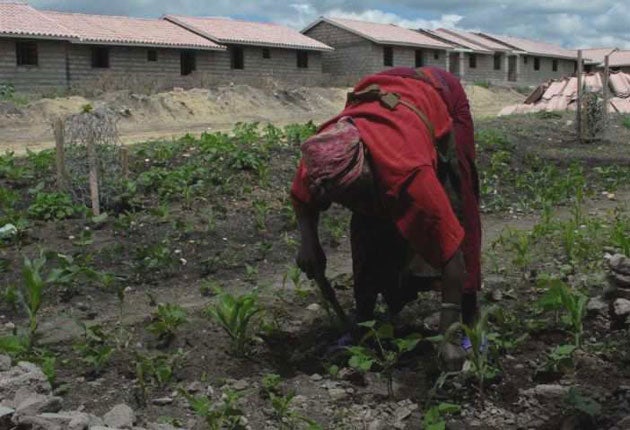
Clarice Adhiambo was looking for the usual things when she moved. Safe streets, more space, a guest room, maybe even a view of something green. More than anything she wanted a place to call her own. Her wish-list would be familiar to first-time buyers anywhere in the world. What would be less recognisable is the place from which she was moving.
Clarice left behind a 10ft by 10ft tin shack that she shared with eight others in the Nairobi slum of Soweto. Unlike the iconic South African shanty town of the same name, there is no electricity, running water or flushing toilets and no prospect of getting them. Kenya's capital offers some of the most appalling urban poverty to be found anywhere in the world. It was in places like Kibera, Mathare and Soweto that the term "flying toilet" was invented. It describes the desperate people who cannot afford to use pit latrines and have to defecate into plastic bags and hurl them on to a nearby roof.
In her new home in Kaputei, an eco-town rising from the plains south of Nairobi, she has a flushing loo for the first time in her life and understandably she's delighted. "This place has fresh air," the 53-year-old says, almost unbelievingly.
Clarice is part of one of 50 families who have bought into a startling experiment that it is hoped will change the nature of microfinance and banking for the poor. The practice pioneered by the Nobel laureate Muhammad Yunus, of offering tiny loans to the some of the world's bottom billion living on less than $1 a day, is flourishing. From six million borrowers worldwide in 1987, microfinance groups now lend to 150 million people. And while the rest of the banking industry has been in meltdown, microfinance has been a rare pocket of stability and growth. The sector brings together an unlikely, eclectic mix of people from frustrated charity workers to entrepreneurs, to those who have already made their fortune and come to microfinance with the evangelical zeal of the reborn.
Ed Bland falls into this last category. In his past life as a Microsoft executive he was the man who launched the X-Box. Today he is the president of Unitus, an American non-profit group in a hurry to make a big difference to global poverty and intent on using microfinance to do it. Mr Bland explains his credo as "the ability to use common business principles to make people's lives better in a way that development has shown it can't do". In the future, he believes there will be an "opportunity for enterprising banks to focus on the bottom and not just the top". "Look what happened when we just focused on the top," he muses.
Seattle-based Unitus uses its capital, connections and corporate credibility to persuade mainstream banks to loan to, or underwrite, microfinance institutions (MFIs). It then uses its know-how to identify and support innovative microfinance outfits it believes can make a dramatic impact on alleviating poverty.
Mr Bland rates Jamii Bora, Kenya's oldest and biggest MFI, among the most innovative organisations in the world. When Jamii Bora – Swahili for "better families" – found that micro loans and repayments could take the poorest only so far, it decided to do something new.
"As long as you are living in the slums, you will never climb out of poverty," says Ingrid Munro, the founder of Jamii Bora. "Families of course need economic opportunities to rise out of poverty but what good are they if you are still living in hell?" The solution they came up with was to build an entirely new town, a Milton Keynes of microfinance.
The result is Kaputei with its neat rows of clay-tiled roofs. From a distance, it looks like the shining town on a hill, only this one is set among Maasai grazing lands and the occasional polythene flower farm. "We are seeing something that we haven't seen anywhere else in the world," says Mr Bland, bumping along the dirt track towards it in a mini-bus.
When Jamii Bora found that the Kenya power corporation wanted a fortune to connect the town to the grid, their attitude was "we'll do it ourselves". So they built their own renewable power station. When builders' merchants wanted to overcharge for breeze blocks and tiles, they built their own factories which now provide jobs as well as materials. Kaputei's houses are powered by solar panels and its water will be processed by one of the first ecologically sound recycling plants in Africa.
The question is whether Kaputei is scaleable. Even if it succeeds in getting 2,500 families to move from the slums, it is a pressure release that will be barely felt in the likes of Kibera, with its one-million plus residents.
Relaxing in an armchair in her sitting room, Clarice gives the former Microsoft whizzkids her take on where Jamii Bora's ferocious can-do mentality comes from. It is an organisation she knows well, having joined at the "ground level".
Born into poverty near Lake Victoria, Clarice had a hard life. She was badly beaten by her husband and the father of three of her four children. He eventually threw her out and she drifted from friend to relative before ending up a street beggar in Nairobi.
While living rough she was raped, conceiving her only son. Clarice and her fellow beggars struck up a relationship with a kindly worker of a non-government organisation they knew as Mama Ingrid. As well as a little money, the Swede would take the time to talk to the women, Clarice remembers.
Despite this friendship, the women were deeply suspicious when Mama offered to help them learn how to save money. The women thought "she'd been sent from Sweden to come and eat our money" and hatched a plan to beat her up. Ingrid Munro persisted and persuaded a few dozen of the beggars to trust her. Clarice's face contorts with remembered shock when she recalls the day Mama told her she had saved 1,000 Kenyan shillings (£8).
There were more surprises to come as Mrs Munro offered to lend her the same amount again to set up a business. "Don't give me a headache," was Clarice's initial response. "What is a loan? What business can I do? I don't even know how to write my name." The Great Lakes girl put her 2,000 Kenyan shillings in fish. With each loan repaid she would borrow more.
By her sixth loan, there was too much money for fish and she expanded into market stalls. By her 10th, she was borrowing £1,200 and opening a string of slum businesses. The first group of 50 beggars a decade ago has swollen to a membership of 225,000.
Clarice's latest loan is a mortgage on her home in Kaputei with monthly payments of £23. She is "overpaying" at the moment to settle the loan early.
From the window of Clarice's kitchen, the green of the grasslands is only interrupted by the black and white lines of a herd of zebra. But it is the sink tap that holds her attention. She turns it on. "So much water," she says with infectious wonder.
Join our commenting forum
Join thought-provoking conversations, follow other Independent readers and see their replies
Comments