Kenya's decline and fall
The streets are no longer burning, but smouldering corruption at every level of government threatens to rip the country apart. Once the pride of East Africa, it has now been judged a failure of a state, writes Daniel Howden
GETTY IMAGES
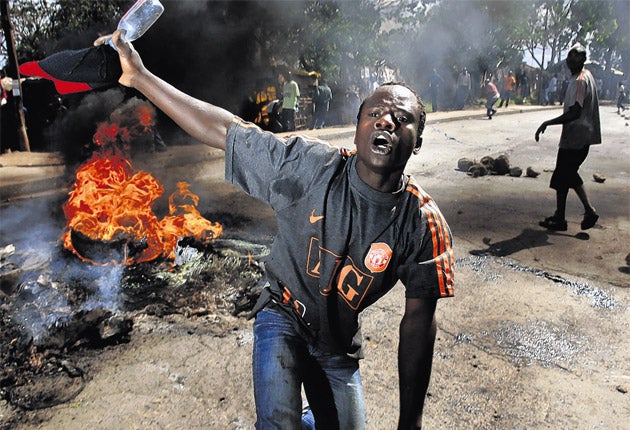
More than 1,500 people died in violence which took the world by surprise when it broke out last year after Raila Odinga won the Kenyan election
Symbols rarely come as obvious or appropriate as Nairobi's Integrity Centre. A stone's throw from State House Avenue, the headquarters of Kenya's Anti-Corruption Commission (Kacc) is both a rusting hulk and a public joke. It was built to project the arrival of a brash new world but its metal panels have oxidised and bled, scarring its bronze facade with rivulets like the tracks of filthy brown tears.
In a country so traumatised by the consequences of corruption this ought to be a hive of activity. Instead it is a place which most experts would be happy to see closed. "They should be locked in and paid to stay there," says Mwalimu Mati, an anti-corruption campaigner. "They're not ever going to fight grand corruption. They are managers of scandal and no action is ever taken."
The Kacc is not the exception, it is the rule. Kenya is replete with commissions and authorities, hollow institutions that the ruling elite has long known how to manipulate when using "process" to paralyse reform.
Eighteen months after East Africa's island of stability was brought to the brink of civil war by the fallout from a stolen election, there is a temptation to assume that if the country is not burning, it must be healing. That would be wrong, according to the annual index of failed states, issued yesterday, which put Kenya in the critically failed group, one place below Burma.
The appearance at 14th in the respected rankings compiled by the US-based Fund for Peace has shocked some in Nairobi but others are clear where the failures lie. "If a state exists to provide security, maintain its borders, provide food and a system of arbitration, then you can make the case that Kenya doesn't do those things," says Mr Mati.
The bloated unity government that emerged from the violence is not helping. Remarkably, there is only one MP in parliament who was left outside of government, a situation that has left the job of opposition to foreign envoys. "There was real hope that we'd get a new Kenya. That has not happened," is the verdict of one Western diplomat. "There are no political hopes out there. There is no one with a clean pair of hands."
Foreign aid supplies roughly eight per cent of Kenya's budget but using that leverage to bring change is complicated by venal politicians, the diplomat argue. "If we pull that money, it means no bore holes in Garissa, it doesn't hit them [the politicians]."
While the daily theatre of scandals, meetings and reconciliations in the unity government dominates the Kenyan papers, the symptoms of an extraordinary crisis are present just beneath the surface.
The rule of law is collapsing and the UN has accused the police of a wave of extra-judicial killings. Watchdogs say the grand coalition has launched a "feeding frenzy" of corruption. International agencies are feeding one-quarter of the population. An ethnic criminal sect, the Mungiki, is in open war for the Central Province. And there has been no progress on any of the keystones of the 2008 peace plan brokered by Kofi Annan.
While these crises multiply, corruption is all that holds the government together, according to John Githongo, Kenya's most famous whistleblower. "The glue is greed," he explains. He predicts the government will hold together for only as long as it takes rivals to build up "big enough war chests" to literally fight all over again.
The cosy consensus voiced by the Prime Minister, Raila Odinga, that "Kenya looked over the edge of the abyss and stepped back," is wishful thinking, according to Michela Wrong, the British writer whose critique of Kenya's ruling elite, It's Our Turn To Eat, has been effectively banned from bookshops.
Interest in her book – which charts the recent history of the former British colony through Mr Githongo's story and argues that high-level corruption destabilised the country – is such that an underground movement has been set up to get it out to the public. Four hundred people turned up to hear a reading from the book at the National Theatre, the podcast of which is now a popular Kenyan download.
The book drive is evidence of the interest of ordinary Kenyans in finding out about the history of looting of the state coffers by their political leaders. The Goldenberg scandal of the 1990s which cost the country at least 10 per cent of gross domestic product found a sequel in the Anglo Leasing scandal under the so-called anti-corruption administration of Mwai Kibaki. Efforts to punish the guilty and recover the lost millions have in both cases frozen.
The consequences for the rest of the region of an outright failure in Kenya were brought home during the post-election fighting that killed more than 1,500 people last year, when fuel prices in Uganda and Rwanda went up nearly 20 per cent.
The Waki Commission, appointed to identify the culprits behind the political violence has long since delivered its report. But the names it contains remain hidden and the deadline for setting up a local tribunal has passed, raising the prospect of government leaders being taken before the International Criminal Court.
Mr Githongo has said that the only cause for optimism is that the grand coalition is proving to all of Kenya's 42 tribes that having their respective "ethnic baron" in power does not improve their lives. He hopes this could break the mould which has seen elections amount to little more than a periodic ethnic census.
Meanwhile, the political void is exacerbating Kenya's tendency to look for "political messiahs", Mr Mati argues. Mr Githongo, the former graft tsar who worked for the current president for two years before fleeing to London with a caseload of evidence of grand corruption, is even being touted as one of them.
Back in Kenya and working as a consultant, Mr Githongo has been engaging in what he calls "conversations with the grassroots" across the country. An editorial in The Nation said the effort to circulate Wrong's book was a new political movement.
Murithi Mutiga, a younger political commentator in Nairobi, is part of a generation that everyone hopes will find a way out of the crisis. He believes the country has come to resemble the banks that have shaken the global financial system. "Kenya is in the curious position of qualifying to be a failed state but for the big Western powers, it's too important to fail."
The telephone directory of Kenya's non-government organisations weighs enough to remind anyone that Nairobi is the region's hub. It is the UN's third most important base after New York and Geneva and hosts the region's largest US diplomatic mission. Nairobi's elite and the international agency staffers, known as "two-yearers", are living in what Mutiga calls an "imaginary stability".
Not many people here perceive themselves to be living in a failed state. And yet "Kenya is a failing state", in his view. And it was this complacency that prompted the shocked response to the Kenya's descent into violence last year.
View all comments that have been posted about this article.
Offensive or abusive comments will be removed and your IP logged and may be used to prevent further submission. In submitting a comment to the site, you agree to be bound by the Independent Minds Terms of Service.
- Print Article
- Email Article
-
Click here for copyright permissions
Copyright 2009 Independent News and Media Limited


Comments
The frauded election of December 2007 and the pathetic deal cobbled together by the International Community have ruined Kenya's promising developments in the post-Moi era since 2003. The only solution to this Kenyan and indeed worldwide problem is the global implementation of unfraudable election systems.
These exist, but the West and China are determined that they will not be implemented. Britain is at the heart of this Fascist reaction to a global change which can lift billions from poverty and bring them also human dignity, freedom and justice.
Mr Alex Weir, Harare and Gaborone
Kibaki's goons murdered and raped hundreds of thousands after the elections but we naturally assumed that this was no biggie, seeing as the Indy / Guardian Wurlitzers kept on playing the same two African tunes, namely "Save Darfur" and "Get Mugabe." The Kenyan single never got anyone near the top 10 on the Wurlitzer media charts.
Kibaki's defense minister had his John Hancock under the invoice for Yushchenko's tanks in the ship hijacked off Somalia although Kenya never bought a single tank from Ukraine and the stuff was really going to the Yank-backed South Sudan rebels to start a new war there. It turned out that Kenya had been fronting for such illegal arms shipments for decades. Did the Indy / Guardian find this fact worthy of our attention? Hell no, not when the ICC's rapist prosecutor was on his soap box flinging bogus accusations of "genocide by rape" against Sudan. When the ICC judges threw those baseless accusations out, the Indy / Guardian Wurlitzer turned the volume down once again to a barely audible whisper.
So now, out of the blue, we get this quite sensible analysis of the rotten state of Kenya? Is the Indy developing a split personality? Becoming bipolar maybe? Coming down with Alzheimers?
1. 'Kibaki's goons murdered and raped hundreds of thousands after the elections...' Hundreds of thousand were not killed and certainly no major issue of rapes but the police. Rapes and murders were mostly by ODM supporters, then govt stepped in to defend the people being persecuted for daring to excercise their right to vote for whomever the heck they chose. Mungiki - majority Kikuyu group hence assumed to be pro-govt (or more likely anti-ODM) also mobilised to protect the Kikuyus being killed and driven out of their homes and land by the (mostly) Luos & Kalenjins.
2. '... but we naturally assumed that this was no biggie, seeing as the Indy / Guardian Wurlitzers kept on playing the same two African tunes, namely "Save Darfur" and "Get Mugabe." The Kenyan single never got anyone near the top 10 on the Wurlitzer media charts.
Kenya was covered ad nauseum by the international media including the Guardian in the run up to the elections and especially after the post election violence erupted. Mos coverage was very pro-ODM and anti-PNU/Kibaki/Kikuyu/govt. Thank you for your utter lack of objectivity then. It was very irritating to seem them try to justify criminal acts as alleged expressions of 'democracy' i.e. the right to protest. Arson, rape, murder and ethnic cleansing have never been synonymous with democracy.
'
We have problems here but i don't think we cannot solve them.
By the way which measure do they use? I always suspect the intentions of UK towards Kenya.Remember Jan 2008 all BBC coverage was always about Kenya, Somalis are fighting check BBC and it has never been the lead story!
With the British MP's claiming refunds for porn rentals I find this rather myopic. Kenya is and will never be a failed state. Just check out the entire west Africa and parts of Asia to know that we cannot be
we produce tea and coffee and it is packed and sold as a British product and when we pack it they wont buy.
the other day they wanted to ban our flowers ostensibly that they are causing global warming but their guilty conscience couldn't approve it.
the aid money which we pay later is the mind boggling profits that they get from tilted trade practices with third world.
so please understand the aid money first and stop praising those blood suckers.
our country is not a failed state just because we have an ambitious and free media does not mean we are better off than Americans who are allowed to have guns at home.
i am a proud Kenyan and nobody has to come up with stupid and i say again stupid ilogical thinking of wanting to describe kenya as a failed state
The fact about the elections are that, the west were so desperate for Kibaki to vacate the presidency that they believed everything which came from the opposition. The opposition prior to the elections had managed to hoodwink Kenyans regarding Kikuyu hegemony and because it was systematic, most Kenyans believed. How can you lie to people that once you win the election that everything that belongs to the Kikuyu will be theirs. This is not only stupid, it is also making people believe that they can get anything for nothing.
ODM minutes and manifesto before the elections is still available and every sane person can know where it all started. Thanks God Kenya passed through the worst and it is now showing some signs of healing.
Lenny,
So Kenya is a stable and more stable than UK or US
Isaiah Oink UK LONDON
We lack leadership in Kenya, to help transform the challenges before 'actually fall'. Young people below the age of 30 are more than determined to be part of this change. many affected by the post-election and living in sorry state in Kenya slums... they are forcused to bring the change we all long for. after the peace summit held in April, 2009 in Nairobi, more than 200 youths are tirelessly working at every corner of this country to preach peace and develop new leaders free from corruption, tribalism and other ills affecting Kenya today.
for more information:http://peacesummit2009.word
University graduates who have gone through some of the most rigorous educations systems are resorting to crime as are a bulk of the youth- or so it seems. They take out their frustrations on the common mwananchi and so once you leave the house, you're not sure if you'll make it hme and when home,you don't know if you'll last til the morning. Life in Kenya is incredibly valueless. You can be killed for anything or nothing!
People in Kisii just burned to death 11 'witches' (ON CAMERA no less) who were accused of causing all sorts of ills to the community but nobody thought they could do any more damage as they were being abused and eventually killed. The killers join a long line of Kenyans (starting with our 'leaders') who behave with impunity and not a thing has been done. Blaming old people for witchcraft when someone falls sick or dies is no wiser than accusing tribe X of 'stealing al the money in Kenya' meanwhile our so called leaders are robbing the nation blind and we NEVER hold them accountable.
If all Kenyans had access to economic opportunities, healthcare all these manufactured issues of tribal animosity, witchcraft etc The competition for scarce resources is what is tearing our country apart.
Our legal system is a joke. Justice can be bought and depends largely on who you know and what you have. A pity.
Poverty, disilusionment and hopelessness is indeed a dangerous mix. If our so called leaders continue to do nothing more than pay lip-service to the idea of alleviating poverty, I fear the worst is yet to come.