Massive statue of Pharaoh Taharqa discovered deep in Sudan
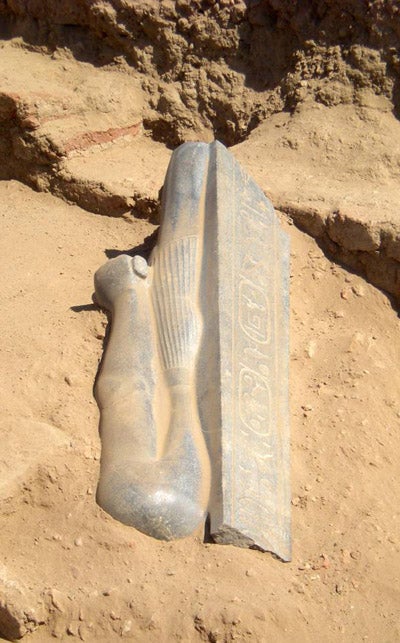
No statue of a pharaoh has ever been found further south of Egypt than this one. At the height of his reign, King Taharqa controlled an empire stretching from Sudan to the Levant.
A massive, one ton, statue of Taharqa that was found deep in Sudan. Taharqa was a pharaoh of the 25th dynasty of Egypt and came to power ca. 690 BC, controlling an empire stretching from Sudan to the Levant. The pharaohs of this dynasty were from Nubia – a territory located in modern day Sudan and southern Egypt.
The Nubian pharaohs tried to incorporate Egyptian culture into their own. They built pyramids in Sudan – even though pyramid building in Egypt hadn’t been practised in nearly 800 years. Taharqa’s rule was a high water mark for the 25th dynasty. By the end of his reign a conflict with the Assyrians had forced him to retreat south, back into Nubia – where he died in 664 BC. Egypt became an Assyrian vassal – eventually gaining independence during the 26th dynasty. Taharqa’s successors were never able to retake Egypt.
In addition to Taharqa’s statue, those of two of his successors - Senkamanisken and Aspelta – were found alongside. These two rulers controlled territory in Sudan, but not Egypt.
Dr. Julie Anderson of the British Museum is the co-director for the Dangeil excavations. This project is an archaeological mission of the National Corporation for Antiquities and Museums, Sudan. It is also co-directed by Dr. Salah eldin Mohamed Ahmed.
Dr. Anderson confirmed that no statue of a pharaoh has ever been found further south of Egypt than this one. “That’s one reason it’s so exciting and very interesting,” she said. The discovery was such a surprise that one colleague of Anderson's didn't believe it at first saying that the statues “can’t possibly be (at) Dangeil.”
Dangeil is near the fifth cataract of the Nile River, about 350 kilometres northeast of the Sudanese capital of Khartoum. There was a settlement at the time of Taharqa, but little of it has been excavated. Most of the finds discovered at Dangeil, so far, date to the time of the Kingdom of Meroe (3rd century BC – 3rd century AD).
While this is the furthest south that a pharaoh’s statue has been found, it doesn’t necessarily mean that Dangeil is the southern border of Taharqa’s empire. It’s possible that he controlled territory further up the Nile.
The statue of Taharqa is truly monumental. “It’s a symbol of royal power,” said Dr. Anderson, an indicator that Dangeil was an “important royal city.”
It’s made of granite and weighs more than one ton. It stood about 2.6 meters (8.5 feet) when it had its head. In ancient times it was smashed into several pieces on purpose. This was also done to the two other statues. It’s not known who did this or why. It happened “a long time after Taharqa,” said Anderson.
One idea is that there was a dynastic struggle. A group came to power in Nubia that was determined to eliminate reminders of Taharqa’s reign and that of this successors. Another possibility is that in 593 BC an Egyptian military force, led by pharaoh Psamtek II, succeeded in reaching Dangeil and decided to damage the statues.
The largest piece of Taharqa's statue is the torso and base. This part of the statue is so heavy that the archaeological team had to use 18 men to move it onto a truck.
“We had trouble moving him a couple hundred meters,” said Anderson. The move was “extremely well planned,” with the team spending eight to nine days figuring out how to accomplish it without the statue (or the movers) getting damaged.
Given the lack of moving equipment the team resorted to “traditional methods.” Anderson and Ahmed say that “the back of the statue was first protected with sacking after which a heavy plank of wood was attached to the backpillar. Trenches were dug under the statue to facilitate the attachment of the wood backing,”
The team than rotated the statue so that it rested on this wood. A platform of red-brick and silt was created beneath the statue. “The statue was raised upwards, one brick’s thickness at a time (approximately 80mm), using wooden and iron levers.” A team of 18 men then brought it to a truck, dragging it over an ancient wall.
Taharqa’s ancient statue movers would have had an even rougher job. The nearest granite quarry is at the third cataract – hundreds of kilometres up the Nile. The trip was “certainly many days” said Anderson, consisting of a river ride and in “some places dragging.”
The construction of the statue and the painstaking effort to move it to Dangeil “demonstrates how powerful he (Taharqa) was.”
Massive Taharqa Statue Discovered deep in Sudan – Pictures, inscriptions and an interview
Barbara Racker on Neighbourly Relations between Nubia and Egypt
Upcoming in London: Forensic Aspects of Ancient Egypt with Joyce Filer
Join our commenting forum
Join thought-provoking conversations, follow other Independent readers and see their replies
Comments
Bookmark popover
Removed from bookmarks