Misery at the border as Gaddafi's guests flee
Libya's migrant workers have become a pitiful human tide. Robert Fisk reports
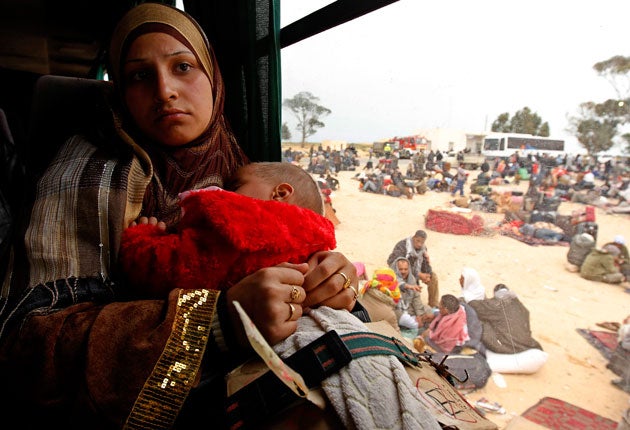
"We want the Egyptian army – why isn't our army here?" they shouted in their thousands: the refugees, the poor, the sick – the wealthy having long ago fled Gaddafi's rump dictatorship – as they stormed around the frontier station through refuse and muck. They are the people of Cairo and Alexandria and Sohag and Assiut and a thousand Delta villages, all with their monstrous, preposterous, overweight baggage of cheap clothes and bedding.
The Egyptian army cannot come to Tunisia, of course, to save the tens of thousands of its countrymen pushing their way over the border. Only the Egyptian navy came yesterday, in the shape of a black-painted frigate that carried just 1,000 men, women and children home over rough, wind-topped seas.
But the misery at the border was greater than any ship of mercy. Perhaps 7,000 people – perhaps 8,000, the figures are as imperfect as they are unable to convey such suffering – squeezed themselves up to the last Libyan barrier and over into Tunisia. Libyans beat them – and then the young men of Ben Gardene beat them for arriving in their nearby Tunisian town to take their jobs. The Egyptians were not seeking work – nor were the thousands of Bangladeshis with no embassy in Tunis, nor the Chinese, nor the Filipinos. For yes, this was misery from what we once called the Third World, now made jobless and homeless by a truly Third World dictator.
A young Tunisian security policeman, in a black leather jacket and shades and holding a Steyr rifle, began shouting at journalists. "Do you see how many there are? How can Tunisia look after all these thousands? Go and look at them yourselves." And we could see them on the Libyan side, pushing against a concrete wall, dwarfed by Libya's glowering green-domed customs station. Tunisian army officers cursed the cop for demonstrating his own country's plight.
Yet the Tunisians were also kind. They drove Egyptian peasant workers to a newly installed refugee camp in their own cars. They stamped temporary visas for those who had driven to Jerba airport for flights to Cairo and to the harbour at Djerdjes. They brought bread rolls and water and blankets to the frontier.
An Egyptian foreign ministry official, in a white T-shirt with the Egyptian flag sewn on to it, told us he had come as a volunteer to help his people – not something you could have expected under Mubarak's corrupt old regime – and he, too, praised the Tunisians.
And if 100,000 refugees have now fled Libya for Tunisia and for Egypt itself, how to avoid the ultimate figure of responsibility – that of the despot of Tripoli, he who supposedly gave power, in his wretched Green Book, to the people? "No Democracy without People's Congresses and Committees Everywhere," read one of the nonsensical lines which I read on a poster in Tripoli last week. Then what of all these people at Ras Jdir? No congress or committees for them. Just the hard road home. Or rough seas. For yesterday morning, the Egyptian navy came to the rescue. True, it was a mere frigate with the capacity for only 1,000 souls, but the arrival at Djerdjes of the Shalatein, streaming with Egyptian banners and decks lined with smart Egyptian marines, somehow retrieved this crisis from just pain and destitution. It was the first Egyptian military operation since the overthrow of Mubarak, and the seamen and marines knew that the world's cameras were upon them. They carried children aboard, welcomed old men leaning on walking sticks, put their arms around the rough fellahin from upper Egypt.
Over the ship's Tannoy system they played "Al-Helmel Arabi" – the "Arab Dream", the old song of Arab unity – as buses brought hundreds more Egyptian migrant workers from the border 50 miles away.
Even the reporter of the Egyptian navy's house magazine took pictures of the middle-aged and elderly peasants, almost all of them clutching soiled blankets and cheap plastic bags containing all they possessed. Less than two decades ago Gaddafi threw half of his Palestinian migrant workers out of Libya, a dry-run for this infinitely greater exodus.
But what happens when all these huddled masses at the Tunisian border go home? The economy of Egypt will be sorely hit. So, too, will those of Bangladesh and Turkey. But none more so than Libya itself, whose construction plants and power stations and oil and gas facilities now lie idle.
Four more Egyptian naval ships are en route to Tunisia, a bigger task force than the British and Americans sent for their own evacuees. But even these vessels will not be able to carry the growing crowds at the frontier.
Join our commenting forum
Join thought-provoking conversations, follow other Independent readers and see their replies
Comments