Mohamed ElBaradei: The man who would be President
Exclusive intervew: Robert Fisk meets Mohamed ElBaradei, Egypt's saviour-in-waiting
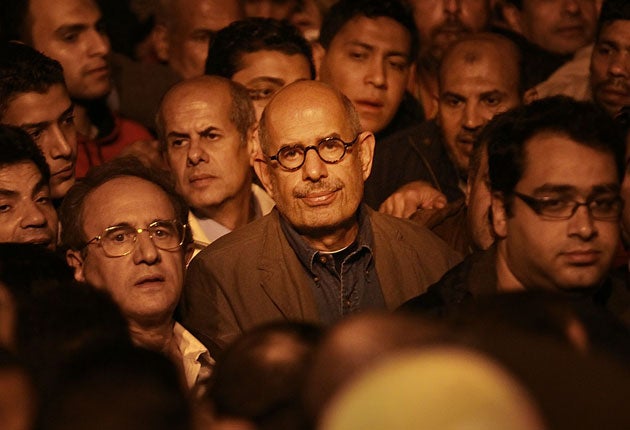
Man of the moment? Of course Mohamed ElBaradei is. But man of the people, I have my doubts. He doesn't claim to be, of course, and sitting in his garden easy chair near an impossibly blue but rather small swimming pool, he sometimes appears – even wearing his baseball hat – like a very friendly, shrewd and bespectacled mouse. He will not like that description, but this is a mouse, I suspect, with very sharp teeth.
It's almost a delight to dissect the bigger mice who work in the White House and the State Department. "Do you remember how on the second day, all we heard was that they were 'monitoring the situation'. On the second day, Secretary Clinton said: 'We assess the situation as stable'; it was funny yesterday, too, to hear Clinton say that 'we have been urging the Egyptian Mubarak for 30 years to move on this – and he moved backward – how on earth can you still ask him to introduce democratic reform? Then Clinton talks about 'the legitimate aspirations of the Egyptian people' and now they are talking about 'the smooth transition of power'... I think they know that Mubarak's days are numbered."
Without any prompting, ElBaradei – Nobel peace laureate, ex-UN nuclear chief inspector, etc, etc – bites our own dear leader. "Yesterday, I heard Mr Cameron saying that 'democracy is not an election, that it's 'block-building'. Well, everybody knows that. But how do you talk about building a judiciary, civil society – how do you talk about these 'building blocks' – under a dictatorship? You either have a civil society or you don't."
Sometimes, ElBaradei sounds too hopeful. He agrees that the best potential Egyptian leadership have all been exiled, deliberately of course. On a recent speaking engagement at Harvard, he found 15 Egyptians on the Harvard Board.
"I told them: If you come back, you can run Egypt." But it's not that simple. As ElBaradei admits: "It's an old story that ends: 'Mubarak is a friend of Israel and we think a change will bring a government hostile to Israel and it will bring on an Iranian-type velayeh-fakhi [guidance by a supreme religious leader]. I say this is like 'True Fiction'. You need to get rid of this 'True Fiction' about the Muslim Brotherhood and the automatic hostility towards Israel. It is a fact that a durable peace can only be between democracies and not between dictators and, if you want a durable peace, whether Egypt is a democracy or a dictatorship, the feeling of the people in the region is not going to change."
He says he is convinced that Mubarak will go. And so say all of us. He also says he believes the Egyptian army will not fight the Egyptian people, which is by no means certain. I suspect that, like me, ElBaradei isn't very keen on armies. "I think, ultimately, that the Egyptian army will be with the people. This is common sense when you see a couple of million people in the street who are representative of 85 million Egyptian people who hate Mubarak, who want to see his back. The army is part of the people. And at the end of the day, after anyone takes off his uniform, he is part of the people with the same problems, the same repression, the same inability to have a decent life. So eventually, I don't think they are going to shoot their people. And why should they shoot their people? To protect what?"
When Egypt lost the 1967 war, ElBaradei wrote that "a soldier fights because he defends something he wants to keep. But in the 1967 war, what was the Egyptian soldier fighting for? There was nothing to go back to. So they ran away". Nasser, so the great man believes, was the worst of Egyptian dictators – "he even nationalised the grocery shops" – but the path of dictatorship ran right through to today. Even a few months ago he could not imagine what would happen. "I had gone to a wake, I told my brother, and I looked at the eyes of the mourners and they were dead – they were dead souls. And now I look at the people today and they have recovered their self-confidence. They are free. It was like a pressure cooker."
He talks about hypocrisy, dictatorship, criminal malfeasance, the darkest deeds of the Egyptian security services, the loyalty of the Egyptian army to the people in a high, astringent but deadly voice. No he doesn't want to be the president, but when I ask him if he might consider a transitional presidency for himself – until fair elections, naturally – I receive a traditional reply. "If there's a consensus by all people to do whatever they think I can do for them... I will do that." Hmmm, I think to myself.
"All this will continue to be the same until you address the plight of the Palestinians, until you review your policy in the region. We have this strange relationship where you are calling this peace but you cannot even publish an Israeli book here, or vice-versa, for example. If you really want peace, yes, the peace can be made durable with democracy, but also you have your responsibility – which is to review a balanced relationship, particularly on the Palestinian issue, Iraq, Afghanistan, what have you, and then you will have an Arab world which will be friendly to the West."
ElBaradei is surprisingly mild when he speaks of Mubarak the man. He last saw him two years ago. "I would go to see him when I returned from a UN mission or a holiday. I always received a friendly reception. It was a very cordial relationship. It was one-to-one, just us, and there was no formality. I would tell him what I thought of this or that problem, what might be done. He doesn't really have advisers who have the guts to tell him the truth."
Much good did ElBaradei's advice do. He is outraged by the arson and looting. When I ask if state security policemen were behind the arson – which is used by Mubarak, Obama and Clinton to "tag" those who demand Mubarak's departure with violence – the mouse shows its teeth. "They [the police] were, we are now hearing about documents which show that some of these uniformed officers have taken off their uniforms and gone about looting. And everybody says that they have been ordered to do this by the regime or the ministry of interior or whatever. And if this is true, then this is the most sinister of criminal acts. We have to verify this. But for sure, many of these bands of thugs and looters are from part of the secret police."
And then suddenly, in that high voice, eyes glittering behind pebbling spectacles, the mouse becomes a tiger. "When a regime withdraws the police entirely from the streets of Cairo, when thugs are part of the secret police, trying to give the impression that without Mubarak the country will go into chaos, this is a criminal act. Somebody has to be accountable. And now, as you can hear in the streets, people are not saying Mubarak should go, they are now saying he should be put on trial. If he wants to save his skin, he better leave."
My God, those teeth are sharp.
Mohamed ElBaradei – challenger to Mubarak
* Mohamed ElBaradei was born in Cairo and launched a legal career, joining the International Atomic Energy Agency in the 1980s and became head of the United Nations body in 1997.
* He was outspoken about the lack of evidence of weapons of mass destruction in Iraq before the US-led invasion in 2003, which angered the administration of George W Bush. The award of the Nobel Prize for Peace jointly with the IAEA in 2005 further rankled.
* A secret nuclear programme was uncovered in Iran while he was the head of the IAEA. Tehran has always claimed that the programme is peaceful.
* ElBaradei, 68, began overt opposition to President Hosni Mubarak on his return to Egypt in February 2010 and won widespread support among young people and the middle classes.
* Last June he called on supporters to campaign for a change in the constitution to allow a democratic succession.
* ElBaradei put pressure on the United States to support calls for Mubarak to step down at the weekend, saying "life support to the dictator" must end. He dismissed US calls for Mubarak to enact sweeping reform in response to the mass protests.
* The official media has tried to ridicule ElBaradei, saying that he knows nothing about Egypt and has no political experience.
Join our commenting forum
Join thought-provoking conversations, follow other Independent readers and see their replies
Comments