Mohamed Heikal: 'I was sure my country would explode. But the young are wiser than us'
Robert Fisk meets the doyen of Egypt's journalists
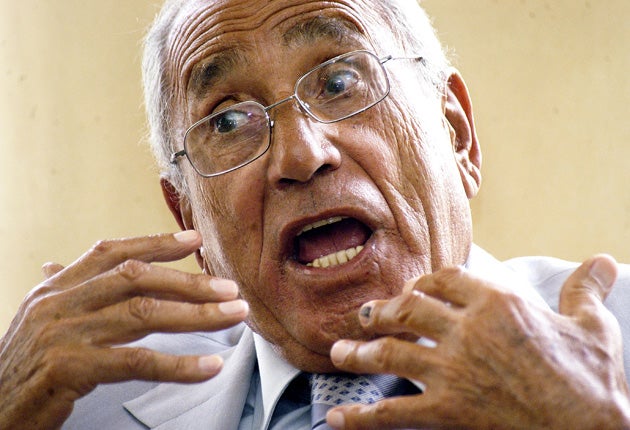
The old man's voice is scathing, his mind like a razor, that of a veteran fighter, writer, sage, perhaps the most important living witness and historian of modern Egypt, turning on the sins of the regime that tried to shut him up forever. "Mubarak betrayed the republican spirit – and then he wanted to continue through his son Gamal," he says, finger pointed to heaven. "It was a project, not an idea; it was a plan. The last 10 years of the life of this country were wasted because of this question, because of the search for inheritance – as if Egypt was Syria, or Papa Doc and Baby Doc in Haiti."
At 87, Mohamed Heikal is the doyen, the icon – for once the cliché is correct – of Egyptian journalism, friend and adviser and minister to Nasser and to Sadat, the one man who has predicted for 30 years the revolution that he has, amazingly, lived to see.
We didn't believe him. For three decades, I came here to see Heikal and he predicted the implosion of Egypt with absolute conviction, outlining in devastating detail the corruption and violence of the Mubarak regime, and its inevitable collapse. And sometimes I wrote cynically about him, sometimes humorously, occasionally – I fear – patronisingly, rarely as seriously as he deserved. Yesterday, he offered me a cigar and invited me to say if I thought I was still right. No, I said, I was wrong. He was right.
Heikal in old age is a man of such eloquence, such energy, with such a vast memory, that men and women who are younger – a quality he much admires, and which won Egypt's revolution last week – must be silent in his presence. "I lost the most important thing in my life," he says with painful candour. "I lost my youth. I would love to have been out with those young people in the square."
But Heikal is a wily beast. He was here for the Nasser revolution of 1952 and remembers the folly of power displayed by Egypt's dictators. "I was completely sure there was going to be an explosion," he says. "What stunned me was the movement of the millions. I was not sure I was going to live to see this day. I was not sure I was going to see the rising of the people.
"My old friend Dr Mohamed Fawzi came to see me a few days ago and said: 'The balloon of lies is getting bigger every day. It will explode with the prick of a pin – and God save us when it explodes.' Then the people came and filled the vacuum.
"I was worried that there would be chaos. But a new generation in Egypt came along, wiser than us a million times over, and they behaved in a moderate, intelligent way. There was no vacuum. The explosion didn't happen.
"What I am worried about is that everything came as a surprise, and nobody is ready for what comes next. Nobody wants to give time for the air to clear. In these circumstances, you can't take the right decisions. These people carry with them huge aspirations. The Americans and Israel and the Arab world are all pushing. Even the Military Council were not prepared for this. I say: give yourself time to sleep at last.
"Mubarak kept us all in suspense," he goes on. "He was like Alfred Hitchcock, a master of surprise. But this was an Alfred Hitchcock situation without a plot. The man was improvising every day – like an old fox. The millions moved. I watched him – and I was stunned.
"In this grave situation, the regime got into contact with some people in the square, and it asked them if some delegation of powers from Mubarak to the Vice-President would be acceptable, and the people they were talking to said: 'Maybe, yes.' And so Mubarak thought he could make his speech on Thursday night because he was sure he had got an 'OK' from the square. I couldn't believe my ears."
Heikal was pleased that Mubarak delayed the crisis by remaining silent while the crowds built up in Tahrir Square. "In those 18 days, something very important happened. We started with about 50-60,000 people. But as Mubarak delayed and prevaricated like the old fox he is, it gave the chance for the people to come out. This changed the whole equation. Six days into the crisis, Mubarak simply didn't understand what had happened."
Heikal bemoans the wasted years and the deaths of the past three weeks – "our revolution was a great historical tragedy," he says – and does not yet see the nature of post-revolutionary Egypt. "I am happy with the presence of the army – but I want the presence of the people, too. The people are bewildered about what they have achieved."
On Saturday night, Heikal was invited, for the first time in almost three decades, to appear once more on Egyptian state television. His reply was as feisty as it was when Sadat offered him the job of chief of the National Security Council after Nasser's death. "I told Sadat that if we differed as we did when I was a newspaperman on Al-Ahram, how could I lead his National Security Council?" So when the government television asked him to appear this weekend, Heikal replied: "I was prevented by government order from appearing for 30 years and now you tell me that the doors are open again. I was prevented from appearing by government order, and now I am supposed to come by invitation."
A few months ago, after Heikal had visited Lebanon and met Sayyid Hassan Nasrallah, the Hezbollah leader, a furious Egyptian Foreign Minister turned up at Heikal's farm in the Nile Delta. "Do you think you represent the Egyptian people?" the minister shouted at him. Heikal asked the minister: "Do you think you represent the Egyptian people?"
The lines look good on Heikal's face, a wise old bird as well as wily. But he's a bit hard of hearing and feels it necessary to apologise for his 87 years, a young man trapped in an old man's body. And anyone invited to his inner sanctum above the Nile, full of books and beautiful carpets and the smell of fine cigars, can see Heikal's sadness.
"The difference between Mubarak and me is that I never tried to hide my age," he says. "He did. He dyed his hair. So whenever he looked in the mirror, he saw Mubarak as a young man. But all old men have vanity. When I was young and was on television, I used to ask my friends: 'Did I say the right thing?' Now I ask them: 'How did I look?" For The Independent's post-revolutionary portrait of the great man, he whipped off his spectacles. "Vanity!" he cried.
Mubarak, he believes, was terrified that government files would be released if he resigned, that the regime's secrets would come tumbling out. "What I'm afraid of is that the dishonesty of some of the politicians in Egypt will tarnish such a valuable event," Heikal says. "They will use the issue of accountability to settle accounts. I want this country to have a proper investigation, not throw these files away for people to use for their own agenda. It is opportunism by politicians that I am afraid of. All the [regime's] files should be opened. An account should be given to our people for the last 30 years – but it should not be a matter for revenge. If small politicians use this, it will affect the value of what must be done."
Historically, Heikal regards the events of the past three weeks as overwhelming, unstoppable, unprecedented.
"In revolutions, there is no pattern. People want a change from a present to a future. Every revolution is conditioned by where it starts and where it is moving. But this event showed a huge Egyptian mass of people that it is possible to defy the terror of the state. I think this will revolutionise the Arab world."
Locked up by Anwar Sadat shortly before his assassination, Heikal was released from prison by Mubarak, and I recalled that we met within hours of his release, when he – Heikal – was grateful to Mubarak, and sang his praises. "Yes, but as a man of transition," he replied. "I thought he would be President only a short time. He came from the Egyptian military, a national and loved institution. He saw Sadat being killed by his own people – he was present when this happened – and I thought he must have learned a tragic lesson about the Egyptian people when their patience runs out. I thought he could be a good bridge for the future.
"In the last document that Nasser wrote on 30 March 1968, he promised that after the 1967 war, his role must end. 'The people proved to be more powerful than the regime,' he wrote. 'The people have become bigger than the regime.'
"But everyone forgets. Once you enjoy power and the sea of quietness that comes with it, you forget. And day after day, you discover the privileges of power.
"Now we have semi-politicians who want to take advantage of this revolution. Some contenders are already promoting themselves. But the system has to be changed. The people made known what they want. They want something different. All the most modern technology in the world was used in this uprising. The people want something different."
Heikal saw me to the door of the lift, shook hands courteously, eyebrows raised. Yes, I repeated. He was right.
Join our commenting forum
Join thought-provoking conversations, follow other Independent readers and see their replies
Comments