Mubarak's anointed one begins to assume power
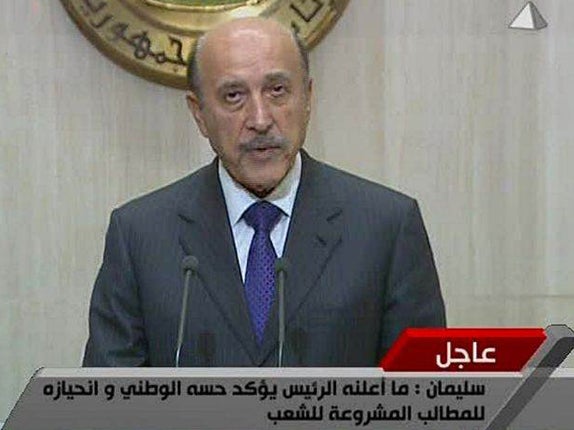
Among the hundreds of thousands seeking Hosni Mubarak's departure in Tahrir Square over the last fortnight, it has been impossible to find any that were prepared to say they would vote in a free election for Omar Suleiman, the Vice-President who assumed much of Mr Mubarak's power last night. But among the few thousand loyal supporters who took part in a pro-Mubarak demonstration in the Muhandiseen district of Cairo last week, it was equally impossible to find one who wouldn't. Given that Mr Mubarak's son Gamal was no longer a possible candidate, Mr Suleiman was the one they preferred.
The contrast underlines how far the close friend and confidant of Mr Mubarak, appointed to be vice-president as the crisis unfolded, had become integral to his rule. Even as the pivotal figure who Washington hoped would usher in enough constitutional and political reform to defuse the crisis, Mr Suleiman has not exactly behaved like a man who thinks that urgent and profound change is necessary. From warning that "foreign" elements might be prolonging the protests, to making clear his view that Egypt was not yet ready for democracy, 74-year-old Mr Suleiman has seemed at times like the public face of the very regime from which he was supposed to be overseeing an "orderly transition."
Mr Suleiman's credentials with Israel, much of the West, some other parts of the Arab world and with Mr Mubarak himself are not in doubt. Born in Qena, Upper Egypt, a graduate of Egypt's military academy and also trained in the former Soviet Union, as well as studying political science at Cairo University, he is a well-educated and street-wise official who prefers civilian clothes to the military uniform.
He has long exhibited deep distrust of Iran, has favoured the cold peace – and considerable security co-operation – with Israel. He has shared – and helped to persuade much of the outside world to share – President Mubarak's almost obsessive preoccupation with the perceived threat from the Islamist Muslim Brotherhood, and the debatable view that the Brotherhood was the most likely alternative to the regime which has lasted for 30 years.
He was credited with saving Mr Mubarak's life in 1995 in Ethiopia by insisting that he travelled in an armoured car; the Egyptian President escaped unhurt when a gunman fired on the vehicle. A recent Wiki-Leaks cable attests to the value put by Washington on its intelligence relationship with Mr Suleiman, but also quotes him as pointing out that a peaceful resolution of the Israel-Palestinian conflict would be a "big blow to terrorist organisations that use it as a pretext".
What is much less clear now is just what role he plays in the future Egypt. Despite his military background, his relationship with the army has sometimes been frictional, a factor which could yet become crucial in coming days and weeks. And the only terms on which he could be remotely acceptable to the protesters, if at all, would be as a genuinely transitional figure prepared to move Egypt much more swiftly towards free elections and democracy.
Of course, if that happened, he could present himself as one of many candidates for the presidency, if for example he was adopted by the hitherto ruling National Democratic Party. What is certain is that the revolution did not seek the victory of ousting Mr Mubarak to see the old Egypt remain in place with another autocrat in power.
The main protagonists
Sami Enan
Chief of Staff of armed forces, popular among rank-and-file soldiers. Seen as having close ties with Washington and viewed by analysts as a more likely leader than his boss, head of the armed forces, Mohamed Hussein Tantawi. The Muslim Brotherhood has spoken of Mr Enan as an acceptable transitional leader.
Mohamed ElBaradei
Respected if not loved, the former head of the UN nuclear inspectorate returned to Egypt after the start of the protests to become a figurehead for the protests. Critics have cited the long time he has spent outside Egypt on his diplomatic missions as proof of his unsuitability for leadership. He called for Mubarak to leave before any talks could start between the government and opposition.
Mohamed Hussein Tantawi
The head of the armed forces who chaired the meeting of senior generals that cleared the way for Mubarak to stand down. The move was significant as Mr Tantawi was close to the president. In leaked cables before he visited Washington, Tantawi was described as "charming" but opposed to reforms.
Ayman Nour
Nour was Mubarak's main opponent in the 2005 presidential elections, castigating the regime for its failure to provide jobs. He trailed a distant second and was jailed for five years for alleged election offences.
Muslim Brotherhood
Largest political and social force but no clear figurehead. Has influenced political movements globally but has been banned for 60 years in Egypt.
Join our commenting forum
Join thought-provoking conversations, follow other Independent readers and see their replies
Comments
Bookmark popover
Removed from bookmarks