Mugabe: the writing's on the wall
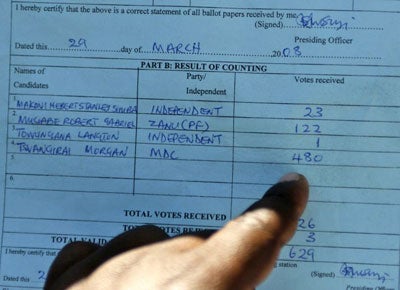
The writing was on the wall for Robert Mugabe last night. It was pinned to the side of polling tents, posted on school fences and written on the walls of community halls. The election results that Zimbabwe's president had made every effort to rig were coming in against him.
First to go were his chief lieutenants as, one by one, they lost their parliamentary seats. The list read like a Who's Who of corruption, fraud, intimidation and robbery: Joyce Mujuru, the vice-president and mistress of a vast confiscated estate outside the capital; Patrick Chinamasa the man who perverted the justice system to serve the regime; and Didymus Mutasa the man who amassed millions of pounds worth of stolen farms.
At least nine of Mr Mugabe's politburo, his inner circle, were out of a job according to official results posted at polling stations in their own constituencies.
As evidence emerged of what appeared to be a landslide for opposition leader Morgan Tsvangirai, Zimbabwe's electoral commission – Mugabe placemen all – were hiding out in the capital, refusing to release results of the presidential poll.
What nobody could stop were independently verified, lawfully reported parliamentary and senate results as the count finished at each of the 9,000 polling stations nationwide. And the early results were stunning.
Provisional findings, leaked to The Independent last night by a senior source at the electoral commission, indicated that Mr Tsvangirai's Movement for Democratic Change had taken 191 of 210 parliamentary seats, with the remainder split between the ruling Zanu-PF and the smaller MDC faction backing the ruling party defector Simba Makoni.
Were those results to be reflected in the presidential contest, as expected, it would deliver a resounding first round victory to Mr Tsvangirai, a former union leader, and bring down the curtain on the only president Zimbabwe has ever known.
There was not a word from the man who turned one of Africa's most promising economies into an impoverished, intimidated and emptying country. Or from the man who withstood beatings, imprisonment and death threats but who, last night, appeared set to replace him.
For that to happen, Mr Tsvangirai would need to collect at least 51 per cent of the vote, otherwise the two leading candidates would go to a run-off in three weeks' time.
Throughout the day, state television ignored the most important election since independence in 1980, broadcasting a bizarre mixture of cartoons, church sermons and 1970s football matches.
At the MDC headquarters in Zimbabwe's second city, Bulawayo, the excitement was palpable as the whiteboards covering the flaking walls began to fill up with poll counts – numbers that could finally amount to change.
Into the middle of the melee was Dorcas Sibanda, a single mother with four young children, and also one of the newly elected MDC MPs for Bulawayo. "In my constituency, [Mugabe] got nothing," she said. "We knew people had made up their mind, we went door to door, and people said he had to go. If he won't go, it will cause chaos, people know what has happened. He needs to pack his bags and leave the State House." Pausing for hugs and high-fives with colleagues, she continued: "They're going into the garbage dump of history where they belong."
Outside, a crowd began to gather and a pick-up truck with speakers parked near by to provide the soundtrack. Activists waved flags and one of them shouted: "This is what we wanted, the country has come back to its owners."
Passing drivers honked their horns as people in MDC T-shirts danced in the traffic. An elderly white couple in a 4x4 rolled down their windows to wave at the dancers who saluted them in unison with their arms raised.
A truck full of riot police rolled by showing little interest, with one officer even smiling at the party that was starting. The head of the city's riot police later returned to ask officials to tone down celebrations, promising an announcement later in the afternoon. By nightfall, there was still no word.
The official silence on the result was stoking tension in the capital, Harare, where police were deployed in the poor townships. Security chiefs gave their full backing to the octogenarian president in the run-up to Saturday's vote and warned that they would not accept an opposition victory.
Even the limited observers that the Mugabe regime had allowed to monitor the election were yesterday declaring serious problems in its conduct.
The head of the Pan-African Parliament observer mission said he was sure most results were known and warned against a delay in releasing them.
"We are trying to exercise as much constraint as possible so as not to contribute to the deteriorating security situation," said Noel Kututwa, explaining why his Zimbabwe Elections Support Network, an independent monitoring organisation, was not releasing any results. "Clearly the delay is fuelling speculation that something might be going on."
The silence was filled with wild rumours: the "old man" had left the country; the military had convened an emergency council; Mr Tsvangirai would declare victory.
One report that could be confirmed was that a senior ruling party member, Elliot Manica, had shot and killed at least one person at a polling station and had been placed under arrest.
Previous elections have followed a similar pattern with early results from urban centres appearing to favour the opposition before returns from rural voters who make up three quarters of the electorate have gone to the ruling party.
David Coltart, who won a senate seat for the smaller MDC faction that was backing Mr Makoni, a Zanu defector and former finance minister, sounded a note of caution. "It looks like a landslide for Morgan but Mugabe is unpredictable," said Mr Coltart, a respected white Zimbabwean lawyer.
And yet everywhere yesterday, people were convinced that this time it would be different. They ignored Mr Mugabe's divide and rule on racial lines and on seeing a white face on the streets, smiling people would stand up at bus stops or wave from windows, all saying the same thing, "We are winning".
* Results of the parliamentary election began trickling out on Monday, 36 hours after polls closed, but no official details were available on the presidential vote.
Latest results showed the opposition Movement for Democratic Change (MDC) and Mugabe's ZANU-PF running neck-and-neck, with 12 seats each from a total parliament of 210 constituencies, according to figures issued by the electoral commission. Reuters
Join our commenting forum
Join thought-provoking conversations, follow other Independent readers and see their replies
Comments
Bookmark popover
Removed from bookmarks