Rebel feud puts UK's Libya policy in jeopardy
Government demands answers after assassination of general
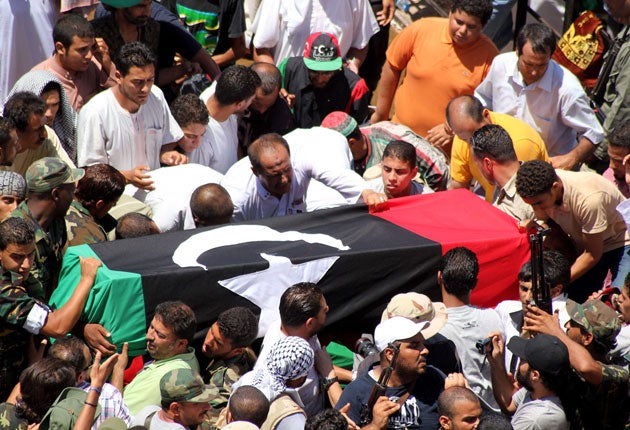
The credibility of the British-backed rebel forces in Libya has been thrown into doubt after the shock assassination of a top military commander led to claims that the movement is enmeshed in a bloody internal feud.
Increasing evidence has begun to emerge that the savage killings of General Abdel Fatah Younes and two other senior officers – who were shot and whose bodies were burnt – may have been carried out by their own side.
The news of the deaths led to outbreaks of violence in the opposition capital, Benghazi, yesterday, with troops loyal to the General and members of the large and powerful tribe to which he belonged, the Obeidis, vowing retribution.
The killings came at a difficult time for David Cameron's government, which just a day earlier had formally recognised the rebel Transitional National Council (TNC) as the representatives of the Libyan state and ordered diplomats of the Tripoli regime to leave the UK. In a speech offering unreserved praise, the Foreign Secretary, William Hague, had praised the rebels' "increasing legitimacy, competence and success." Major Younes is believed to have been under arrest on the orders of the chairman of the TNC, Mustafa Abdul Jalil – a former justice minister under Col Gaddafi – at the time of his death on Thursday evening. Yesterday, as the circumstances surrounding the killing remained hazy, Alistair Burt, a Foreign Office Minister, spoke to Mr Jalil.
"Exactly what happened remains unclear," he said. "I welcome chairman Jalil's statement yesterday that the killing will be thoroughly investigated, and he reiterated this to me during our conversation. We agreed that it is important that those responsible are held to account through proper judicial processes."
Analysts said that it was likely that whoever carried out the assassination was on the rebel side. Fawaz Gerges, director of the Middle East Centre at the London School of Economics, said that "given the infighting among the rebels, probably some elements that are opposed to him did it". He added that whoever was responsible, it was "a major blow to the credibility of the rebels... Paris or London or Washington are probably extremely anxious about this turn of events."
Oliver Miles, a former British ambassador to Tripoli, said that "the most straightforward explanation was that Gaddafi forces had killed Gen Younes – but that did not make it the most likely explanation. He had a lot of enemies. It could be personal; it could be factional within the TNC."
Gen Younes, who had himself served as interior minister in the regime, had been accused of holding secret talks with Tripoli officials and leaking military secrets. The news of his arrest led to men from the Obeidi tribe gathering outside the Tibesti Hotel on Thursday evening, where the rebels were due to hold a press conference, threatening to take action to free the commander unless he was released. Two hours later, in a convoluted statement, Mr Jalil held that Gen Younes had merely been "summoned" for questioning and been released on his own recognisance before being killed in an attack by an "armed gang". Rebel security forces, he maintained, were still trying to find the bodies, but the TNC leader refused to answer questions on how, in that case, he could know that the men were already dead.
Soon after Mr Jalil had left an armed group from the Obeidi tribe opened fire at the hotel with semi-automatic rifles.
Yesterday, at the funeral of Gen Younes, his relations pledged support for the revolution. But units loyal to the commander were said to have left the front line to travel to Benghazi to find out who was responsible for the killings. Inside the city the rebels' 17 Brigade, which pledges allegiance to Mr Jalil and his coterie at the TNC, set up roadblocks.
Meanwhile Mr Jalil's version of events was contradicted by the TNC's military spokesman, Mohammed al-Rijali, who stated that Gen Younes had been detained at the oil port of Brega and brought to Benghazi for interrogation prior to his death. A third rebel official, a senior security officer, Fadlallah Haroun, maintained that three corpses had already been found before Mr Jalil had made his announcement. He could not explain why the TNC leader had failed to mention this at the press conference.
The Gaddafi cronies who changed sides
Mustafa Abdul Jalil
The former justice minister was one of the first defectors from the Gaddafi regime. He was previously a judge with a reputation for ruling against the government. He was made justice minister in 2007 in order to give the regime a more reform-minded hue. Secret US cables revealed by WikiLeaks showed that he received favourable reviews from the US ambassador to the country. He switched sides after seeing regime forces kill protesters when he was sent to Benghazi to try to end the unrest.
Mahmoud Jibril
The head of foreign affairs for the Transitional National Council. He was the former head of the National Economic Development Board founded to encourage investment and growth in Libya, and reporting directly to the leadership. He was seen as someone with whom the United States could do business, and was the recipient of a letter, revealed yesterday by The Independent, from the US Senator John McCain urging him to halt human rights abuses by rebel fighters or risk losing international support.
Khalifa Heftar
A former regime general who symbolised the dysfunctional relationships within the rebel leadership. Mr Heftar was a fierce rival of General Abdel Fatah Younes, who appointed himself head of revolutionary forces after the uprising. Mr Heftar had quit the regime earlier and returned from exile in the United States to appoint himself as rebel field commander. After military setbacks marred early gains for the rebels, the feuding leaders were summoned for a meeting and Mr Heftar was sidelined.
Join our commenting forum
Join thought-provoking conversations, follow other Independent readers and see their replies
Comments
Bookmark popover
Removed from bookmarks