The Big Question: What is going on in Madagascar, and can the African island republic survive?
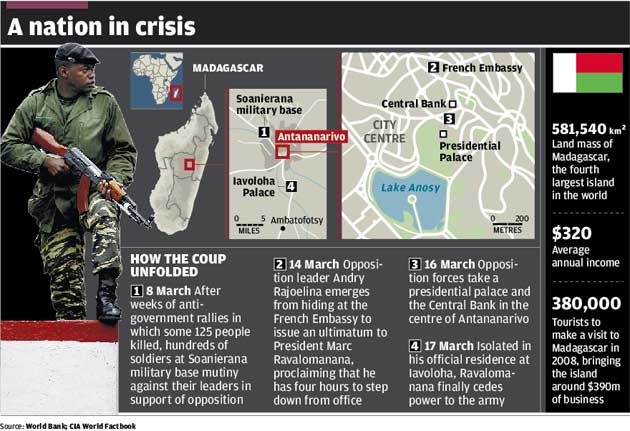
Why are we asking this question now?
After three months of violent unrest, an opposition leader on the vast Indian Ocean island of Madagascar has set himself up in the President's offices in the capital Antananarivo, declaring himself de facto boss. The elected President, Marc Ravalomanana, is holed up at his palace on the outskirts of the city, guarded by a poorly-armed crowd of loyalists. After insisting for days that he would not resign and would fight "to the death" if necessary, he appeared to signal yesterday that he had quit. His departure would hand power to a military board, only a day after the army stormed his city offices in a show of support for his political rival.
Who is the young pretender challenging the President?
In the space of two years, Andry Rajoelina has gone from being a popular disc jockey, to mayor of the capital, to opposition leader, to the verge of becoming Madagascar's acting head of state. His ascent has been so fast that he has been nicknamed "TGV" after France's high-speed train. After making his fortune in advertising, he waded into the mayoral contest in December 2007 and won at a canter.
At only 34, Mr Rajoelina is still six years too young for the presidency, according to the island's constitution, but his populist campaigning style has seen him force his way to the top. He seemed to have overplayed his hand last month when he told the thousands of protesters he had assembled to decry corruption and high food prices that he was now taking charge. The President responded by firing him but, after a brief spell in hiding, Mr Rajoelina returned with more support than ever. Some believe he is a frontman for the former president, Didier Ratsiraka.
Who is actually in charge now?
Mr Ravalomanana's attempt yesterday to hand power to the military rather than to his political foe, Mr Rajoelina, may have been a final attempt prevent the younger man from usurping him outright.
Some 24 hours earlier, Mr Ravalomanana had offered to hold a national referendum on his rule but that offer was dismissed by the opposition, who clearly felt that their man was already in an unassailable position. Vice-Admiral Hyppolite Ramorosan was named head of the military board, but it was unclear with what authority the presidency announced this.
Why has the army sided with the younger man?
The mayor's tactic of daily mass protests in the capital brought a heavy-handed response from the embattled President, with 28 people shot dead in one day of clashes alone. Mr Ravalomanana's attempt to settle the issue by force seems to have ruptured his fragile relationship with the military and, with the death toll now as high as 135, the army has ditched its traditional neutrality. This move came only after a mutiny by younger officers disenchanted with the crackdown, who removed the former chief of staff loyal to the president. In a statement this week, the new army chief, Colonel Andre Ndriarijaona, said: "If Andry Rajoelina can resolve the problem, we are behind him. I would say 99 per cent of the forces are behind him."
Why has the President's popularity plummeted?
Mr Ravalamanana's political ascent was remarkably similar to that of the man who ousted him. A business tycoon who made his way into politics through city hall just as Mr Rajoelina had, he has been compared by some to Italy's Silvio Berlusconi. He set himself up as a modern alternative to the politics-as-usual establishment on the island and won a first term by doing so. But, in his bid for a second term, he faced accusations of election-rigging in 2006 as the island was rocked by rising food prices.
Could there be civil war on the island?
The US ambassador to Madagascar certainly thinks so. Last week, Niels Marquardt warned that the island was on the verge of civil war after the former army chief, Edmond Rasolofomahandry, and the defence minister, Vice-Admiral Mamy Ranaivoniarivo, were forced out by a mutiny. But there has been little sign of a split in the army's rank-and-file, and it remains unclear whether the President has the military backing to take on his rival by force. There have been persistent accusations, all denied, that he has hired foreign mercenaries to re-establish control. The army has deployed tanks to make sure no outside force can threaten the capital.
So who is in charge?
Madagascar's history of upheaval did not begin with independence from France in 1960; it is best understood as a continuation of instability under colonial rule. Its economy was set up to benefit French settlers and a Francophone elite in Antananarivo. This inequality continued undisturbed after independence. France retained military bases on the island into the 1970s, intervening in local power struggles as it saw fit. During that decade, the island off the coast of Mozambique was a laboratory for radical social and economic experiments that courted support from both sides in the Cold War – and was subject to near-constant coups d'état.
Why are most Malagasys still mired in poverty?
The islanders are a mix of Africans and Indonesians, with most in the highlands descended from Asians, and those in the coastal areas more African. The one point of convergence is poverty – with 70 per cent of the population living on less than $2 a day. Recent attempts to take the island into the global economy have brought benefits for big businesses and, in particular, the conglomerate owned by the President, which deals in everything from milk to cooking oil. The poor have seen little change.
What is at stake economically?
Popular resentment at big business has already put the brakes on a multi-million pound deal to parcel off prime farmland to South Korea's Daewoo corporation for intensive agriculture. The political uncertainty has also dealt a heavy blow to the valuable tourism sector. The mining group Rio Tinto has significant holdings on the southern tip of Madagascar, which have so far been unaffected. But further unrest could threaten oil exploration, which has already earned the government millions of pounds from Exxon Mobil.
And what is at stake for the world?
Madagascar is a wonderland of flora and fauna not found anywhere else. It is the fourth largest island on the planet – 1,000 miles from north to south – and is home to spectacular indigenous species such as lemurs and chameleons. Human encroachment has already made countless species, including the pygmy hippo and the elephant bird extinct. Its future development and stability will decide how many of its priceless ecological treasures survive.
What happens next?
The mayor is likely to make the final step with the backing of the army. He has said he wants to lead an interim government for two years before moving to general elections. The new administration would have to amend the constitution to install him in the long term, but in the short there seems little to stop Mr Rajoelina.
Would a presidential change help the island?
Yes...
* Huge protests have shown popular support for a new leader, and the island could get back to work and repair its image
* The overthrow of the President would bring an anti-corruption campaigner into office
* The army is united behind the former mayor of Antananarivo
No...
* A power struggle has been decided on the streets, rather than at the ballot box
* There would be no clear change in ideology with one business tycoon replacing another
* Two more years of uncertainty lie ahead before anyone is given a democratic mandate to rule
Join our commenting forum
Join thought-provoking conversations, follow other Independent readers and see their replies
Comments
Bookmark popover
Removed from bookmarks