The Big Question: Who are the Elders, and can they do anything to resolve world crises?
Why are we asking this now?
The political and humanitarian crisis in Zimbabwe has dropped off the news agenda in recent months, as events there have stagnated and reverted to the deeply depressing status quo. In an attempt to change that, a group of influential world leaders who have now left their public offices arranged a visit.
The group – known as the Global Elders – had intended to draw attention to food shortages and a cholera outbreak. But on Saturday, just when the visit was supposed to begin, the delegation issued a statement saying that it had been barred from Zimbabwe by the Mugabe regime, which refused to issue them visas. That snub has led to questions about the nature of their influence in world affairs – and what good, if any, they can do.
Who are the Elders?
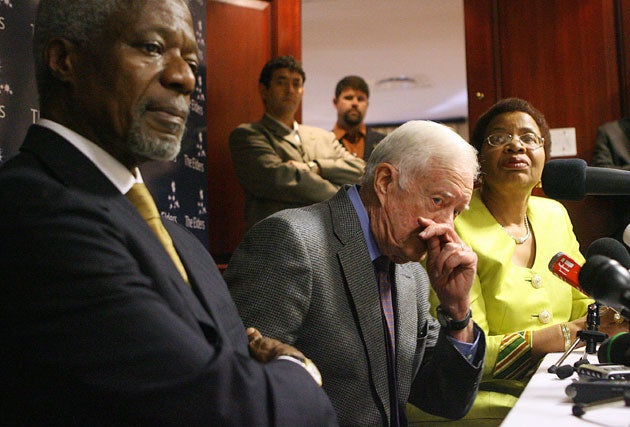
The Elders are a kind of political dream team, a dozen of the most widely respected world leaders alive today, whose glittering CVs and unimpeachable commitment to human rights are supposed to open doors that would remain closed to less feted figures. Their figurehead is secular saint Nelson Mandela; the group also includes Jimmy Carter, Kofi Annan, Archbishop Desmond Tutu, former Irish president and UN Commissioner for Human Rights Mary Robinson, and, in absentia, Burmese democracy activist Aung Sun Suu Kyi. The group may well have the highest concentration of Nobel prize-winners in the world, with five of its 12 members recipients of the honour.
What are they for?
The idea is that they can exert influence and bring attention to humanitarian crises that might otherwise go unnoticed or unsolved. Between the 12 of them, they command access to an unrivalled network of leaders that, in theory, means that they can make a difference in contexts where other means like governmental interventions might have failed.
The whole group meets twice a year, and smaller delegations travel to crisis-ridden areas in the hope of finding solutions. Jimmy Carter argues that the group can "fill an existing void in the world community." "Almost impervious to the consequences of outside criticism," he says, they have "opportunities for unrestrained analysis of important and complex issues, the evolution of suggestions, and for sharing our ideas with the general public and with others who might take action to resolve problems."
How did the Elders come together?
By the good offices of supreme entrepreneur Richard Branson and music pioneer Peter Gabriel. In 1999, the two men had a conversation about the potential benefit of an organisation that followed the "village elders" model of influence, whereby the wisdom of the most senior members of a community carries great weight.
Branson, who had got to know Mandela, broached the idea to him in 2001; and the group formally launched in April last year, with $18m in initial funding that Branson and Gabriel helped to raise. Since then they have worked in Cyprus, Sudan, Kenya, and the Middle East.
Can the model work?
The jury is still out: the group, unlike its members, is very young. It is hard to draw firm conclusions when the Elders' work is always bound to be most effective in the margins, in ways that may not always be obvious to the external observer. "I think their influence could be limited," says Josephine Osikena, Democracy and Development programme manager at the Foreign Policy Centre. "But because they're international elder statespeople, there is some kind of effect. Perhaps they can intervene and discuss in ways that the UK government, for example, can't, because it would be seen as antagonistic."
What evidence of their effectiveness is there?
The relative success of the group's mission to Kenya might be seen as an example of how they can function effectively. The arrival of Kofi Annan et al in January this year was by no means a panacea after violent clashes followed the last election there, and the group could not offer any incentives beyond the weight of their names and experience to the negotiating parties. But, says Sally Healy, Associate Fellow of the Africa Programme at Chatham House, their sheer presence had a calming effect. "They helped to 'freeze' the situation," she says, "and they created a sense that stuff was happening, and so you didn't have to go and fight today."
Their influence, adds Healy, can be particularly powerful in Africa, where government is much more reliant on personal relationships than the kind of systematic approach more prevalent in the West, and where the village elders model is culturally significant. "Someone we might regard as an old has-been might be seen in a different context in Kenya or Zimbabwe," she says. "It's partly to do with tradition, and it's partly weak institutions."
And can they have a negative impact?
Possibly. Many are sceptical of what one newspaper editorial said might be referred to as a "makework scheme for ex-leaders who cannot let go". In Israel, some saw their role as a distraction: "This is not a conflict where people lack heroic leadership," said Robert Satloff, executive director of the Washington Institute for Near East Policy. "These are not issues that tend to lend themselves to whatever these otherwise distinguished stastesmen can contribute."
Earlier this year the Israeli government turned down an offer to mediate a ceasefire with Hamas, with the country's UN ambassador Dan Gillerman saying that "nothing good could come out of this initiative". And, according to Sally Healy, "it would be very foolish to put your eggs in the old boys' mediating network basket without the hard-edged government diplomacy as well."
What happened in Zimbabwe?
Zanu-PF seems to have made a calculation that the negative PR that will result from denying the Elders' access will be less damaging to the regime than letting them in to observe and condemn the government's failure to help people who are starving to death. Mugabe has attempted to cast the group as Western stooges lacking the moral authority to cast judgement in Zimbabwe. (The Zimbabwean government also says that they are only postponing the trip, and that it will take place at a later date, though few believe it.) The Elders' argument that they are not coming to Zimbabwe with a political purpose but a humanitarian one has fallen on stony ground – particularly in the light of previous condemnation of the Mugabe regime by Desmond Tutu, among others.
So can the Elders still have an influence there?
Paradoxically, it may be that Mugabe's decision will actually increase their long-term influence. It confers a sense that the group are capable of meaningful action – why ban anyone whose words would have no consequences? – and raises the profile of the situation in Zimbabwe in a way that might otherwise have been impossible.
The Elders are continuing to work in neighbouring South Africa, and their statements in the aftermath of their ban have emphasised the non-partisan, humanitarian good that they seek to do." "We need no red-carpet treatment from the government of Zimbabwe," said Mr Annan. "We seek no permission other than permission to help the poor and the desperate."
Can the Elders succeed in changing things for the better?
Yes...
*Their connections are remarkable. They can probably get any politician in the world on the phone
*There's nothing like Nelson Mandela making his feelings known about an issue to turn the spotlight on it
*Their separation from governments allows them to pursue what they believe is right
No...
*Past ties to institutions like the UN means they can be dismissed as agents of Western influence
*The temporary blast of publicity they can bring doesn't necessarily lead to tangible results
*The levers available to national governments – like trade sanctions – are far more influential in the end
Join our commenting forum
Join thought-provoking conversations, follow other Independent readers and see their replies
Comments