The dark secrets of the trillion-dollar oil trade
Tankers full of oil its owners don't want to sell. Shady deals with brutal regimes. Vast profits. Pollution scandals. Cahal Milmo investigates a very murky business
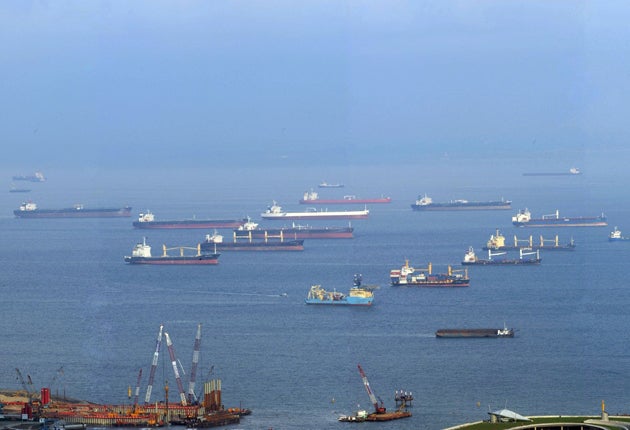
With a combined capacity for 313,000 tonnes of oil, the Delta Ios and the NS Burgas supertankers were launched two months ago to criss-cross the globe in search of trade. Instead, the vast vessels were to be found yesterday lying idle off the coast of Singapore after their owners were paid by two of the world's richest and most secretive oil companies to turn them into floating petrochemical warehouses.
At first glance, the decision by Trafigura Group and Vitol Holding BV to charter the newly built ships at an estimated cost of £47,000 a day to do nothing for up to four months in South-east Asia while laden with cargos of diesel worth at least £77m per vessel makes little economic sense.
When this is combined with the fact that the Delta Ios and the NS Burgas are just two ships in an enormous fleet of tankers which are currently being paid about £80m a month by independent oil traders like Trafigura and Vitol, as well as giants such as Shell, to stay anchored around the globe with anything between 50 and 150 million barrels of redundant crude on board, it seem that the ruthless barons of black gold must be losing money as fast as they can make it.
Far from it. The phenomenon of "floating storage", which has been brought about by a huge over-supply of global tanker capacity and unusual market conditions, is just one example of the multitude of ways in which a small group of private, mostly Swiss-based companies have become adept at turning vast profits from the closed and often murky world of independent oil trading. A glut of oil caused by the recession means that crude available for immediate purchase is currently cheaper than that bought on longer-term or "future" contracts – a practice known as "contango". The result is that independent traders have been rushing to buy the cheaper "spot" oil and storing it wherever they can – namely in under-employed tanker fleets – in anticipation of a sharp rise in price as the global economy begins to recover. The resulting profit can be anything between 15 and 20 per cent – tens of millions of dollars – even after the cost of hiring a tanker is deducted.
It is a situation which prompted one senior oil company executive to declare that the spring and summer of 2009 represented "blessed times for trading". Another oil trader told The Independent: "Contango has been a real boon. The independents have become very adept at buying up tanker capacity as cheaply as possible, sitting on the stock and selling it on via arbitrage. They've been as slick as you like."
The deals are part of a world in which discretion and an ability to keep out of the public eye have long been treasured. While the oil majors such as ExxonMobil, Shell and BP operate as global corporations, the independents or "jobbers" have thrived in the grey zone of fast trading-room deals and personal contacts that allow access to lucrative oil reserves.
But increasingly the activities of the "big four" independent traders – Trafigura, Vitol, Gunvor (which has consistently denied reports that it is linked to the Russian Prime Minister, Vladimir Putin) and the hugely successful Glencore – are coming under scrutiny. Questions are being asked about their role in uniting the oil wealth of some of the world's more unsavoury regimes with the open market.
Trafigura, which until August 2006 was barely known outside the oil trade – despite growing to become one of the world's biggest companies with a turnover of $73bn (£46bn) since it was founded 16 years ago – last week found itself making headlines around the world when it agreed to pay about £30m to thousands of residents of the Ivory Coast port of Abidjan who fell ill after toxic oil waste from a ship chartered by the company was dumped by a sub-contractor near the west African city.
The settlement of the claim brought on behalf of 31,000 Ivorians at the High Court in London after tonnes of foul-smelling sludge were fly-tipped in August 2006 was said by Trafigura to vindicate its position that there was no link between the waste and people who died or suffered serious illnesses.
But the Abidjan pollution disaster shone a light into the nature of the way these multibillion-pound "jobbers" of the oil trade make their money. In the case of Trafigura, the events of August 2006 were just part of a deal conducted across three continents in which a cheap, low-quality form of oil known as coker gasoline bought from a Mexican refinery was further refined in Europe, and the subsequent fuel was sold at a profit of about $7m per cargo.
Oil industry insiders have told The Independent that coker gasoline is just one of a myriad of methods used by independent traders to turn a profit, ranging from "paper" deals struck in the City of London's trading floors, to floating storage, to what is known as "physical trading" – transporting hundreds of consignments of different grades of oil on chartered tankers looking for the best price from dozens of offices across the globe. Executives, who are frequently equity partners in the companies, speak of constant shuttling around the world to close deals and negotiate prices.
By any standards, it is a huge and profitable industry. From a situation 20 years ago where the "majors" dominated the international trade, independents now account for about 15 per cent of world's $2 trillion oil industry.
Glencore, founded in 1974 by the controversial trader Marc Rich – who was indicted for tax evasion and later pardoned by President Bill Clinton – is estimated to supply 3 per cent of the world's daily oil consumption. The company is no longer involved with Mr Rich.
Between them, the "big four" had turnovers last year of about $415bn – equivalent to the GDP of Austria. Because the companies are privately owned, comprehensive profit figures are hard to come by, but Glencore announced a profit of $4.75bn for 2008. Trafigura made $440m last year.
In an industry which deals with a commodity for which many countries have gone to war, insiders say it is inevitable that traders will find themselves dealing with authoritarian oil-rich regimes and dabbling in controversial schemes. On at least one occasion, three of the big four – Glencore, Trafigura and Vitol – have been found to have crossed the line between incentives and kickbacks through their involvement in the United Nations' oil-for-food scheme to help Saddam Hussein's Iraq buy humanitarian supplies.
In the UN's Volcker report, all three companies were cited for paying surcharges demanded by Saddam's regime to win oil supply contracts. In 2007, Vitol pleaded guilty in America to paying $13m in surcharges, and the Swiss arm of Trafigura forfeited $20m. Both companies insisted that the deals had been handled in good faith via third parties. Glencore, which was cited for paying $6.6m in surcharges, denied any wrongdoing.
Glencore was also named in a 2005 High Court judgment as one of the companies which handled shipments of oil sold by the state-owned oil company of Congo-Brazzaville in central Africa. It was subsequently shown that cash derived from the shipments was used by the son of the country's President to pay credit card bills for shopping sprees in Paris. There was no suggestion that Glencore acted improperly.
All of the "big four" point out that they operate in accordance with international law and the Organisation for Economic Co-operation and Development's guidelines on business conduct. But campaigners complain that a lack of transparency in the industry means that proper scrutiny of the oil-rich governments in Africa and the middlemen they deal with is impossible.
Gavin Hayman, director of campaigns for Global Witness, said: "These companies play a major role in selling Africa's oil and their operations are notoriously opaque. It would be legitimate to ask: 'How do they get these contracts, do they sell the oil for its proper price, and do they send the money back to the correct place?'
"This lack of transparency creates a big risk that corrupt officials can siphon off some of the profits and deprive ordinary citizens of their rightful benefit from natural resource wealth."
Join our commenting forum
Join thought-provoking conversations, follow other Independent readers and see their replies
Comments