The price of food is at the heart of this wave of revolutions
No one saw the uprisings coming, but their deeper cause isn't hard to fathom
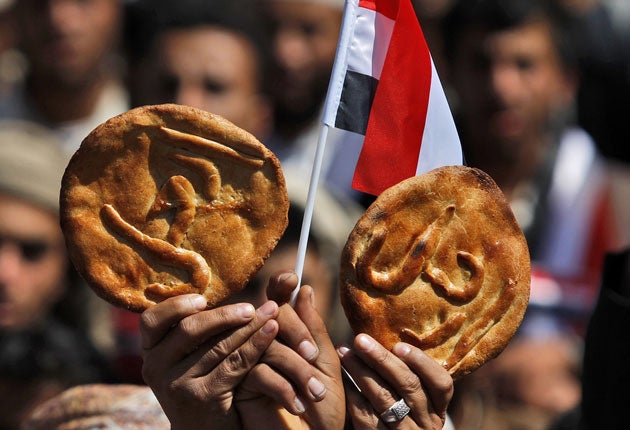
Revolution is breaking out all over. As Gaddafi marshals his thugs and mercenaries for a last-ditch fight in Tripoli, several died as protests grew more serious in Iraq. Saudi Arabia's King Abdullah tried to bribe his people into docility by splashing out $35bn on housing, social services and education. Across the water in Bahrain the release of political prisoners failed to staunch the uprising. In Iran, President Ahmadinejad crowed about chaos in the Arab world, but said nothing about the seething anger in his own backyard; in Yemen, the opposition gathers strength daily.
And it's not just the Middle East. This is an African crisis: Tunisia, where it started, is an African country, and last week in Senegal, a desperate army veteran died after setting fire to himself in front of the presidential palace, emulating Mohamed Bouazizi, the market trader whose self-immolation sparked the revolution in Tunisia. Meanwhile, the spirit of revolt has already leapt like a forest fire to half a dozen other ill-governed African nations, with serious disturbances reported in Mauritania, Gabon, Cameroon and Zimbabwe.
Nowhere is immune: dozens of activists in China are in detention or under other forms of surveillance, and the LinkedIn network was shut down as authorities seek to stamp out Middle East-style protests there. In what is arguably the most repressive state on the planet, North Korea, the army was called out and five died in the northern city of Sinuiju after violent protests erupted there and in two other cities. The generals who rule Burma under a trashy façade of constitutional government were keeping a close eye on the Middle East, ready to lock up Aung San Suu Kyi again at the first sign of copycat disturbances.
Nowhere is immune to this wave of rebellion because globalisation is a fact; all the world's markets are intricately interlinked, and woe in one place quickly translates into fury in another. Twenty years ago, things were more manageable. When grain production collapsed in the Soviet Union during the 1980s and what had been one of the world's greatest grain exporters became a net importer, the resulting surges of anger brought down the whole Communist system within a couple of years – but stopped there. Today there are no such firebreaks, and thanks to digital communications, events happen much faster.
Why are all these revolutions happening now? Plenty of answers have been offered: the emergence of huge urban populations with college degrees but no prospect of work; the accumulation of decades of resentment at rulers who are "authoritarian familial kleptocracies delivering little to their people", as Peter Bergen of the New America Foundation put it; the subversive role of Facebook and Twitter, fatally undermining the state's systems of thought control.
Absent from this list – to the combined bewilderment and relief of the US and Europe – are the factors that were universally supposed to be driving populist politics in the Middle East: Islamic fundamentalism coupled with anti-Zionism and anti-Americanism. As one Egyptian pointed out after the fall of Mubarak, at no point during weeks of passionate revolt did either the Israeli or the US embassies become a target of the crowd's fury, even though both are within easy reach of Tahrir Square. "Not so much as a Coke can was thrown over the wall," he said.
Of course, that does not mean that allies of al-Qa'ida will not seek to exploit the growing chaos in Libya in particular, striving to turn it into a new Somalia-sur-Med. Nor does it guarantee that any of the other revolts will produce stable democracies. Because the real cause of these revolutions, beyond all the chatter about social networks, is a problem that is liable to get worse in coming years rather than better, and that is largely beyond the power of anyone to contain or control.
The first warnings of what was to come appeared in the form of a briefing paper on the website of the UN's Food and Agriculture Organisation in December. "Recent bouts of extreme price volatility in global agricultural markets," it said, "portend rising and more frequent threats to world food security. There is emerging consensus that the global food system is becoming more vulnerable and susceptible to episodes of extreme price volatility. As markets are increasingly integrated in the world economy, shocks in the international arena can now transpire and propagate to domestic markets much quicker than before."
The "shocks" all occurred a long way from Cairo and Tunis. They included fires in Russia last autumn which wiped out hundreds of thousands of acres of grain; heavy rains in Canada, destroying the wheat crop there; hot, dry weather in Argentina which destroyed the soybean crop; the Australian floods which ruined the wheat harvest. The Middle East accounts for one-third of worldwide wheat imports. The combined effect of these far-flung agricultural problems was to bump up the food price index by 32 per cent in the second half of 2010.
The FAO likens "extreme price volatility" to great natural disasters – major earthquakes, tsunamis, catastrophic cyclones. "Historically, bouts of such extreme volatility... have been rare," they say. "To draw the analogy with natural disasters, they typically have a low possibility of occurrence but bring with them extremely high risks and potential costs to society."
A similar chain of unconnected farming catastrophes in early 2008 led to a similar outbreak of "extreme price volatility" around the world which provoked food riots in more than 40 countries, from Haiti to Bangladesh, including Mexico, Uzbekistan and Eritrea but also involving several countries caught up in the present round of uprisings, including Egypt, Yemen, Morocco, Mauritania, Senegal and Zimbabwe. All were among the 80 countries around the world that combine low incomes with food deficits – the need to import food, bringing exposure to wildly fluctuating world market prices. In these poor countries, food purchases can consume 70 per cent of income. The result, when prices of flour and grains shoot up by 30 per cent, is extreme distress – the sort of distress that sends people out into the streets in fury.
Abdolreza Abbassian, FAO's chief economist saw – in his dry, cautious, academic manner – the present turmoil coming. "It's getting a little bit uncomfortable," he said back in December. "A lot of countries, especially the poorer ones, have to rely so much on world markets. They have to import food at much higher prices. Whether or not this will lead to domestic problems, turmoil, demonstrations, riots, the kind of things we saw in 2008, it is not possible to predict."
For the poor of the Middle East, the price shocks at the start of this year were like experiencing a second killer earthquake in three years – but unlike with an earthquake, there was someone you could blame. So angry were the food price protesters in Tunisia that, after Mohamed Bouazizi set fire to himself, President Zine el-Abidine Ben Ali declared a state of emergency and promised to reduce the price of food. But it was too little, too late: by mid-January he was gone.
Tunisia's turmoil, warned The Washington Post as the toppled president flew off into exile, "has economists worried that we may be seeing the beginning of a second wave of global food riots". As we know now, it turned out somewhat differently. Food riots in 2008, revolutions in 2011 – what, where, who is next?
Join our commenting forum
Join thought-provoking conversations, follow other Independent readers and see their replies
Comments