The vast and complex military machine will decide its nation’s future
No leader will be able to take control without the army’s backing
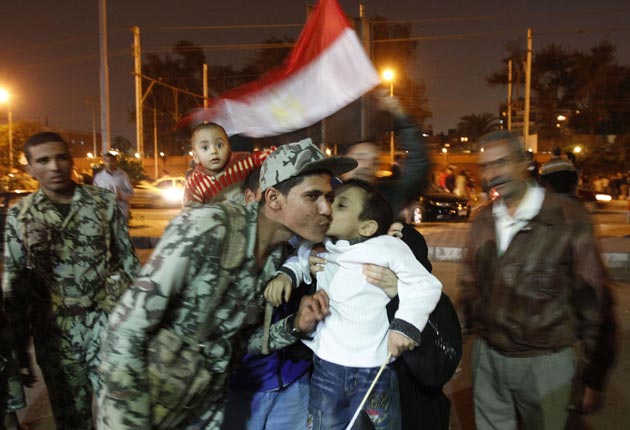
The half-million man Egyptian military is the largest in Africa and 11th largest in the world.
Since it started in the late 1970s, US military aid to Egypt has totalled a staggering $40bn (£24.9bn). It is now charged, since the collapse yesterday of the 30-year-old Mubarak regime, with running the country.
Some 40 per cent of troops are conscripts, suggesting that, despite its size, and its influence over Egyptian society, it is yet to make the transition to being a professional military force. Personnel structures remain rigid, there is no recruitment channel from the ranks of non-commissioned to commissioned officers and a single re-enlistment choice for conscripts is for 20 years further service.
However, the internal structures belie the fact that the military is central to the narrative and historical reality of the emergence of contemporary Egypt, a message that is driven home not least by an impressive array of military museums, through curricula for the teaching of Egyptian history, and in the media, which lionises the past and present roles of the military.
No opposition political party dares be openly critical of the military, because not only does such criticism cross an informal "red line" drawn rigidly by the government, but also because such criticism would not strike a chord with most Egyptians.
The encroachment of the military into civilian domains, such as sports, is scarcely noticed and apparently not resented, as the much cheered victory in the 2010 Egyptian Cup of the Border Guards' football team attests.
Tangible economic and political interests underpin the military's popularity. It commands a sprawling economic empire that produces a vast array of military and civilian goods and services, none of which appears in the national budget. Close observers liken Field Marshal, Minister of Defence and now head of the Higher Military Council that took control of Egypt yesterday, Mohamed Tantawi, to the CEO of the largest corporate conglomerate in Egypt.
In the mid 1980s the World Bank urged that military companies be sold to civilian interests as part of the broader privatisation programme, advice that was rejected out of hand. Since then the military economy has continued to expand. Paradoxically, it has itself benefited from the privatisation programme, with formerly state owned civilian enterprises being handed over to military control.
That control is embedded in the constitution, which empowers the president, whoever that may eventually be, to determine the composition of the officer corps and to select the cabinet, hence to choose the Minister of Defence and Minister of Military Production, the latter presiding over the military economy.
Field Marshal Tantawi has long held both portfolios, suggesting the degree to which the military and its economic empire are intertwined and control over them centralised. The only civilian employees in the Ministry of Defence are said – and not jokingly – to be those who serve tea and coffee.
In more regular times, under the Egyptian constitution, neither the legislature nor civil society can exert any meaningful control over the military.
Civil society has been largely passive in the face of the military's autonomy. It has no access to relevant information about the armed forces, as attested to by Egypt's rank at the very bottom of Global Integrity's ranking of citizen's access under law and in practice to governmental information, its scores being zero on both dimensions. The asymmetry of information between the military and civil society has steadily tilted more in the former's favour over the past three decades. The media reported more information on defence and military matters in the 1980s than subsequently. A European defence attaché's lament that he learned more from the internet about the Egyptian military than he did during his three years in office in Egypt, reflects the information blackout that has been successfully imposed.
The political opposition, even if it wants to, cannot rapidly gain popular traction with a campaign to subject the military to civilian control, reduce it in size and restrict its role in the economy, a change that, even now, would be remarkable.
At present, despite its undoubted achievements in mobilising millions of Egyptians in protest against the established and military-backed political order, the opposition is not substantially more popular than the armed forces.
As manoeuvring around the establishment of the new political order intensifies, most if not all viable contenders, including the Muslim Brotherhood and other elements of the opposition, to say nothing of the new Vice President, the Minister of Defence and the rest of the high command, recognise that the military will probably be the single most important factor in determining its outcome.
Some members of the opposition may seek to strike a deal with the military to retain some power.
The writer is Professor in the National Security Affairs Department at the Naval Postgraduate School Monterey, California
Join our commenting forum
Join thought-provoking conversations, follow other Independent readers and see their replies
Comments
Bookmark popover
Removed from bookmarks