Thousands massacred as two tribes go to war in South Sudan
UN peacekeepers tell residents of Jonglei state capital to flee as raiders approach
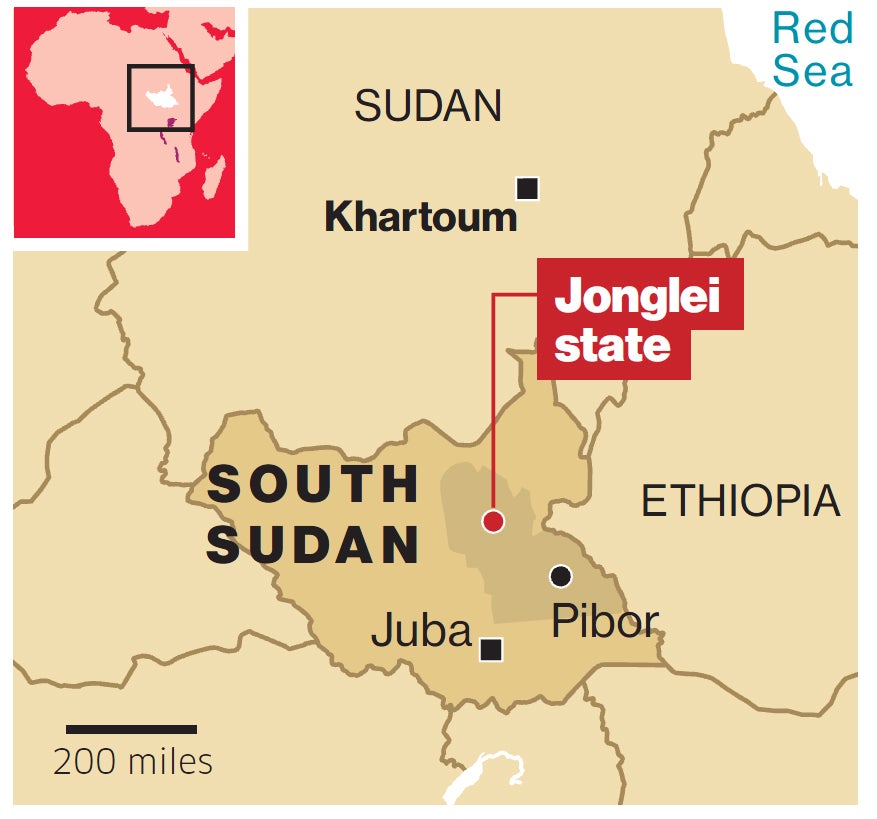
More than 3,000 people have been reported killed in South Sudan during a week of clashes between two tribes in the world's newest state.
Hundreds of children are missing and entire villages are said to have been burnt as a huge raiding party from the Lou Nuer tribe swept through a remote area in the east of the country, attacking their neighbours, the Murle people.
The war party, estimated to be 6,000-strong, has been marching south towards the main town in the Murle area, Pibor, crossing hundreds of miles on foot.
The fighting is part of an escalating war of reprisals between two ethnic groups who rely for survival on vast herds of cattle in one of the least developed countries on earth, and launch regular raids to snatch livestock, women and children.
"There have been mass killings, a massacre," Joshua Konyi, commissioner for Pibor county in Jonglei state, told Agence France-Presse. "We have been out counting the bodies, and we calculate so far that 2,182 women and children were killed and 959 men died."
Sightings of the column of Lou Nuer fighters last week prompted the United Nations to send in peacekeepers and the South's security force, the SPLA, to warn residents in Pibor to flee the town.
The UN has confirmed that tens, maybe hundreds, have died but has not been able to give an accurate figure as many of the killings have taken place in small settlements far from any communications.
The Murle's home area in Eastern Jonglei state is among the least developed parts of South Sudan – which only gained its independence from the north in July last year. Mobile phones have only reached Pibor in the last 18 months and beyond a small clinic run by the medical charity MSF, there is no healthcare facility for hundreds of miles.
Only dirt tracks connect the town to the outside world and it is cut off completely for half the year during the rainy season, when planes often cannot land on its waterlogged airstrip.
Due to their isolation and rumoured involvement in child abduction, the Murle are widely distrusted by the country's major tribes, the Dinka and Nuer. Their relative exclusion has seen very few Murle take senior roles in South Sudan's new government or in the powerful SPLA.
Both the Murle and the Lou Nuer dispatch most of their young men to cattle camps, where they are responsible for guarding the community's livestock and live away from the rest of society for months at a time. Large caches of weapons, often left over from two decades of civil war with the north, are stored in many of these camps.
During the dry season raiding parties cross into their rivals' terrain in a series of sometimes epic raids and counter-raids.
Their have been attempts by the government to disarm different factions, especially in the vast state of Jonglei, where many of the clashes have taken place, but the administration has little authority over its outlying areas.
Jonglei state information minister, Isaac Ajiba, would not confirm or deny the claims made by commissioner Konyi, who is an ethnic Murle. "Yes, there have been casualties, but we don't have the details," he said.
South Sudan's army spokesman, Philip Aguer, said he was waiting for his troops on the ground to report back on casualties: "For the assessment to be credible they must have gone into the villages to count all the bodies."
Join our commenting forum
Join thought-provoking conversations, follow other Independent readers and see their replies
Comments