Ultimatum for Gaddafi loyalists: surrender or face all-out attack
Libyan rebels claim that refusing their offer will result in many more casualties and are in talks with tribes
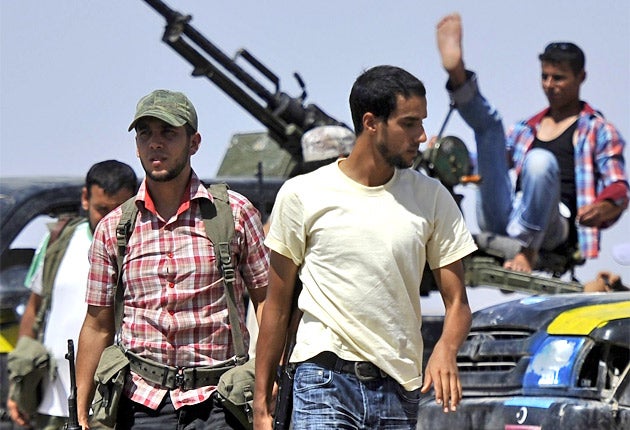
The forces of Muammar Gaddafi continuing to offer resistance will face full-scale military assaults unless they surrender by Saturday, Libya's new rebel government declared yesterday.
Click HERE to view graphic (250k jpg)
The stark message is aimed primarily at Sirte, the dictator's birthplace and the biggest loyalist stronghold left in the country. It also affects other pockets of supporters under siege, including the towns of Sabha and Bani Walid.
There is persistent speculation that Colonel Gaddafi has fled to one of the few towns still under the control of his supporters. Algeria, which has given refuge to members of his family and was seen as a possible bolthole, is said to have decided that it will hand over the Libyan dictator to the ICC (International Criminal Court) – which has issued a warrant for his arrest – should he enter the country.
The Libyan rebels have scathingly criticised Algeria for letting in the Gaddafi family members. But, according to reports from Algiers, President Abdelaziz Bouteflika told the cabinet that Algeria would respect international law. Colonel Gaddafi's wife and children, who crossed the border on Monday, are not wanted for war crimes.
The dictator's wife, Safia, his daughter, Aisha, and sons Hannibal and Mohammed, along with their spouses and children, had crossed over the border just before 9am on Monday. The convoy – which consisted of several Mercedes limousines and a bus – had to stop for a woman to give birth, according to Mourad Benmehidi, Algeria's permanent representative to the United Nations. The health ministry in Algiers claimed the mother was Aisha and the baby, born without any medical help, was a girl. Mr Benmehidi stressed the family members had been allowed enter on humanitarian grounds and that the rebel administration, the Transitional National Council (TNC), had been immediately informed. There was, he said, a "holy rule of hospitality" in the desert region.
Algeria has, so far, refused to recognise the TNC as the new government, unlike the two other neighbouring states, Tunisia and Egypt. Senior members of the TNC also blame Algiers for playing a part in the refusal of the African Union's failure to accept them as the legitimate rulers of Libya.
In Libya, with fighting still continuing in several areas, Mustafa Abdul Jalil, the head of the TNC, declared in Benghazi that unless there was a "peaceful indication, we will decide this matter militarily. We do not wish to do so but we cannot wait longer". The rebel military spokesman, Colonel Ahmed Bani, added "zero hour is quickly approaching".
The ultimatum – if ignored by the Gaddafi loyalists – threatens to end up adding to what the rebels yesterday estimated was 50,000 deaths in Libya since the uprising began six months ago. "In Misrata and Zlitan between 15,000 and 17,000 were killed and Jebel Nafusa (the Western Mountains) took a lot of casualties," Colonel Hisham Buhagiar, commander of the anti-Gaddafi troops, said. "We liberated about 28,000 prisoners. We presume that all those missing are dead. Then there was Ajdabiya, Brega. Many people were killed there too," he said, referring to towns repeatedly fought over in eastern Libya.
But the onus is still on a negotiated settlement. Colonel Bani said: "We're not negotiating with the (Gaddafi) regime. We're talking to the elders of the various affiliates and tribes."
The Independent revealed earlier this week that the revolutionaries claim progress in talks with the largest clan in Sirte, the Farjan, and their allies, the Hamalah. Members of the Rasoun and the Olad-Wafi, two other "families" who have been traditionally loyal to Colonel Gaddafi and have raised forces for him during the conflict, are also said to be at the point of accepting that the war is now lost despite their best efforts, and there is no dishonour in a cease-fire. Senior figures in the opposition administration say they will strive to avoid a bloodbath in Sirte. The US and European sponsors of the TNC, including Britain, have also urged a negotiated solution to be found to avoid feuds that would undermine post-conflict stability. But Nato has continued its military action, announcing it had hit 22 armed vehicles, three command and control centres, and four radar installations in the Sirte area.
Saturday will also see the end of three days of Eid celebrations, marking the end of the holy month of Ramadan, traditionally a time of reinforcing family and community bonds. "It would be an ideal time to reach a peaceful settlement and we are taking practical steps to try and see that it happens," Mustafa Abdurrahman, a rebel commander with knowledge of the talks, said.
Join our commenting forum
Join thought-provoking conversations, follow other Independent readers and see their replies
Comments
Bookmark popover
Removed from bookmarks