UN accused of standing by while Sudanese forces killed civilians
Daniel Howden hears shocking evidence that international peacekeeping mission did nothing to stop ethnic cleansing
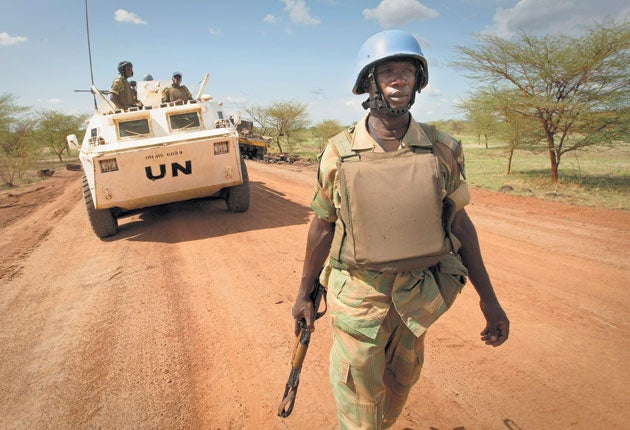
The UN mission in Sudan stands accused of serious failures in its duty to protect civilians who have been killed in their hundreds during a month-long campaign of violence by the Khartoum government on its restive southern border.
Eyewitnesses described to The Independent how they saw peacekeepers standing by while unarmed civilians were shot dead outside the gates of a UN base before being dragged away "like slaughtered sheep". They also said that local leaders have been handed over to government forces after seeking shelter with UN officials.
The violence has driven tens of thousands of civilians into hiding in the Nuba Mountains, which are controlled by rebel fighters and where public anger at the UN has left peacekeepers afraid to leave their bases, according to officers from the mission's Egyptian contingent.
When fighting erupted in the South Kordofan state capital of Kadugli in early June, tens of thousands of terrified civilians flocked to a "safe haven" directly outside the gates of the UN Missions in Sudan (Unmis) base.
Hawa Mando, a school teacher, reached the camp for internally displaced people on 5 June with her family after fighting in the town forced her to flee her home. She witnessed government agents and irregular troops – notorious from atrocities in Darfur – known as the Popular Defence Force entering the camp hunting for people on a list of government critics.
"They had lists of people they were looking for," said the mother of seven. "Local spies would point people out and they would shoot them." She continued: "In front of my eyes I saw six people shot dead. They just dragged the bodies away by their feet like slaughtered sheep.
"People were crying and screaming and the UN soldiers just stood and watched in their watchtowers." Kouider Zerrouk, an Unmis spokesman based in Khartoum, denied that peacekeepers had stood by while civilians were killed but did not elaborate.
The Khartoum regime has been attacking the South Kordofan region for at least a month as tensions rise before South Sudan's declaration of independence tomorrow. The devastating military onslaught against forces loyal to the one-time rebel Sudan People's Liberation Army was preceded by repeated warnings that government forces were building up in the border region, which will be of crucial importance to the North as its main source of oil. Western aid workers have called the campaign "ethnic cleansing" of the Nuba people which the UN has done nothing to prevent.
With their ugly echoes of the UN's failure to protect civilians during the massacre of Bosnian Muslims at Srebrenica in 1995, the allegations are a troubling addition to the organisation's difficulties as it attempts to ensure that South Sudan's move to independence goes smoothly. The incendiary claims come against a backdrop of bitter suspicion of the UN. Angry locals in South Kordofan have accused UN forces of failing in their duty to investigate the bombing of civilian areas and of retreating into their bases in violation of the mandate from the Security Council.
Under the terms of the mandate given to the mission by the UN Security Council the peacekeepers were "authorised to take the necessary action... to protect civilians under imminent threat of physical violence".
The failure to protect civilians displaced by the fighting who sought shelter at the base has led to accusations that the UN force was not neutral. Resolution 1590 which created Unmis further calls for "particular attention" to be given to the protection of "vulnerable groups including internally displaced persons".
There are no independently confirmed figures for the number of casualties from the fighting and humanitarian organisations working in the area have had to evacuate their staff. Estimates from local doctors suggest at least 600 people have been killed.
The UN mission is accused of ignoring repeated warnings of a military build-up in the state and allowing government forces to camp right next to the Unmis base in Kadugli.
In a letter copied to the UN head of mission in the town prior to the fighting, a local Nuban leader, Abdel Aziz Adam al-Hilu, questioned the presence of "combat troops and vehicles" which were "adjacent" to the peacekeepers' base. "What is the relation between your forces and these forces?" his letter asked, but no explanation was forthcoming. The Unmis spokesman Mr Zerrouk told The Independent that the organisation had tried, but failed, to persuade the authorities to set up the camp elsewhere.
After the shooting started and it became clear that Mr Abdel Aziz and his supporters were being targeted in house-to-house searches many activists tried to reach the haven at the camp for displaced people outside the UN base.
Unmis officials are also accused of selectively preventing civilians with links to opposition groups from sheltering there. Najda Romeo-Peter, a civil servant at the governor's office, said she saw UN officials standing with government agents and soldiers at the camp gate when they refused to allow in known activists from the opposition SPLM party: "They were told the camp was full and they were turned away.
"They [the activists] knew they would be killed so they refused to leave but the peacekeepers forced them away."
The names of two local Nuban Unmis staff, Nimeri Philip and Juma Bahar, were also given to The Independent – both men were killed by government forces, according to witnesses, while trying to assist civilians near the base.
Additionally civil servants working in the state government were arrested while on board an evacuation flight bound for southern Sudan. The witness testimony was backed by the Bishop of Kadugli, the Rt Rev Andudu Adam Elnail, whose church was burned down and who has sought refuge in the US. "When the SAF [government] troops came, the UN handed the civilians to SAF and they were killed," he said.
Unmis reports have seriously underplayed the almost daily bombing raids over the Nuba Mountains by Northern government forces, according to local monitors. The alleged complicity of the UN mission – which is dominated by Egyptian troops – has stoked outrage among the local Nuba population. On 27 June dozens of women and children marched to the gates of the Unmis base in the rebel-held town of Kauda where they presented a petition outlining repeated failures to enforce the mandate to protect civilians and investigate violations of the 2005 peace agreement.
"The UN is not neutral," said the woman who led the march, whose name cannot be given for security reasons. "They are doing nothing to protect us so they should go."
The Sudan expert John Ashworth said that the reports from South Kordofan were part of repeated failures by the UN to remain neutral in Sudan's internal conflicts. "This isn't the first time that we're hearing about Egyptian peacekeepers" failing to fulfil their duties, he said. Mr Ashworth accused the UN of allowing Khartoum to dictate which nationalities would be used where in peacekeeping forces: "They choose either countries where they're linked by culture and religion or countries where they are linked by oil.
"The international community doesn't understand how clever the Khartoum government is and the UN has been manipulated repeatedly," he said.
"It has been going on so long we can't say it's inadvertent any more," he added. At the Unmis base in Kauda, an Egyptian captain, Mohamed el-Kadawy, said they had stopped patrols for the last two weeks and that it had become "too dangerous" for his men to go outside. He denied the existence of any deal between the northern government and his commanders but said his men were not there to "make peace" but to "observe". "It's not safe for us here. We are waiting to hear from Khartoum when we will leave."
Q&A: An oil region of crucial importance
Why is the Khartoum government attacking South Kordofan?
The attacks over the past month have been motivated by the regime's perception that rebels loyal to the breakaway South – particularly the Sudan People's Liberation Movement – have gained sway in the region. The region is of vital importance to the North because it is now the only significant source of oil.
Why have the attacks taken place in the build-up to Saturday's independence?
Many civilians in South Kordofan are loyal to the ex-rebel army of what will now be South Sudan, the SPLA. Analysts say the attacks are a deliberate attempt by President Omar al-Bashir to suppress further secessionist feeling in what remains of the north of the country. The Khartoum regime has become increasingly concerned that the declaration of independence will act as a rallying call to northern rebels.
Why might the UN be reluctant to intervene?
Some analysts believe that the Egyptian peacekeeping forces are sympathetic to President Bashir's cause and so have been ineffective in policing his forces in the region. The forces' leadership are said to prioritise the maintenance of Egypt's relationship with Sudan over the good of the population. Locally, UN forces say it has become too dangerous to leave their bases as often as necessary to fulfil their duties.
Join our commenting forum
Join thought-provoking conversations, follow other Independent readers and see their replies
Comments
Bookmark popover
Removed from bookmarks