UN moves to stop another bloodbath in Ivory Coast
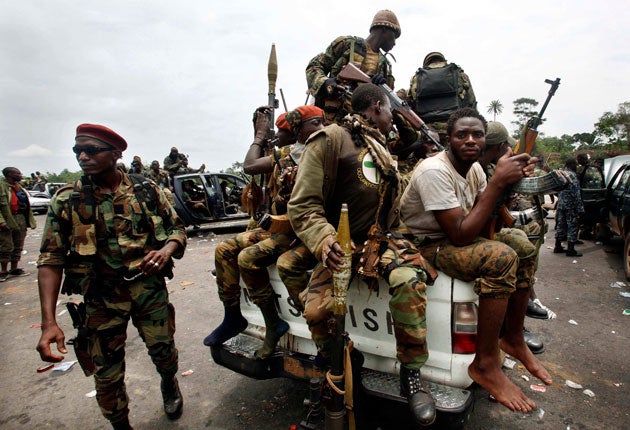
The United Nations and France joined the offensive to dislodge Ivory Coast's presidential pariah Laurent Gbagbo last night, launching air strikes against forces loyal to the man who has refused to cede power after losing an election.
The battle for Abidjan took on an unprecedented international aspect as the UN responded to days of attacks against its peacekeepers by stretching its mandate to protect civilians to the maximum with a show of force.
Witnesses claimed that opposition forces had succeeded in taking control of the presidential palace, although the whereabouts of Mr Gbagbo remained unclear. UN attack helicopters fired missiles on an Ivorian military camp. "There was a massive explosion and we can still see the smoke," said one.
In what appeared to be a premeditated move to support the forces of Mr Ouattara, France quickly authorised its military to join in the UN campaign. Last night, the attack was intensified with rockets fired at targets close to Mr Gbagbo's official residence in Abidjan.
Ivory Coast's rival presidents have been locked for days in a violent stand-off in the commercial capital, with hundreds of thousands of civilians trapped amid the fighting.
The sudden escalation came after diplomats in New York confirmed warnings by the UN's special representative to Ivory Coast, Choi Young-jin, that peacekeepers were planning to use "air assets" to fire back at Gbagbo forces who have wounded 11 UN personnel in recent days.
An especially strongly worded resolution passed last week by the UN Security Council condemned "in the strongest terms the recent escalation of violence throughout the country which could amount to crimes against humanity". The unanimous resolution also stressed the Council's "full support" for the UN peacekeeping force in Ivory Coast "to use all necessary means to carry out its mandate to protect civilians under imminent threat of physical violence... including to prevent the use of heavy weapons against the civilian population."
Hundreds of fighters loyal to Mr Ouattara, who won November's election, were seen moving into the centre of the port city last night after promising to launch a "final push" against the incumbent. Militiamen loyal to Mr Gbagbo, who called on his supporters to make a last stand against a "French plot" to oust him, were reported to have seized foreign hostages from a hotel close to the presidential palace. Armed men entered the Novotel in Abidjan where the foreign media were sheltering. Residents said that at least two people had been taken hostage.
The first signal of a dramatic shift in the UN strategy came from UN chief, Mr Choi, who told the BBC earlier in the day: "We are planning action. We can no longer condone their [Mr Gbagbo's forces'] reckless and mindless attack on civilians and the United Nations blue helmets with heavy weapons."
While international anger at the Gbagbo regime has been mounting there will be concern that the UN, which is due to hold a Security Council meeting today, does not overreach by engaging in a second conflict so soon after sanctioning military action in Libya.
Last night's offensive appeared to stretch to the limit the mandate for the international peacekeeping force, including 1,650 French troops, which is limited to protecting civilians.
Over the weekend the UN airlifted all civilian staff out of Abidjan after repeated attacks by Mr Gbagbo's presidential guard. Analysts said that the former university professor may have overplayed his hand by openly inciting attacks on foreigners and blaming the French for a "Rwanda-style" genocidal plot against his supporters.
US Secretary of State Hillary Clinton has called on the UN to "aggressively enforce" its mandate to protect civilians.
In an uncharacteristically belligerent interview, Mr Choi said that plans were under way to use the UN's air power in Abidjan. "We will be using our air assets... We will be taking action soon," he said.
The UN in Ivory Coast has a Ukrainian aviation unit with three Mi-24 attack helicopters, as well as lightly armed Mi-8 and Mi-17 utility helicopters. One of the Mi-24s was reported to be the aircraft used last night.
During the day yesterday, sporadic gun fire and occasional heavy weapons barrages were heard near the presidential palace. The Ivorian army chief who took shelter in the South African embassy over the weekend rejoined Mr Gbagbo's forces yesterday in an apparent boost to his military strength.
A spokesman for the UN mission said they were expecting 2,000 more troops to arrive "imminently". Hamadun Toure said negotiations to avoid a large-scale confrontation were a non-starter as there was "no one to talk to" on Mr Gbagbo's side.
"We are now in a way under siege, so we cannot go out freely, [they're] targeting us with snipers, it's a deliberate shoot at United Nations," said Mr Choi.
"For the last few days we have 11 [peacekeepers] wounded by their gunshots. They are targeting the headquarters, they cut off the water... and we are now in the bunker."
Before formally joining the UN mission last night France, the former colonial power, sent in 150 more troops to strengthen its Force Licorne. French troops, who are governed by the same limited mandate as the UN force, control Abidjan's airport. They have begun to take the estimated 12,000 French citizens who are still in the country to three protected sites so they can be evacuated.
In London, the Foreign Secretary William Hague said a rapid deployment team had been despatched to help evacuate the "small number" of British nationals who have so far ignored warnings to leave Ivory Coast.
Conflict timeline
By Richard Hall
2 December 2010 After years of fighting and delays to the vote, Alassane Ouattara is declared the winner of a presidential election in Ivory Coast with 54.1 per cent, compared to 45.9 per cent for Gbagbo.
3 December The Constitutional Council reverses the decision of the electoral commission, saying votes in many districts should not have been counted because Ouatarra supporters had intimated voters. Gbagbo is declared the winner. The ruling results in street protests.
23 December The UN recognises Ouatarra as Ivory Coast's legitimate leader, and rescinds the credentials of Gbagbo's UN ambassador.
31 December Gbagbo denounces outside intervention in Ivory Coast as a coup d'etat, as violence continues to escalate around the country.
4 March 2011 Thousands protest against Gbagbo's refusal to leave power. Six women protesters are killed by security forces during demonstrations.
30 March The UN Security Council passes a resolution demanding an immediate end to escalating violence in Ivory Coast, and imposes sanctions on Gbagbo.
2 April Aid agencies report masskillings in the Ivory Coast city of Duekoue, captured by fighterssupporting UN-recognised president Alassane Ouattara. The Red Crosssays at least 800 civilians were killedin inter-ethnic violence in a singleneighbourhood of the city in thepreceding few days.
3 April French and United Nations peacekeepers take over the airport in Abidjan, Ivory Coast's largest city. Fighters from both presidential camps amass in the city.
4 April A UN helicopter fires on incumbent Laurent Gbagbo's compound, as France authorises its military to destroy his heavy weapons. The day's events mark a dramatic escalation in the international community's efforts to oust the entrenched leader.
UN resolution 1975
Extract from last week's resolution, which the UN believes gives it authority to take military action to protect UN forces and civilians:
The Security Council...
* Considering that the attacks currently taking place in Côte d'Ivoire against the civilian population could amount to crimes against humanity...
* Determining that the situation in Côte d'Ivoire continues to constitute a threat to international peace and security...
* Recalls its authorisation and stresses its full support given to the UN Operation in Cote d'Ivoire, while impartially implementing its mandate, to use all necessary means to carry out its mandate to protect civilians under imminent threat of physical violence, within its capabilities and its areas of deployment, including to prevent the use of heavy weapons against the civilian population and requests the Secretary-General to keep it urgently informed of measures taken and efforts made in this regard.
Join our commenting forum
Join thought-provoking conversations, follow other Independent readers and see their replies
Comments