UN's most expensive mission exposed as farcical shambles
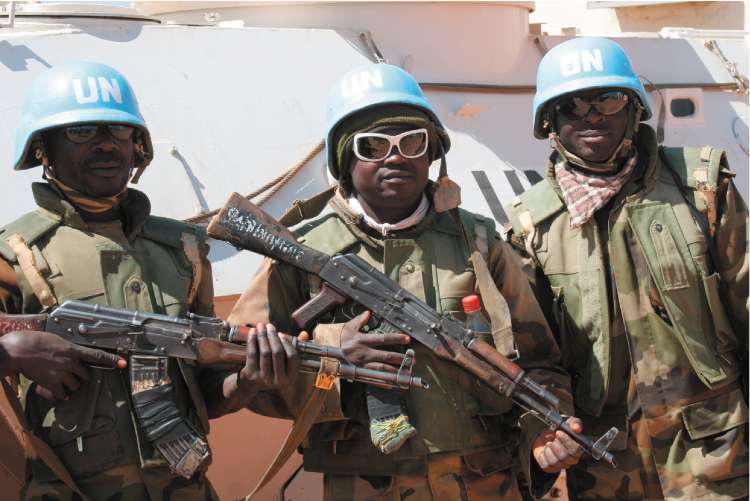
Almost six months after the United Nations launched its largest, most expensive and most hyped peacekeeping mission, promising to send 26,000 peacekeepers to Darfur, the operation is failing to protect the people it was sent to save.
Just one third of the military personnel and one quarter of the police have been deployed in what has been billed as the biggest and most important mission in the UN's 60-year history. It is now threatening to turn into its most catastrophic failure. No new equipment has arrived. Peacekeepers have had to paint their helmets blue (or put blue plastic bags over them, tied on with elastic).
To cap it all, the general leading the force, Martin Luther Agwai, revealed he had considered quitting because "I thought the world didn't care about us". Only after reading a self-help book, Stop Worrying and Start Living, did he decide to stay.
To date, not a single additional soldier has arrived since the joint UN and African Union mission was born at the start of the year to help protect seven million Darfuris in Sudan's western province from militia and rebel attacks, and banditry. The joint mission took over from its under-resourced and under-funded AU predecessor, Amis.
"At the moment we are Amis with blue helmets," said the force commander, General Agwai.
But even the helmets are not new. Most soldiers had to paint their green helmets blue. Much-needed equipment, such as helicopters and new armoured personnel carriers, has not arrived. The vehicles the mission does have, inherited from Amis, are falling apart – four years in the desert takes its toll. Most of the vehicles still bear the legend "Amis".
On the civilian staff there are splits between the old AU officials and the new UN ones. The UN staff are "arrogant" and "superior", according to several AU officials; the new UN recruits in turn accuse some AU staff of "laziness" and "incompetence". "They play solitaire all day and have a nap in the afternoon," said one UN appointee.
From the dusty, dry heat of the over-crowded displacement camps to the air-conditioned containers in the El Fasher headquarters of Unamid, as the hybrid mission is known, there is a sense of despair.
For those who fled their village as long as five years ago, those who have waited in camps for an international force to make it safe enough for them to return home, Unamid's performance has been a crushing blow.
"We thought they would save us," said Zahara Khetir, a 60-year-old mother of 10 living in ZamZam camp, 16 miles outside El Fasher. "But there is no change. We are just waiting for when we will die."
The town she fled from, Tawila, is still being attacked – the most recent janjaweed offensive was last month. The UN troops stationed there watched as the market was burned and homes were looted.
The frustration among senior Unamid officials is palpable. "We don't have the manpower to guard all these camps across Darfur," said Lt-Col Ahmed al-Masri. "Unamid can't do anything, only observe."
But there is also a growing anger towards the international community – namely the United States, Britain and France – for not backing up their words with action. "Unamid is not the problem," insisted Henry Anyidoho, the deputy political head of the mission. "The problem is the failure of the international community to give Unamid the equipment it needs to do its job. They expect too much, too quickly – even though they are not providing the means."
New battalions are expected in the coming months. Publicly, the force remains hopeful that the full 26,000 military personnel and police officers will be deployed by this time next year. Privately, some admit it may never reach full deployment.
The force is also suffering from potentially damaging internal splits. Some senior officials openly support the Sudanese government, others do little to hide their affection for the rebels.
Col Augustine Agundu, the Nigerian chairman of the ceasefire commission – which has to work closely with both the Sudanese government and the rebels – said the government's role in the conflict was misunderstood in the West.
"The government are the good guys," he said. "They are putting things in order ... It might not be acceptable in your culture, in your democracy, but one thing you must understand – the way government is done in this part of the world is different." His counterpart at the ZamZam military base, Col David Ngarambe, disagreed vehemently. "There are signs of genocide here," he said. "The plan itself is to eliminate the blacks of Darfur."
Col Ngarambe, a Rwandan who fought alongside President Paul Kagame during the genocide in 1994, said he saw similarities between the two conflicts. "We cannot sit back and watch."
These splits could grow with the deployment in the coming months of the first of two battalions from Egypt. Sudan's northern neighbour is seen as a strong ally of the Khartoum government. When one of the Darfur rebel groups, the Justice and Equality Movement, launched an attack on the capital last month, Egypt sent planes and offered troops to support the government.
Unamid's failure to protect civilians has coincided with a sharp rise in banditry. The rebel movements have divided, splintered and divided again. Conservative estimates put the number of factions at 30. But most people have given up counting.
The splits make Darfur increasingly insecure. On a 50-mile stretch of road between the towns of Nyala and Kass in South Darfur there are 15 checkpoints – all run by different factions. Vehicles travelling along the road have to gain clearance from each faction before they can consider it is safe to travel.
Even Unamid itself is not immune. A Nigerian commander and a handful of soldiers were ambushed last month by dozens of armed men on horseback near El Geneina, the capital of West Darfur. The bandits took their guns and the vehicle. The Unamid soldiers had to walk back to their base.
Hijackings, abductions and murders in Darfur
*The growing insecurity, and Unamid's inability to deal with it, is beginning to have an effect on the Darfur aid operation, humanitarian groups said. Last year was bad enough. More than 130 humanitarian vehicles were hijacked, 147 staff were temporarily abducted and 13 aid workers were killed. This year will be worse. Almost 140 vehicles have already been taken, while 120 staff have been abducted and nine killed.
"It has never been so dangerous for such a sustained period of time," said Oxfam's Alun McDonald. "Every day there is a hijacking, an armed robbery or staff getting abducted. This time last year we'd talk about it – have you heard so-and-so's been hijacked?' – now it's quite mundane, it's just daily life."
Land Cruisers bearing aid agency logos now sit behind compound gates – too many have found their way into the hands of rebel groups. Instead agencies have resorted to hiring beaten-up 4x4s, taxis, even donkey carts to deliver aid. Roughly half of the vehicles hijacked have been World Food Programme (WFP) trucks. As a result WFP has been forced to cut the rations it hands out in Darfur's displacement camps. "We have the food in Sudan," said WFP's Emilia Casella. "We just can't get it into Darfur."
For the past four years the international humanitarian operation has been the sole success story in Darfur. Mortality rates have fallen by more than half since 2004. The proportion of people with access to safe drinking water has risen from 62.5 per cent in 2005 to 76 per cent last year. In the same period use of latrines has risen from 57.6 per cent to 67 per cent.
Steve Bloomfield
Join our commenting forum
Join thought-provoking conversations, follow other Independent readers and see their replies
Comments