Winners and losers: The legacy of the 2010 World Cup
What will it all mean for South Africa when the circus has packed up and gone?
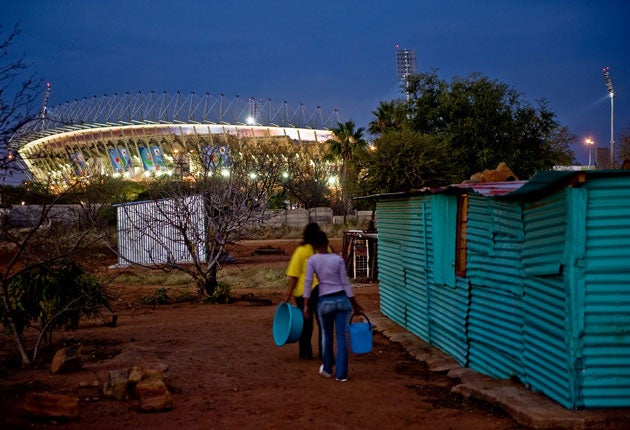
Spain or Holland will lift the most coveted trophy in sport tonight, but it is the success or failure of only one nation that matters in the longer run. After months of toil, media inquisition, doubts and controversies, South Africa is about to discover whether hosting the world's biggest sporting event will pay off.
South Africa, despite its national team going out in the first round, is already benefiting from a new sense of national pride and identity, as well as an economic boost from the thousands of travelling fans and £2.8bn of infrastructure projects.
The big question now is whether it will all last. South Africa, once a global pariah as the home of apartheid, became a symbol of hope 15 years ago when it transformed peacefully into a democracy. Since then, it has been blighted by slow progress in tackling apartheid's legacy of crime and poverty. It has an unemployment rate of 24 per cent; half its population of 48.6 million are below the poverty line and life expectancy is just 49 years. It is hoped the economic boost of the World Cup will help to alter these figures. One thing that is for sure, however, is that, as with the Rugby World Cup in 1995, sport has helped bring a divided nation together.
The Rainbow Nation may be a cliché, but it seemed a pretty apt description of the atmosphere on the bus journey to Soccer City for the opening match of the World Cup. At the front sat Phume, a large black woman decked out in the yellow shirt of the South African team and a jester's hat in the red, green and blue of the national flag. Her young son was also wearing a yellow replica shirt. Behind her were four white South Africans, flags painted on their cheeks and all wearing makarapas, the plastic mining helmets worn by the more hardcore football fan. The bus was a mix of white and black, all dressed in yellow. Phume started the chanting: "Give me a B!" she bellowed, and her fellow passengers – 40 in all – yelled back in unison. She spelled out "Bafana Bafana", the nickname of the South African team, and everyone sang along.
South Africa played only three matches. But on every occasion fans gathered there was a mix of races and a genuine sense of national unity. Afrikaner rugby fans ventured to the fan park in Soweto to watch the Uruguay match on a big screen. Indian families that had never been interested in football took their children to the stadium in Bloemfontein for the France game.
Robert Nyamane, 17, who leads tourists on a bicycle tour of the Orlando district, recalled his visit to a Soweto fan park. "When we are watching soccer on the big screen, all of us see one thing and all of us cheer. People see that South Africa has changed. It has made me proud," he said.
The bill for hosting the World Cup is £2bn. Or maybe it's £2.5bn. No one can quite put a final figure on it. What everyone knows is that six years ago it was supposed to be £200m. The money has not just gone on stadiums. The Gautrain opened a few days before the World Cup started. Africa's first high-speed rail link is not without its critics. It is too expensive. It serves only the rich. There are more pressing transport needs.
"The poorest people needed bus networks from the townships to work," said Josephine Osikena of the Foreign Policy Centre in London. "If that had happened people wouldn't have to get up at the crack of dawn just to get to work. High-speed rail services won't benefit the poorest."
Road networks have been revamped and the telecommunications system has been transformed. Tens of thousands of jobs were created in the construction industry and this has helped existing businesses too.
No one can put a price on the long-term benefit to South Africa. It is hoped that in five years' time unemployment will fall to 20 per cent, and life expectancy will be up to 50 years and only 47 per cent of people will be below the poverty line. But everyone knows who really benefits. Fifa, described in The New York Times as the "imposing overlords" of international football, expects to rake in about £2bn from the World Cup. It will pay tax in South Africa on none of it.
Fifa made its money through corporate sponsorship, or "partnership" as it prefers to term it. Those partners needed protection, so Fifa insisted that phrases such as "World Cup" and even "2010" were not to be used by any other companies. One South African airline, Kulula.com, tried to get round the rules by declaring it was "the unofficial airline of you-know-what". Fifa insisted the ads were removed. Undeterred, Kulula.com put out adverts referring to "the thing that's happening right now". South African street hawkers who normally sell their horns and hats outside stadiums were moved to an exclusion zone placed around each venue.
"Fifa has made a lot of money out of this and it should be going to the disadvantaged... helping to create jobs, but it hasn't done as much of it as it could," said Haratio Motjuwadi, editor of the Soweto paper Sunday World.
The Mzimhlophe hostel in Soweto was built in the 1950s for mineworkers. There are dead rats among the rubbish in the dirt streets outside, where children play and chickens peck. Inside one of the cramped dwellings sits Mxolisi, who shares the two rooms with his three brothers. There is no toilet or running water, but there is a colour TV and he sits transfixed by a replay of Carles Puyol's semi-final winner for Spain against Germany.
It is a striking juxtaposition, yet this is a country long used to divides. On the streets of Soweto the prevailing mood appears almost wholly positive, at least from a scratch of the surface. The nearest thing to a dissenting voice comes from Mountain Msezane, at work in the nearby Klipsruit Fish and Chips store. He complains that "there is no knock-on effect" for his business and that the World Cup is "only for upmarket people". Yet his complaints come mixed with hope: more tourism, less crime, perhaps even "bigger things" for Soweto. The township has benefited from some of the new transport infrastructure, including the Rea Vaya bus system and upgrades to the Metro Rail system.
In the weeks leading up to the tournament, Johannesburg was full of yellow diversion signs as roads were tarred. There was a deadline that had to be met. But there has been no such sense of urgency for South Africa's most pressing problems. The crime rate remains one of the highest in the world. Millions still live in slums. These things are a legacy of apartheid. It is often forgotten that in 1994 crime was far higher and the country was all but bankrupt. The World Cup organisers – all of them South African – have proved what the country is capable of.
The challenge now is crime, education, housing, poverty. Women like Phume will do their best to make sure the pressure remains. As she got off the bus, she turned to one of the white fans in the makarapa. "See? See what we can really do when we try?"
Steve Bloomfield is the author of 'Africa United: How Football Explains Africa'
Join our commenting forum
Join thought-provoking conversations, follow other Independent readers and see their replies
Comments